Makeup, disguise, and identity performance
The Woman in Cabin 10Makeup, disguise, and identity performance shape how people are seen and believed aboard the Aurora Borealis: a penciled brow can help sustain a false identity, while its removal exposes the deception. Cosmetics also become both a fragile link to the missing woman and a means by which Laura Blacklock prepares herself to resist fear. Across these scenes, appearance is not a reliable guide to identity; it is something characters construct, interpret, and sometimes deliberately erase.
Cosmetics as a social technique
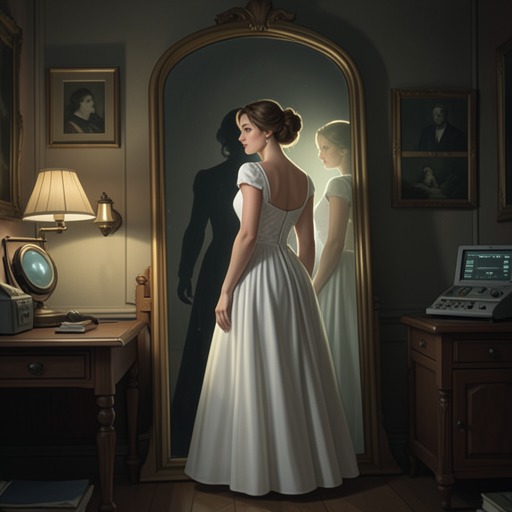
At the spa, Laura finds Chloe Jenssen without her usual makeup. The contrast unsettles her: without the smoky eyes and sharply defined cheekbones that had marked Chloe’s appearance the previous night, Chloe looks faded and flat in the daylight. Chloe notices Laura watching in the mirror and explains that she has taken her makeup off before a facial. She identifies herself as a makeup artist and describes contouring as a way to transform someone into an entirely different-looking person. The exchange makes cosmetic skill explicit as a form of expertise: the face is not simply presented but assembled through technique, lighting, and the expectations of whoever looks at it.
That scene also gives Laura a concrete lesson in how unstable visual judgment can be. Chloe’s features have not changed, but the effect of her face has; Laura’s impression of the same person shifts with the removal of makeup. The mirror, in which Chloe catches Laura looking, becomes a small stage for that shift. The revelation of the concealed door behind another mirror extends the scene’s pattern of surfaces that conceal something behind them, though the immediate conversation concerns cosmetics rather than the secret passage. Together, the details make appearance and concealment part of the ship’s ordinary visual environment.
The Pink-and-green mascara as evidence
The Pink-and-green mascara enters the mystery as more than a cosmetic. After Laura insists that the missing girl was in her cabin, she remembers that the girl lent her mascara and searches the bathroom. She finds the bright tube tucked behind the retractable shaving mirror. Its smallness and ordinary use contrast with the weight Laura gives it: the object offers material confirmation of an encounter that others have reason to doubt.
That confirmation does not last. When Laura returns to her suite, it has been meticulously serviced. The sink and windows have been cleaned, her dirty clothes have disappeared, and her torn evening dress is gone. She searches the neatly arranged makeup and cleansers, then the bedroom drawers and the spaces beneath the chairs. The mascara is nowhere to be found. Laura understands the loss as the disappearance of her one link to the missing girl. Cosmetics therefore occupy two opposing roles in the investigation: makeup can help manufacture a face, while a discarded cosmetic object can serve as evidence that a person was present. Once the tube is gone, the claim becomes harder to substantiate.
Anne Bullmer’s appearance and the disguise
Laura’s first view of Anne Bullmer emphasizes the visible signs of illness. At dinner, Anne wears a gray silk wrap and a scarf over her scalp; her skin appears waxy and pale, and she has no eyebrows. Her drawn face and prominent cheekbones make an impression that Laura later recognizes as difficult to reconcile with the woman who appears healthy and alive. Anne explains that she is fatigued after chemotherapy and hopes to continue with radiotherapy after the voyage. At another dinner, a bruise on her collarbone is visible when her robe slips. Anne attributes it to a fall in the shower and says that chemotherapy has made her bruise easily. In these encounters, the signs of treatment are visible, and Anne herself supplies an explanation for them.
The appearance that Laura takes for Anne is actually being performed by another woman. The decisive recognition comes when the woman in the hidden cabin looks in a small mirror and wipes blood from her face. In doing so, she wipes away the penciled eyebrows as well. The smooth, skull-like forehead and familiar cheekbones make Laura recognize the woman as Anne Bullmer. The effect is immediate because the face Laura had understood through its styling is suddenly stripped of the feature that helped sustain the impersonation.
Laura then reinterprets the earlier resemblance. The woman posing as Anne and Anne share the same height, weight, and broad cheekbones, while their eyes differ. The impersonator’s hair and carefully drawn brows had made her appear young, healthy, and alive; without them, the unadorned face seemed markedly different. Richard Bullmer had also told Cole Lederer not to photograph his wife. Laura realizes that this restriction prevented the creation of compromising images that friends and family could later compare with the impersonator. Makeup, hair, and the absence of photographs work together as parts of a deception: one supplies the likeness, while the other removes a way to test it.
Laura’s performed composure
Laura also uses appearance to manage how she can function under pressure. Preparing for dinner after the threat to stop digging, she applies her makeup in layers and experiences the routine as putting on war paint. The public face she creates is a calm, professional mask, set against her fear of eating among people who may be connected to a murder. She considers withdrawing to her cabin, but the prospect of appearing before the others helps her remain among potential witnesses rather than alone.
The ritual becomes a moment of self-assessment. In the mirror, Laura searches for the idealistic journalism student she once was and compares that aspiration with her actual career in travel writing at Velocity. She is not ashamed of the work she has done, but the danger aboard the ship forces her to ask whether she can face herself if she refuses to investigate the story before her. She remembers the STOP DIGGING threat, breathes onto the mirror, and writes NO in the steam. Makeup and the mirror thus frame two acts of self-presentation: she composes a face for the dinner guests, then makes a private decision not to let fear dictate her actions.
The mascara also connects that decision to Chloe Jenssen. On the night Laura resolves to keep investigating, she uses mascara borrowed from Chloe while finishing her makeup. The borrowed cosmetic is distinct from the Pink-and-green mascara that linked her to the missing girl: one has vanished as evidence, while the other helps Laura prepare to return to the social space where she may learn more. The recurrence makes cosmetics part of Laura’s practical navigation of the ship, rather than merely an emblem of appearance.
Disguise as an escape strategy
Near the end of the evidence, disguise becomes a practical means of getting away. Carrie wraps a green-and-gold scarf patterned with ropes and anchors around Laura’s head, pins it in place, and judges whether Laura might pass as Anne in poor light. She notes that the resemblance is imperfect because Laura is not thin enough, but adds that she has not met most of the sailing crew. The assessment is conditional and specific: the disguise depends on dim lighting and on the limited familiarity of the people who might see it.
This transformation echoes the impersonation that had concealed the real Anne, but the circumstances differ. The earlier disguise exploits the fact that few people aboard knew Anne before the trip and that photographs had been restricted. Laura’s borrowed scarf is instead an improvised element in an escape plan, and its likely success rests on who is present and how clearly they can see her. Across both deceptions, the novel makes identity performance material and situational: a scarf, hair, brows, cosmetics, lighting, and an audience can alter recognition, but none guarantees it. The same visual devices that hide a person can also expose the construction of a false identity when one carefully maintained detail is removed.