Northern Lights Group
The Woman in Cabin 10Northern Lights Group is the troubled company whose majority shareholder, Lord Richard Bullmer, is connected to the Aurora and whose financial instability turns the ship’s maiden voyage into more than a luxury journey. The organization represents a business system trying to protect a prestigious launch while an unexplained disappearance threatens to expose how quickly commercial reputation can override safety, accountability, and truth.
Corporate Position and Commercial Ambition
Northern Lights Group is identified as the troubled Northern Lights Group, with Richard Bullmer as its majority shareholder. The company’s financial position is sufficiently uncertain that investment in its enterprise is discussed as a niche and potentially unsustainable proposition. Owen White remarks that he is not fully convinced the setup can endure, although he believes Richard can attract interest elsewhere because Richard has substantial personal resources and Anne Bullmer possesses considerable wealth. Solberg’s absence is also treated as commercially significant because the enterprise falls within his area of expertise.
The group’s business interests are therefore tied to concentrated private wealth rather than presented as a secure, broadly supported venture. Anne’s fortune gives Richard room to wait for a suitable investor, while the company’s dependence on wealthy backing exposes the difference between the appearance of luxury and the fragility of the financial structure beneath it. The conversation at dinner makes the organization’s crisis visible indirectly: its future is being assessed as an investment opportunity even while the people aboard the Aurora are moving through an increasingly dangerous situation.
The Aurora as the Group’s Public Showcase
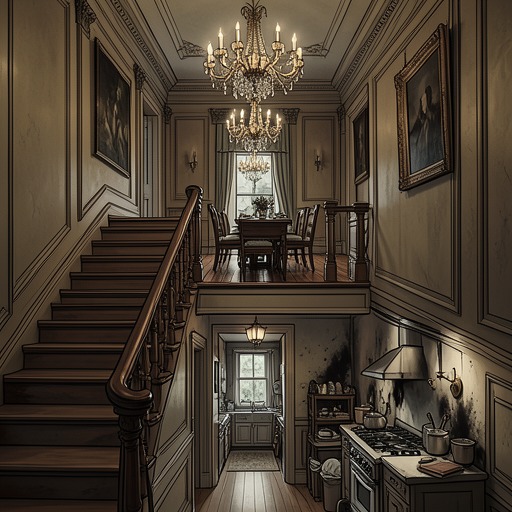
The Aurora is presented as the group’s flagship public achievement. At the beginning of its maiden voyage, Camilla Lidman, in charge of hospitality, speaks proudly of the vessel’s facilities, including the Great Stairway and its chandelier containing more than two thousand Swarovski crystals. She invites guests to a presentation about the boat’s facilities and the Norwegian fjords and Swedish archipelago, while the ship’s staff organize tours, dining, and scheduled entertainment as part of the carefully managed guest experience.
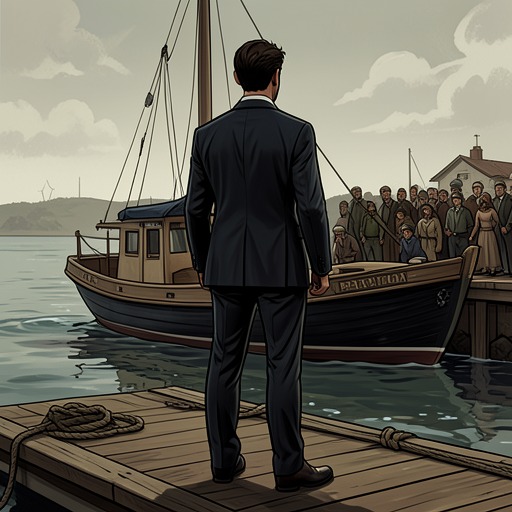
The voyage leaves Hull harbor under the pressure of that polished presentation. The engine increases its power, the ship turns away from the quayside, passes the lights marking the safe channel, and enters the North Sea, where sheltered harbor water gives way to deep-ocean swells. The physical departure thus becomes the group’s transition from publicity to exposure: once the Aurora is in international waters, the company’s carefully staged environment is separated from ordinary shore-based oversight.
Crisis Management and Suppressed Risk
The disappearance reported by Laura Blacklock threatens Northern Lights Group at the moment when the company can least afford scandal. Nilsson explains that there is no sufficient proof to wake the passengers and suggests waiting until morning, while proposing that the ship’s staff be consulted to locate the woman Laura believes she saw. His response places evidentiary caution alongside the practical desire to prevent alarm, and it treats the absence of a missing staff member as a reason not to escalate the report.
Laura understands the institutional pressure behind that hesitation. The Aurora is on its maiden voyage, packed with journalists, photographers, and influential guests. A death on the first voyage could produce headlines describing a passenger drowning on a luxury press trip, damage Nilsson’s position as head of security, and threaten the entire enterprise before it has properly launched. The possible consequences extend through the organization: if publicity sinks the Aurora, everyone from the captain to Iwona, the cleaner, could lose employment. This distributed vulnerability helps explain why a company-wide interest in preserving the voyage’s success can coexist with the failure to act decisively on a passenger’s warning.
The group’s crisis is intensified by the legal ambiguity of crime at sea. The Aurora is not as large as a floating city, but it shares the contradictory status of ships operating in international waters. Disappearances can be brushed aside when no clear police jurisdiction takes control, leaving investigations to onboard security services employed by the cruise company. Because those services cannot easily challenge the liner’s interests, the organization possesses both practical control over information and an incentive to keep an incident from becoming an official emergency.
Reputation, Narrative Control, and Aftermath
The group’s public image depends on maintaining the Aurora as a safe, exclusive, and successful venture. A canceled presentation on the northern lights illustrates how ordinary programming becomes entangled with crisis: Lord Bullmer is called away to deal with an emergency, while Cole Lederer is unable to provide the planned photographs because of an injured hand. The cancellation preserves the appearance of schedule management, but it also signals that the company’s public program is already being displaced by events it cannot openly explain.
After Laura disappears, Richard can potentially offer the other passengers an innocent explanation, such as her being detained in Trondheim or returning home unexpectedly. Laura recognizes that many passengers have little reason to question such an account, since they do not know her well or possess contact details for her family. The organization’s enclosed social world therefore makes disappearance easier to reframe as a logistical matter, especially when the person who controls the explanation is also the company’s dominant financial figure.
The corporate consequences become clear after Richard is reported missing from the Aurora, his luxury yacht, off the coast of Norway. News coverage identifies him as the majority shareholder in the troubled Northern Lights Group and reports that he has been found dead. Later reporting states that Anne’s body, dredged up by fishermen in the North Sea, is identified as hers, while Richard’s body is found near Bergen; Anne died by drowning, and Richard suffered a gunshot wound that was not self-inflicted. The group’s commercial crisis is consequently transformed into a criminal and reputational catastrophe involving its principal shareholder, the Aurora, and the unexplained deaths associated with the voyage.
Narrative Significance
Northern Lights Group gives the mystery an organizational scale. The danger aboard the Aurora is not only the result of individual violence; it is amplified by a corporate environment in which launch publicity, investment, employment, security, and legal uncertainty all encourage delay and controlled messaging. The company’s troubles make every report of danger economically consequential, while its maritime setting makes responsibility difficult to locate.
The group also links the ship’s glittering surface to the precarious labor and financial structure supporting it. The chandelier, formal hospitality, presentations, and exclusive passengers advertise stability, yet the company’s future depends on investors, private wealth, and the successful management of a maiden voyage. Northern Lights Group thus functions as the institutional counterpart to the novel’s floating prison: a luxurious organization whose apparent security relies on keeping disorder out of sight until the sea, the investigation, and the deaths make concealment impossible.