Norwegian fjords
The Woman in Cabin 10The Norwegian fjords are the remote escape zone in which Laura Blacklock breaks out of the Aurora, survives a fall into freezing water, reaches an isolated quay, and continues fleeing from Richard Bullmer. Their steep, dark, and sparsely inhabited landscape turns the cruise's promised scenery into a geography of danger: the ship can disappear into the waterways, help is difficult to summon, and Laura's survival depends on her own physical endurance rather than on any reliable institution.
Geography of Isolation
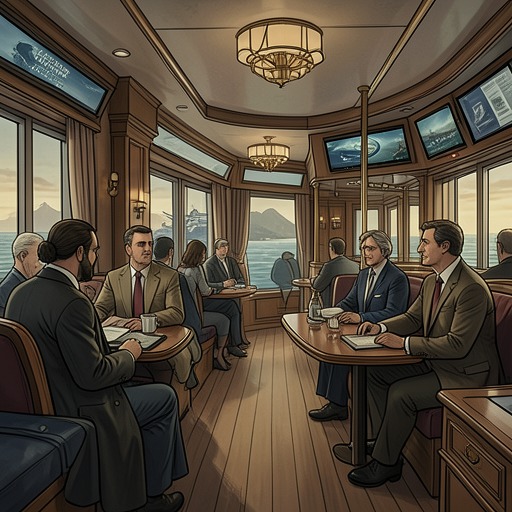
The fjords appear first as part of the Aurora's controlled itinerary. After the vessel leaves Hull Harbour, its engine rises in pitch as it turns away from the quay, passes the green and red lights marking the safe passage, and enters the North Sea. The protected water near the harbour gives way to deep rolling swells, while the shoreline dwindles into an indistinct line. This departure establishes the larger spatial condition that later governs Laura's predicament: once the ship has left land, ordinary access to help becomes uncertain.
That uncertainty is reinforced when Laura asks where the ship is and Nilsson answers that it is in international waters, apparently on its way to Trondheim rather than Bergen. The destination itself becomes unstable, and the difference matters because the ship's movements place its passengers beyond an immediately obvious police jurisdiction. Laura understands that crime at sea occupies a legal gray area: disappearances may be concealed or handled by security staff employed by the cruise line, while the absence of a clearly controlling police force allows institutional self-protection to prevail.
The Fjords as a Closed Maritime System
The fjords do not provide freedom merely because they contain land. When Laura stands on deck after realizing that she may have witnessed blood and a splash, she sees dark gray waves extending mile after mile to the horizon, with no land or ship in sight. There is literally no way to call for help. The open water therefore functions as an extension of the ship's confinement: it is visually immense but practically empty, offering distance without refuge.
The same contradiction governs the hidden lower cabin in which Laura is imprisoned. The windowless cell is only about four feet by six and lies below sea level, with a thousand tons of water separated from her by a skin of steel. Its physical dimensions produce claustrophobia, but the surrounding sea makes the confinement more than architectural. The ship is a floating prison embedded in a larger prison of water, and the fjord landscape remains inaccessible until Laura can first escape the cabin and then survive the drop.
Laura's Escape into the Water
Laura's route from captivity to the fjords begins with a hazardous climb over the glass privacy screen of her cabin's veranda. She pulls herself onto the wall, stands while shaking with fear and exertion, and attempts to edge around the seaward side so that she can swing to safety. The glass overlooks a drop equivalent to roughly a two- or three-story building, making the luxurious balcony a vertical threshold between confinement and possible death.
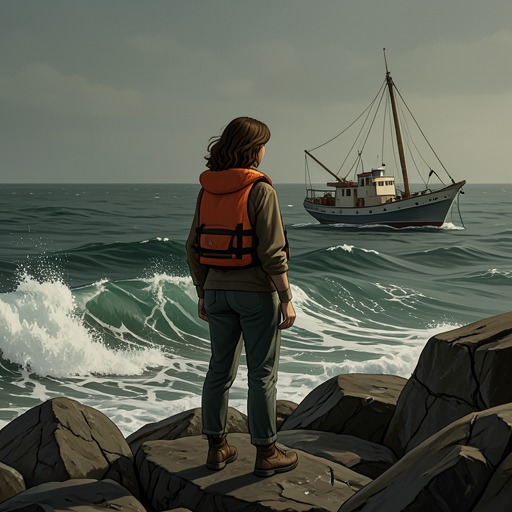
When Laura falls, the fjord initially seems to take her away from survival. She loses the surface, feels the current tug at her body, and then breaks through the water coughing and sobbing. Close enough to the Aurora to feel the engines throbbing through the water, she knows that remaining near the hull could be fatal if the ship begins moving. Hypothermia is an immediate threat even in seas that do not feel extremely cold, so she forces her arms and legs to move despite violent shivering and the body's impulse to gasp.
Laura surfaces near the front of the vessel and makes out the lights of the quay and the possible shape of a ladder. She estimates that she may have fallen only twenty or thirty yards from shore, but the distance becomes psychologically enormous as the cold reaches her bones and the shore lights seem alternately to recede and approach. A soft object strikes her face in the water; she postpones concern about dead rats and decaying fish until after reaching land, concentrating instead on survival. Eventually her numb fingers catch the rusted iron ladder, and she climbs, slipping repeatedly before hauling herself onto the concrete quay.
The Isolated Quay and the Pursuit
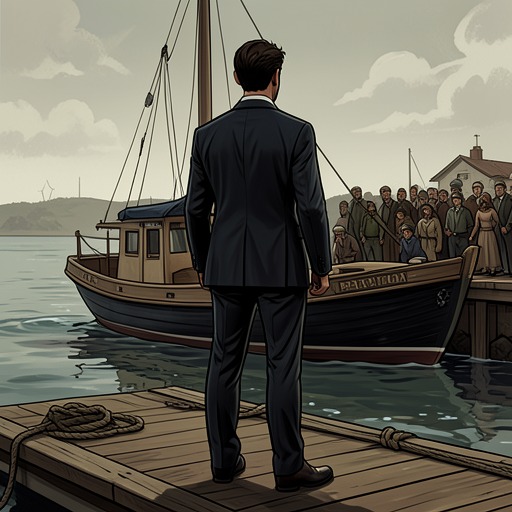
At the edge of the quay, Laura collapses, then looks first toward the Aurora and then toward the settlement. The place is not Bergen but a small town, barely a village, with closed cafes and bars and almost no one outside. A hotel overlooking the quay appears to be the only establishment where she might find assistance. The setting denies her the reassuring arrival usually associated with reaching land: escape ends not in safety but in another exposed and unfamiliar space.
The Aurora begins to pull away as Laura crosses the quay. Its engine rises in pitch, water sloshes against the vessel, and the prow turns toward the fjord. The ship's departure gives the scene a second deadline. Laura has escaped the locked cabin, but she must reach human help before the vessel can carry Richard and the evidence away, or before anyone from the ship can follow her.
She runs through the town and up winding streets, barefoot, with stones cutting into her feet. When the streets peter out, she continues through darkness, puddles, wet grass, and gravel until numbness obscures the pain. She keeps moving because every additional mile places distance between herself and Richard Bullmer, though she knows that exhaustion will eventually force her to stop. As the village lights shrink, she repeatedly looks down toward the port and sees the Aurora's lights drawing nearer along the fjord.
The apparent dawn is another misreading produced by the landscape. Laura first thinks that morning must be approaching, then realizes that the lights are north rather than east and that the green and gold streaks in the sky are the northern lights. The fjords thus make time and direction uncertain as well as distance. Their beauty is inseparable from their menace: the aurora illuminates the scene without revealing a route to safety.
Public Narratives and Aftermath
The isolation of the fjords also shapes what can be known about Laura's disappearance. On Whodunnit, online commentators speculate about a body, Laura's former relationship with Judah Lewis, and the possibility of suicide or murder. Anonymous posters turn her anxiety medication into evidence of supposed instability, while Judah corrects the claims and explains that the unidentified body has not yet been confirmed as Laura. The forum's speculation reproduces the fjords' informational darkness in digital form, filling gaps in evidence with suspicion.
A later family email reports that Scotland Yard asked Judah to identify photographs of clothing recovered through the Norwegian police investigation. He recognizes Laura's distinctive vintage boots and other garments, and the family is devastated even though the body remains in Norway and has not been identified. The apparent certainty of the clothes contrasts with the continuing uncertainty of the body, showing how the fjords preserve not only physical remains but also ambiguous evidence.
The final reporting corrects the most damaging misunderstanding. The body found in the North Sea is identified as Anne Bullmer, while Richard Bullmer's body is found near Bergen; Laura is later found alive in Norway. The Norwegian police state that Anne died by drowning and that Richard's gunshot wound was not self-inflicted. A gun recovered alongside Richard's body is wrapped in clothing belonging to Laura, which initially links his death to her disappearance, but Laura is not treated as a suspect. The fjords therefore hold the aftermath of the crime while also exposing the failure of communication that briefly leaves Laura's family believing she may be dead.
Narrative Significance
The Norwegian fjords convert scenery into structure. The sea separates Laura from help, the ship's legal status permits the concealment of wrongdoing, and the narrow waterways allow the Aurora to remain both visible and unreachable. Yet the same environment that enables her captivity becomes the medium of her escape. Laura's fall, swim, climb, and flight give the landscape an ordeal pattern in which survival is achieved through repeated acts of bodily resistance.
The fjords also preserve the novel's central tension between spectacle and concealment. The Aurora offers midnight sun and northern lights from private balconies, but its polished luxury masks locked rooms, missing people, and institutional evasion. In the fjords, that contradiction becomes literal: sublime light hangs above freezing water, while a small, nearly deserted settlement offers little protection. The location's decisive significance lies in this reversal. What appears to be the cruise's most beautiful destination becomes the place where its hidden violence is most fully exposed, and where Laura begins the difficult movement from a silenced witness to a survivor who can return with the truth.