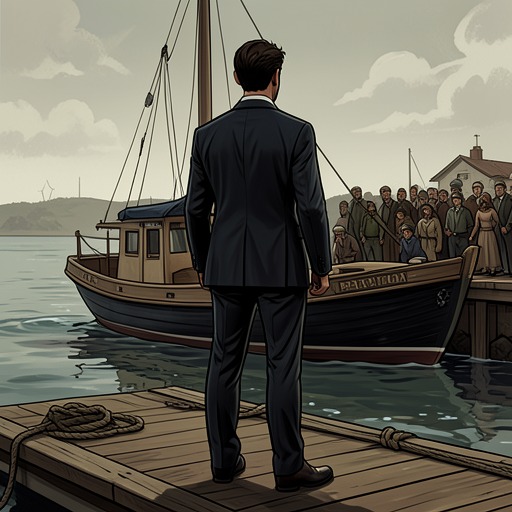
Richard Bullmer is found dead
The Woman in Cabin 10Richard Bullmer’s discovery dead turns the mystery surrounding his disappearance from the Aurora into a public investigation—and then overturns its first conclusions. At first, Norwegian police can only presume that the unidentified man recovered by divers is Bullmer and suggest that his gunshot wound may have been self-inflicted. Later forensic findings establish his identity and contradict that early interpretation: the wound was not self-inflicted, and clothing belonging to missing journalist Laura Blacklock was found with his body.
Discovery and Initial Report
The news reaches Laura in stages. After she has returned from Norway, she is watching television when a familiar image of Bullmer appears on screen. For an instant, the sight unsettles her; the broadcast then identifies the report as news of his death. It says that the British businessman and peer, majority shareholder in the troubled Northern Lights Group, had been found after being reported missing from his luxury yacht, the Aurora, off the coast of Norway. The report establishes the public outline of the case, but not yet its explanation.
An official later gives Laura the fuller account: two bodies have been found at sea. A fishing boat dredged up the first in the early hours of Monday morning; police divers recovered the second later that day. The diver-recovered body is male. It bears a gunshot wound through the temple, and, without identification, police presume it to be Bullmer’s because the crew had reported him missing from the Aurora. At this point, the possibility of suicide remains a provisional police belief, not a settled finding.
Identification and Changing Findings
The two recoveries initially arrive as a single, troubling announcement, but their identities and circumstances become clearer only later. The body found by divers is confirmed as Bullmer’s, while the woman dredged up by fishermen is identified almost two months after the discoveries as his wife, Anne Bullmer. Preliminary findings attribute her death to drowning. The separate recovery sites and different methods of discovery distinguish the cases even as the bodies’ connection through the Bullmer marriage gives the news a shared context.
The later police statement changes the meaning of the gunshot wound. A local pathologist’s findings establish that Bullmer’s death was not self-inflicted, contradicting earlier reports of suicide. A gun recovered alongside his body, wrapped in clothing belonging to Laura, adds a further link: the journalist had disappeared days before Bullmer was reported missing. The clothing prompts initial allegations that his death is connected to her disappearance, but the evidence described in the report does not, by itself, establish who shot him or how the clothing came to be there.
Laura, Suspicion, and Public Communication
The discovery places Laura’s disappearance inside the investigation rather than leaving it as a separate missing-person case. The juxtaposition of Bullmer’s body, the gun, and her clothing produces suspicion before it produces an explanation. Norwegian police have interviewed Laura, but the later report states that they are not considering her a suspect in either death and that their investigations continue. The distinction matters: a material connection can shape public allegations without constituting proof of culpability.
The handling of information also has consequences beyond the inquiry. Laura’s parents spend several days believing that the body may have been identified as their missing daughter. Scotland Yard later stresses that her body was never formally identified among those recovered, while acknowledging that the discovery of her clothes was poorly communicated to the family. It attributes the failure to communication problems between the British and Norwegian forces. The episode shows how uncertainty around identification, evidence, and jurisdiction can circulate beyond the investigation and inflict harm on those waiting for news.
Significance in the Mystery
Bullmer’s death is revealed not as a single, complete fact but as a sequence of revisions: a missing man, an unidentified male body, a tentative presumption of suicide, and finally a death the pathologist says was not self-inflicted. The woman’s body is likewise first described through limited physical findings before being identified as Anne. Each update narrows one uncertainty while exposing another, preserving the mystery of responsibility even after the bodies are named.
The link to Laura’s clothing makes the discovery a reversal in her own story. She has survived captivity and returned to Britain, yet the evidence recovered with Bullmer threatens to recast her as a suspect in the deaths connected to the voyage. The later official account partly corrects that impression without resolving the underlying crimes: Laura is not a suspect, Bullmer’s death was not suicide, and the investigation remains open. His discovery therefore closes neither the case nor the danger of misinterpretation; it converts the apparent answer into a more precise and more consequential set of questions.