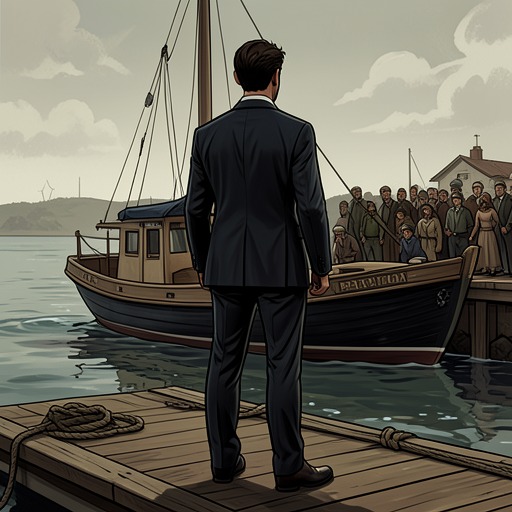
Richard Bullmer–Anne Bullmer marriage
The Woman in Cabin 10Richard Bullmer and Anne Bullmer’s marriage moves from an outwardly polished, conspicuously unequal partnership to the central mechanism of a murder and impersonation plot. At first, Anne appears to be a gravely ill wife cared for solicitously by Richard; later, Laura Blacklock learns that Anne died on the first night of the voyage and that another woman had been impersonating her. The marriage’s distance, Anne’s wealth, and the public performance of her illness all help make that deception possible.
Public Marriage and Private Distance
On board the Aurora Borealis, Anne is introduced through a visible contrast with the ship’s healthy, elegantly dressed guests. She wears a shapeless gray silk wrap and a scarf over her scalp; her pale skin, missing eyebrows, and prominent cheekbones make her look frail. Richard stays beside her and holds her arm solicitously as they leave a reception. Anne speaks in polished English and apologizes for missing dinner because she is tired, promising to meet Laura the next day. Their manners suggest an established public partnership, but the encounter offers little evidence of intimacy beyond Richard’s attentive escort.
Carrie later describes a marriage that was, in her account, cold and controlling and had been nearly over from the beginning. Anne lived in Norway while Richard lived in London, and they led separate lives. Carrie portrays Richard as having framed this estrangement as a personal grievance: he told her that Anne was unable to love him and that he had endured a difficult childhood, including his mother’s departure when he was a baby and his father’s death while he was barely out of school. These are Carrie’s explanations of Richard’s appeal to her, rather than an independent account of the marriage, but they show how he presented himself as wronged and deserving of a different future.
Wealth, Illness, and Leverage
The marriage is also an economic arrangement. During a dinner conversation, an investor remarks that Richard can wait for the right business partner because he has substantial resources of his own—or, more precisely, because Anne does. Laura later recognizes the financial prize that may have shaped Richard’s plans: a future with Anne’s money but without Anne’s control. She connects this prospect to Anne’s illness and to the moment when doctors gave Anne the all-clear, after which Richard, in Laura’s interpretation, no longer wanted to relinquish the future he had imagined.
Anne’s illness is not merely background to the marriage; it shapes how others see her and becomes a resource for concealment. Anne tells Laura that she has finished her most recent round of chemotherapy, expects radiotherapy after returning, and is trying not to let her body dictate her days. At dinner, when a bruise shows at her collarbone, she explains that she bruises easily as a side effect of chemotherapy. The explanation sustains the impression of a vulnerable patient. Yet Laura’s later recognition of Anne’s likeness in the woman impersonating her makes the appearance of illness part of the plot’s larger deception: the scarf, absent eyebrows, and altered hair had made the real Anne seem almost unrecognizable.
The Impersonation and Anne’s Death
Carrie says she met Richard at The Magellan, where she was a waitress hoping to become an actress. He was married, she knew, but told her that the marriage was effectively over and that he would be with her when Anne died. Their affair depended on secrecy: they could not meet publicly, and Carrie could not tell others about him. Richard eventually proposed that Carrie dress as Anne so the pair could go to the theater together. He supplied one of Anne’s kimonos and showed Carrie a film of Anne speaking so she could imitate her manner. Carrie hid her hair beneath a swimming cap and Anne’s scarf; the disguise succeeded well enough for them to share a box and champagne without being recognized.
For the Aurora Borealis voyage, the masquerade became more consequential. Carrie says Richard arranged for a guest not to appear, leaving an empty cabin, and required her to cut her hair to make the likeness convincing. On the first night, while Carrie was changing into Anne’s clothes, Richard arrived in distress. He told her that Anne had discovered the affair, attacked him, fallen against a coffee table, and died. He persuaded Carrie that they had to dispose of Anne’s body at sea and continue the impersonation, claiming that discovery of Carrie’s presence and her earlier disguise would implicate them both.
Laura sees reasons not to accept Richard’s account at face value. The supposed plan to let Anne leave the ship later did not fit the voyage’s timing or the practical question of how Anne could disembark without her passport and without the crew noticing. Laura concludes that Richard had not intended for Anne to walk ashore alive. The marriage’s public form—husband and sick wife travelling together—thus provided cover for the removal of the actual wife and the substitution of a woman selected for her resemblance.
Control, Evidence, and the Afterimage of Anne
The deception required control over what could be seen and remembered. Richard had told Cole Lederer not to photograph Anne. At first, that restriction could appear considerate toward a wife self-conscious about her changed appearance; after the impersonation is exposed, Laura understands that photographs might have allowed Anne’s friends and family to notice that the woman on the ship was not Anne. The absence of images becomes part of the cover-up, while the shared cheekbones and similar build offer just enough likeness for strangers who had barely met the real Anne.
Carrie’s account also reveals the coercive force of the marriage’s unequal circumstances. She had been economically vulnerable and ambitious, while Richard introduced her to a wealthy life and promised that the obstacle of his marriage would eventually disappear. When Anne was found dead, he persuaded Carrie that continuing the plan was the only way to avoid prosecution. Carrie’s loyalty was therefore bound up with the future he had promised, her fear of exposure, and her dependence on his version of events. Laura recognizes this as a form of willful blindness: Carrie accepts an explanation that the practical details undermine, because the alternative threatens the relationship and future she had been led to expect.
The last image of Anne complicates the identity constructed around her illness. In a television report, Laura sees footage of a beautiful woman with long dark-gold hair and broad cheekbones applauding Richard. She recognizes Anne as she had looked before the disguise’s visual signs of illness transformed her into the gaunt figure Laura had met. The image does not undo the murder or establish what Anne felt in that moment; Laura only senses sadness and fear before reading Anne’s lifted chin as a sign of resistance. Against Richard’s effort to reduce his wife to an obstacle, a fortune, and an impersonated public role, Anne’s final appearance in the story preserves the possibility of a person who would not simply yield.