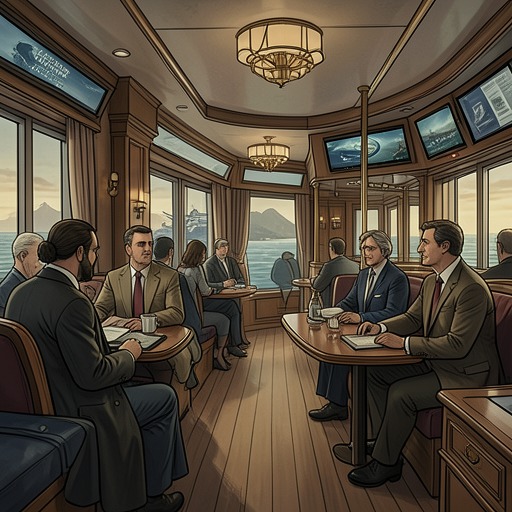
Trondheim
The Woman in Cabin 10Trondheim is the Norwegian port that serves first as the Aurora’s expected destination and then as the crucial false location in the concealment of Laura Blacklock’s disappearance. For Laura, reaching Trondheim promises access to the Internet, the police, and the mainland; for Richard Bullmer and Carrie, it becomes the place where an apparently unstable missing woman can be made to vanish without a trace.
Definition and Setting
Trondheim enters the narrative as a destination on the Aurora’s northward voyage through the North Sea. When Laura asks where the ship is, Johann Nilsson tells her that it is in international waters and is traveling toward Trondheim, although she had believed Bergen would come first. The correction makes the port more than a point on the itinerary: it establishes the changing route and emphasizes Laura’s uncertainty about where the ship is taking her.
The journey to Trondheim begins when the Aurora leaves Hull. Its engine rises in pitch as the vessel turns away from the quayside, passes the green and red lights marking the safe passage, and crosses from the shelter of the harbor wall into the North Sea. The shoreline disappears, leaving the passengers dependent on the ship, its communications systems, and its official account of the route. Trondheim therefore stands at the far end of a transition from an identifiable British harbor to an isolated maritime space.
The Port as Legal and Practical Hope
Trondheim represents Laura’s first realistic opportunity to convert her account of the cabin 10 incident into an official investigation. After describing the suspected murder, she asks Richard Bullmer whether the ship can stop somewhere nearer than Trondheim and says that she wants to report what happened to the police as soon as possible. Bullmer replies that Trondheim will be reached early the next morning and may be the most practical place to disembark, though he must consult Captain Larsen about the proper course.
The question of jurisdiction makes the destination uncertain even before Laura reaches it. Bullmer explains that Norwegian police might not be able to act if the incident occurred in British or international waters, and he adds that the Aurora is registered in the Cayman Islands. The port is physically accessible, but legal responsibility is distributed among the waters in which an event occurred, the vessel’s registration, and the authorities available when the ship docks. This uncertainty strengthens the ship’s internal control: a disappearance at sea can be treated as an administrative problem rather than an ordinary shore-based crime.
Laura also understands Trondheim as the place where her isolation will end. With the ship’s Internet connection unavailable, she reassures herself that she will be able to get online there. Later, standing without phone reception and remembering the blood, the splash, and the woman in cabin 10, she resolves to leave the vessel and go directly to the nearest police station. Trondheim becomes a deadline, a destination, and a mental survival strategy: she needs only to endure until dawn and arrival.
The False Paper Trail
The significance of Trondheim changes when Laura is confined in a windowless cell below deck. She knows that she had intended to go ashore there, and she initially hopes that Ben Howard will realize that an unexplained departure is unlike her. But the running engine and the motion of the hull reveal that the ship has either never stopped or has already left port. Laura understands that everyone may assume she remained in Trondheim while the Aurora continues out to sea, placing any search in the wrong location.
The deception depends on the ordinary procedures associated with a port call. Laura thinks that customs or passport control should produce a record of passengers leaving the vessel, and that someone at the gangway should notice whether she disembarked. Instead, the ship’s movements are used to create the appearance that she left at Trondheim. When the gangway is lowered, she hears passengers disembarking and screams that she is still aboard, but the plastic ceiling absorbs the sound. The port’s normal infrastructure thus becomes part of the cover-up: a departure that never happened can be made to look official because the ship controls the records and the people who might challenge them.
Carrie later explains the intended mechanism. She would have left the Aurora at Trondheim disguised as Anne Bullmer, then put on her wig, changed her clothes, drawn on her eyebrows, and disappeared into the crowd as an anonymous backpacker. The supposed trail would have ended there with an unstable woman facing death who had disappeared without a trace. Richard Bullmer and Carrie could then have reunited publicly, presenting their relationship as a new romance rather than the continuation of a conspiracy. Trondheim is therefore designed as the point at which identities separate, records become misleading, and the investigation is directed toward a fabricated disappearance.
Escape, Pursuit, and Retrospective Meaning
Trondheim remains dangerous even after Carrie helps Laura escape. Carrie warns that Richard has Laura’s passport and influential connections, including people high in the Norwegian police force. She urges Laura to get away from the coast, cross into Sweden, and avoid flying directly to London, where Richard would expect her to go. The port is no longer simply a place of rescue; it is part of the geographical field controlled by Richard’s influence and a place from which Laura must flee under another identity.
The later discovery of two bodies confirms how closely Trondheim is tied to the investigation’s confusion. One body is dredged from the sea by a fishing boat, while the second is recovered by police divers. Subsequent reporting identifies the first as Anne Bullmer and identifies Richard’s body near Bergen; Richard’s death is initially reported as suicide but is later stated not to have been self-inflicted. Laura’s clothing is found with the gun near Richard’s body, helping generate allegations that her disappearance is connected to his death, even though she is later found alive and is not treated as a suspect.
The public discussion surrounding the case also treats Trondheim as an assumed endpoint. On the Whodunnit forum, commenters speculate that Laura got off the ship there voluntarily, while others connect her disappearance to Judah Lewis or to her anxiety medication. Judah corrects the speculation, insisting that Laura’s body has not been identified and that the case remains a missing-person investigation. The forum’s conjectures show how quickly a port of arrival can become a narrative explanation: once Trondheim is imagined as the place where Laura left, every later fact is forced into that mistaken version.
Trondheim ultimately functions as a threshold that Laura never safely crosses in the expected way. It promises contact with land, law, and communication, yet the conspiracy converts it into evidence of an imaginary departure. Its narrative force comes from that contradiction: the port is the place Laura intends to use to expose the truth, the place her enemies use to bury it, and the point whose apparently reliable records help make her real captivity invisible.