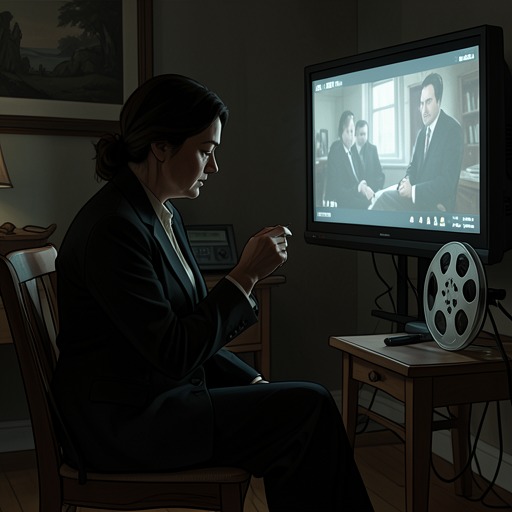
“Four. The magic number.”
The Woman in the Window“Four. The magic number.” names the counting pattern Anna Fox uses to manage her fear of the outdoors. The phrase joins a strikingly concrete set of objects and actions: the black-and-white squares of Ed’s umbrella, breaths counted in fours, and the steps Anna takes into the garden. Its recurrence makes four less a promise of safety than a small, repeatable structure Anna can carry into situations that feel overwhelming.
Form and Meaning
The phrase emerges from a visual pattern Anna can inspect. Ed’s umbrella has four black squares across each fold of its dark tartan canopy and four white lines in its weave. Anna turns those details into a verbal sequence: “Four squares, four lines. Four blacks, four whites.” The repetition translates the umbrella’s arrangement into something she can count and name. Instead of facing the outdoors as an undifferentiated threat, she attends to a bounded pattern with parts that can be identified one by one.
The number also organizes breathing. Anna breathes in for four counts and out for four, making the phrase a cue for a bodily routine rather than an abstract thought. The measured alternation gives each breath a beginning and an end; the words connect that rhythm to the visible geometry in front of her. The umbrella thus provides both a surface for focused attention and the pattern from which she builds her counting ritual.
The Garden Exercise
The phrase is introduced in the context of Anna’s limited attempts to go outside. She says that, although she has been inside for nearly a year, she has managed to venture into the garden five times in eight weeks. Dr. Julian Fielding accompanies these attempts and calls the umbrella her “secret weapon.” He stands in the garden as Anna opens the door, holding the umbrella before her. Its spring opens the canopy, and she concentrates on its ribs, fabric, and repeated squares before stepping out.
The umbrella points forward like a saber or shield, giving the routine a defensive aspect without changing what the object is. Anna counts as she moves: “Out, two, three, four.” She descends the first of four steps and tilts the canopy slightly toward the sky, looking down toward Dr. Julian Fielding’s shoes and shins. These details keep the exercise small and specific: a door opened, a step descended, a familiar pattern held in view. At the same time, Anna registers the world gathering at the edges of her vision, like water pressing against a diving bell. The count does not erase that perception; it accompanies her while she takes the step.
That tension also complicates Dr. Julian Fielding’s reassuring label. He calls the umbrella a secret weapon, but Anna resists the phrase internally: it is an ordinary umbrella, carried in broad daylight. Her objection exposes the difference between a therapist’s encouraging shorthand and her own experience of the object. Its usefulness lies not in secrecy or magic but in the concrete routine she has made around it.
Return Under Pressure
The counting pattern returns when Anna is unable to move and experiences the outdoors as an active threat pressing against the door. With the street seeming too exposed and the person she is trying to reach only steps away across the park, she presses her head to the door and exhales while counting to four. Here the count is no longer attached to the umbrella’s visual pattern or to a garden exercise; it is an available response at the threshold, where fear and the need to act meet.
In the same episode, cold air strikes Anna and she closes her eyes. After a moment of stillness and darkness, the sequence continues through four counts. The return is significant because the number remains usable even when the earlier visual aid is not foregrounded. The passages do not say that counting removes her fear or guarantees that she can act. They show instead that she reaches again for the same limited measure: four counts that can structure a breath or mark a moment when the outside feels difficult to bear.
Narrative Significance
Across the two scenes, four links perception, movement, and breath. In the garden, Anna discovers it by studying the umbrella, then applies it to breathing and steps; under pressure at the door, she returns to counting as she tries to steady herself. The recurrence makes the phrase a compact expression of coping through attention to particulars. Its force comes from the contrast between the smallness of the ritual and the scale of the threat as Anna perceives it.
The wording “The magic number” therefore carries a quiet irony. Four is called magic, yet the text presents no supernatural power in the umbrella or the count. Their significance is practical and provisional: they give Anna a pattern to follow while the world remains frightening. The phrase gathers that strategy into a memorable refrain, joining the visual order of the canopy to the repeated effort of breathing, counting, and attempting a step.