911 call recording
The Woman in the WindowThe 911 call recording is both Anna Fox’s contemporaneous report of a stabbing and a recorded challenge to her reliability. Played back during a police confrontation, it establishes what she told the emergency dispatcher while leaving open the central dispute: whether the scene she described was real or a perception distorted by alcohol, medication, and a film she had watched.
The recording and its playback
Val Norelli brings the recording into a tense encounter involving Anna Fox, Detective Little, and Alistair Russell. She places her phone on the table and explains that she is about to play the 911 call Anna made at 10:33 the previous night. The object is ordinary and portable, but its arrival changes the balance of the conversation: Anna’s account can now be heard rather than merely challenged or repeated from memory.
The phone’s speaker initially makes the dispatcher’s voice tinny and loud. Val Norelli adjusts the volume, and the call continues while the people around the table listen. Anna recognizes the caller’s words as hers but finds the voice difficult to identify with herself: it sounds slurred and altered. That mismatch matters to the scene. The recording confirms that she made a report, but hearing it also gives the others an audible basis for questioning the state she was in when she made it.
The playback is not presented as a recording of the alleged attack. It is a record of the emergency call that followed Anna’s claim. The distinction limits what the object can prove: it captures her report and the dispatcher’s questions, not an independent view of what occurred across the park.
What the call establishes
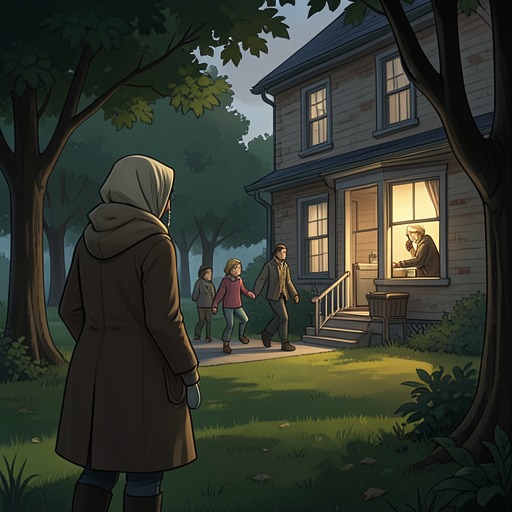
Anna tells the dispatcher that her neighbor has been stabbed and asks for help. When asked for her address, she identifies herself as Anna Fox; when asked for the neighbor’s name, she cannot provide it in the exchange presented. Instead, she explains that the neighbor is in the house across the park. The report is immediate and specific about the emergency and its location, even as its speaker struggles to communicate clearly.
The dispatcher asks whether Anna stabbed her neighbor. After a pause, Anna answers that she looked through the window and saw the neighbor get stabbed. This is the call’s crucial recorded statement: it places Anna as a witness claiming to have seen the attack, rather than as someone reporting that she found an injured person. The recording preserves both her assertion and the dispatcher’s direct question about her possible involvement, without supplying an answer about who attacked the woman.
Val Norelli says the dispatcher stayed on the line for six minutes, until emergency medical technicians confirmed they were at the scene. That detail makes the call more than a brief alarm: it records a sustained exchange through the wait for responders. Yet the confirmation that emergency crews arrived does not, in the material played to Anna, resolve what they found or whether the stabbing occurred. Anna’s immediate response is to wonder what happened at the scene and what became of Jane Russell; Detective Little tells her that nothing has happened to anyone.
Evidence under dispute
Detective Little offers a competing explanation for the recording. He suggests that Anna had been drinking merlot, taking medication, and watching a movie, and that she may have become excited and seen something that was not there. His statement reframes the call: the recording remains proof that Anna reported a stabbing, but her own slurred voice becomes part of the case for doubting her perception. The ruined bottles in the bin and the cutlery visible in the kitchen belong to the immediate setting of this exchange; they accompany Little’s explanation but do not independently establish what Anna saw.
The recording therefore has a precise and limited evidentiary force. It verifies the report, Anna’s account of looking through a window, and the dispatcher’s effort to keep her on the line. It cannot, by itself, verify the attack she describes. The gap between a recorded claim and an unrecorded event lets the other characters treat the call as both corroboration of her distress and grounds for suspicion. For Anna, listening is unsettling because the words are familiar while the voice seems not to be hers.
Memory, film, and the call’s narrative role
Later, Anna revisits other memories that had made Jane Russell seem present in her home. She pictures herself hauling herself up the front steps and into the house, rather than being helped in from the street. She also sees the bottles, pill canisters, chess pieces, and drawings she had associated with Jane. These recollections complicate her confidence in particular encounters, but they do not erase the separate fact that the 911 call recorded her report of seeing a stabbing.
Anna also reconsiders how she identified the woman she knew as Jane. Replaying their first conversation in her mind, she recognizes that she may have supplied the name herself, interpreting the woman’s reference to going next door as confirmation of an identity she had already assigned. This later doubt sharpens the distinction between what the call records and what Anna inferred: the call records her description of a neighbor across the park, while the name and identity attached to that neighbor remain entangled with her uncertain recollections.
Film becomes another frame through which Anna tests her memory. She thinks of Rear Window, Body Double, and Blow-Up as thrillers whose imagery seemed to return in bloody form, and later mentally rewinds the sequence of visitors and events surrounding the night she believed she watched Jane die. A sunset photograph offers a different kind of trace: Anna recognizes in its reflection the woman she knew as Jane, in an image taken from the kitchen window at 6:04 p.m. nearly two weeks earlier. Neither this photograph nor the call settles every uncertainty, but together they show why the recording matters beyond its immediate use in the confrontation. It is a fixed record within a story where memory, naming, and perception repeatedly have to be reconsidered.