Agoraphobia
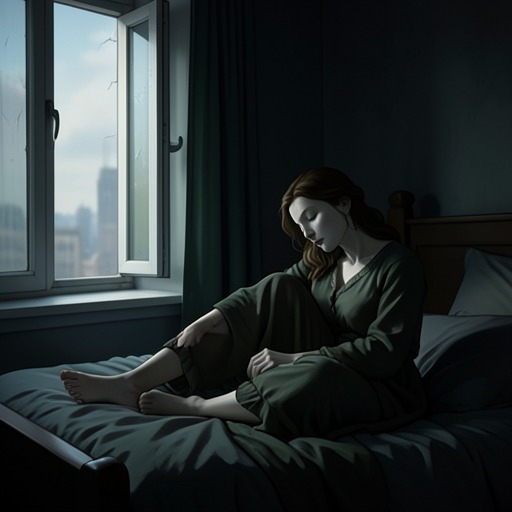
The Woman in the WindowAgoraphobia is the condition that confines Anna Fox to her home for nearly ten months, while also organizing the novel’s contrast between shelter and exposure, clinical explanation and personal experience. Its course is not simply a refusal to go outdoors: Anna experiences the outside as overwhelming after a family tragedy, and leaving home becomes an effort to face fear without any guarantee that it will disappear.
Definition and Lived Experience
Anna explains that the term derives from the fear of the marketplace and describes a range of anxiety disorders. She notes that the condition was documented in the late nineteenth century and later codified as an independent diagnosis, often alongside panic disorder. The diagnostic language gives her a framework for naming what is happening, but does not capture its particular shape in her life.
The examples associated with agoraphobia include being outside alone, in a crowd or queue, on a bridge, or in the middle of a theater row. Anna’s response to these categories is complicated: she longs for the ordinary freedom of standing in a line or crossing a bridge, while identifying open space and exposure as the central difficulty for her. The gap between a general list of feared situations and her own fear makes the diagnosis both useful and insufficient. The label identifies a condition; it does not, by itself, convey what the outside feels like to her or how thoroughly it has narrowed her life.
Anna distinguishes the clinical account from her own experience. Clinically, a person with agoraphobia may seek an environment she can control. For Anna, however, the condition has not merely damaged her life from the outside; it has become the form her life takes. She reports having been inside for nearly a year, though that span includes limited exceptions. This distinction prevents the housebound period from being reduced to a simple measure of time: it is also a restriction on work, social contact, and ordinary movement.
The novel connects the condition to trauma without presenting the diagnosis as a complete explanation. Anna later recalls that shock became fear and then panic after she had spent two nights in an unfamiliar wilderness and watched her family die. She says she needs the familiar confines of home because of those experiences, and needs a controlled environment after witnessing her family’s deaths. The home is therefore both refuge and boundary: it offers predictability, yet its protection reinforces her separation from the outside.
Confinement and Gradual Exposure
Anna’s confinement lasts about ten months. During that time, she continues to seek contact and help from within the house, including online participation in the Agora forum and treatment with Dr. Julian Fielding. Her condition is not presented as a lack of understanding: she is a psychologist who can discuss diagnostic descriptions, yet professional knowledge does not simply remove her own fear. The tension between knowing how a condition is described and living through it is central to her account.
Her attempts to go outdoors proceed in small increments. In one eight-week period, she manages to enter the garden five times. Dr. Julian Fielding accompanies this exposure exercise, standing in the garden while she opens the door. The distance involved is modest, but the repetition matters: each attempt requires her to cross the threshold rather than remain wholly within the familiar space.
Ed’s umbrella becomes a practical focus for those attempts. Anna studies its dark tartan pattern, counting four black squares and four white lines, and coordinates her breathing with the count. The object gives her attention something bounded and repeatable while the outdoors remains difficult to face. She holds it forward like a shield, turning a familiar possession into a support for movement. The umbrella does not make the fear vanish; it helps her take the next step despite it.
Anna’s first excursions remain limited, and the narrative marks the difference between entering a garden and recovering the freedom to go anywhere. When Jane Russell asks what agoraphobia means, Anna explains that she cannot go anywhere and says the condition has lasted ten months. That exchange makes the scale of her restriction legible to another person: what might be mistaken for avoiding camping or outdoor recreation is, for Anna, a constraint on movement more broadly.
Crisis, Responsibility, and the Threshold
The limits of Anna’s coping routine become urgent when Jane is stabbed across the park. Anna is inside, close enough to know that Jane needs help but separated from her by the house and the distance outside. The episode places the condition in conflict with Anna’s sense of responsibility. She recalls her psychotherapist’s duty to avoid harm and promote others’ well-being, and recognizes that Jane had previously helped her. The medical and ethical language that once framed treatment now presses her toward action.
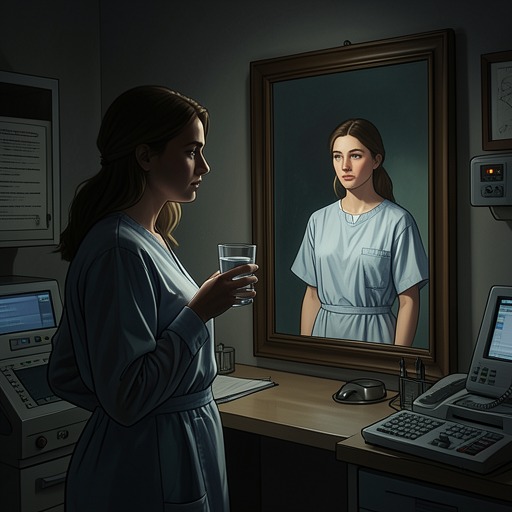
Anna’s return outdoors in this crisis is not a leisurely or completed recovery. She uses the umbrella and the counting routine, then steps outside while trying to reach Jane. The sequence reverses the earlier practice in the garden: an exercise undertaken with Dr. Julian Fielding has become an action demanded by another person’s danger. Her fear remains present, but no longer determines every choice. At the hospital, she explains her agoraphobia, depression, panic disorder, medication regimen, ten months indoors, and Dr. Julian Fielding’s aversion therapy to the medical staff and Detective Little. Giving that history helps them understand the circumstances in which she has acted; it also shows Anna speaking openly about a condition she had been managing largely within her home.
Later, Anna’s sense of confinement becomes a way of understanding her position in the investigation as well as her illness. She thinks of herself as shut in and shut out: physically inside while a woman has been attacked across the park, and socially discounted by the neighbors, the police, and even the people involved in her care. The formulation captures two related constraints. The closed house limits what she can do, while other people’s judgments make it harder for her to be believed. Her agoraphobia is therefore not the only barrier between knowledge and action, although it gives that barrier a concrete spatial form.
A further attempt to leave follows a moment when Anna believes her home may not be safe. She takes three Ativan tablets, retrieves the umbrella, opens the door, and uses breathing and counting as she crosses the threshold. The details echo the garden exercises, but the setting and circumstances have changed: the attempt begins in her house and leads into the hall and through the doorway. This is exposure under pressure, not evidence that the condition has been cured. The repeated attention to breathing shows how much effort each movement still requires.
Recovery and Continuing Significance
The novel ultimately presents recovery as an active process rather than a sudden reversal. Anna recognizes that she has waited for her family to return and for her depression to lift, and that neither expectation can resolve her situation without her own participation. She decides that the time has come to rejoin the world. This change does not erase bereavement or establish that she is free of agoraphobia; it marks a shift from waiting for change to helping make it possible.
With Bina guiding her toward the door and the stairs, Anna approaches the threshold in daylight and with a clear head. She remembers that she had once fought for her life on a roof in the rain, and takes that memory as a reason to keep living. She closes her eyes, opens them, and steps into the light. The ending offers a concrete act rather than a promise of complete recovery: Anna goes outdoors, supported by another person and by what she has learned, while the longer work of living with loss remains.
Across these episodes, agoraphobia is at once diagnosis, daily restriction, and a narrative structure built around doors, thresholds, and open space. The umbrella and the counted breath show how Anna creates small forms of control; Jane’s emergency exposes the cost of remaining inside; the final step shows that movement can begin before fear is settled. The condition is neither dismissed as a metaphor nor treated as a problem solved by willpower. Its consequences persist, but Anna’s actions increasingly make room for connection and choice.