Alcohol and medication misuse
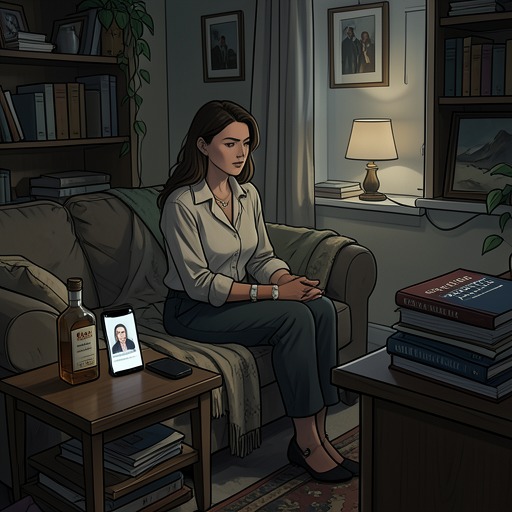
The Woman in the WindowAlcohol and medication misuse is a consequential pattern in Anna Fox’s daily life: she combines wine with prescription pills even as she recognizes the dangers, and the resulting uncertainty about her judgment becomes part of the conflict over whether her perceptions can be trusted. The novel presents both the behavior and its consequences without making every troubling perception reducible to substance use.## Routine and self-knowledge In her kitchen, Anna Fox takes pills with merlot while acknowledging that alcohol is a depressant and therefore a poor fit for someone experiencing depression. Her knowledge is not merely general: she coauthored a paper on juvenile depression and alcohol abuse with Wesley Brill, and she can recall its conclusions. She also invokes Bernard Shaw’s metaphor of alcohol as anesthesia for enduring life. That comparison gives her drinking a ready-made rationale, but it sits beside her awareness that the combination is ill-advised.
The distance between what Anna knows and what she does recurs online. At the Agora, she helps new recruits and joins a debate about drugs, warning participants that none should be taken with alcohol. In the same stretch of narration, she reports that she has mixed her own medicines for almost a year and dismisses concern by pointing to how she appears to be functioning. Her expertise and her warning to others do not protect her from the practice she describes; instead, they sharpen the contrast between professional authority and private denial.
The pattern is not confined to a single lapse. During a later episode, two empty merlot bottles and four pill canisters remain on her coffee table. Anna counts the wine as roughly two bottles, in addition to what she drank at lunchtime, and admits that she has been careless with her medication. When she checks the canisters, one is nearly empty, with only two tablets left. The physical inventory makes her uncertainty concrete: she cannot confidently say whether she took the right pills or the right amount.
Escalation and uncertain perception
After witnessing what she believes is Jane Russell bleeding, Anna is questioned at the hospital about drinking. She acknowledges having had some, but her speech is slurred and she is more concerned that Jane may be dead than with defending her own reliability. The exchange shows the immediate practical consequence of the pattern: at a moment when she wants others to act on her report, her intoxication makes her account easier to doubt.
Detective Little later suggests that wine, medication, and the film Anna had been watching may have contributed to her seeing something that was not there. Anna resists that explanation. A doctor at the hospital has told her that hallucinations can be a side effect of her medication, but this is presented as a possibility, not a settled account of what she experienced. Detective Val Norelli supplies a more concrete measure of Anna’s condition: the hospital recorded her blood-alcohol level at 0.22, almost three times the legal limit. The figure gives the officers grounds for skepticism, while leaving the truth of Anna’s reported experience unresolved.
The narrative also shows Anna returning to the same combination after a disorienting episode. She opens another bottle of wine, drinks from it, and takes two pills. Her thoughts turn in sequence to Jane Russell, a woman, and Alistair Russell. The passage establishes recurrence and proximity between substance use and mental distress, but does not state that drinking or medication is the reason for every thought or perception. At another point, Anna sees a tiny illuminated heart before Jane appears to her, radiant and watching. The image is striking, but the text does not provide enough here to identify it as a medication effect or to settle what it means.
Credibility and narrative significance
Alcohol and medication misuse become entangled with the novel’s central problem of credibility. Anna’s account is not assessed in a neutral setting: she is visibly impaired, has admitted uncertainty about her doses, and has been told that medication may cause hallucinations. Those details give other characters grounds to question what she reports. At the same time, the novel does not treat those grounds as proof that she is wrong. Anna insists that she saw what she saw, and the competing explanations remain in tension.
The pattern also resists a simple account of knowledge as protection. Anna’s professional familiarity with depression, alcohol, and medication lets her identify the risks and warn others, but it does not resolve her own behavior. Her reliance on wine and pills persists alongside that understanding, while episodes of uncertain dosing and substantial intoxication make it harder for her to judge or communicate what is happening. The result is not just a portrait of risky consumption: it is a narrative mechanism that exposes the gap between knowing a danger, living with it, and being believed when perception itself is contested.