Anna Fox
The Woman in the WindowAnna Fox is a psychologist whose professional understanding of anxiety cannot keep her safe from it: after ten months indoors, she is both an observer of her neighbors and a woman struggling to leave her home. When she witnesses Jane Russell’s stabbing, that isolation becomes a test of whether she can make herself act and persuade others to believe what she saw.
Identity and Background
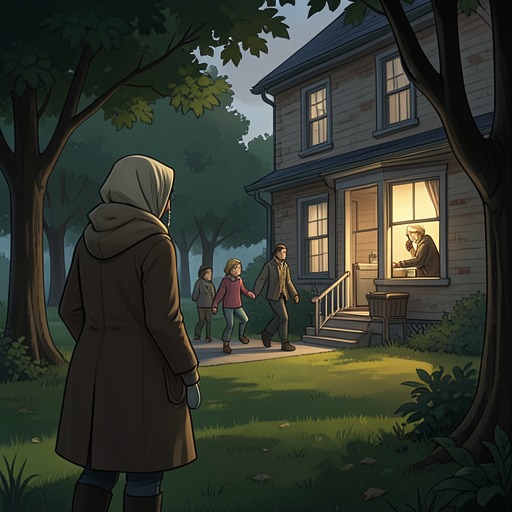
Anna lives alone in her home and watches the neighboring houses from inside. Early in the novel, she follows the online traces of the former residents of number 212, a rust-red townhome whose newlywed occupants have separated. The empty windows and exposed rooms draw her attention; she imagines the house as a place where love has ended. Her habit of looking outward makes the window a boundary between her confined life and the lives she tries to read across the street.
Anna also maintains a presence on Agora, an online forum whose users are scattered across the world. She first chose the handle Annagoraphobe, then revealed to another user that she was a psychologist. After that disclosure spread, she adopted the handle thedoctorisin. The change captures a tension in her identity: she has professional expertise in mental health, but she is not simply an expert observing other people’s difficulties. Her own agoraphobia and panic disorder shape what she can do and how she experiences the world.
During a panic attack, Anna gives her name as Anna Fox and insists that the children nearby are not the cause of her distress: she cannot go outside. Later, after witnessing Jane Russell’s stabbing, she tells the police that she has agoraphobia, depression, and panic disorder. She also describes her medication regimen, her ten months indoors, and the aversion therapy she has received from Dr. Julian Fielding. The disclosure gives the police essential context for her behavior, while making clear that her professional knowledge has not spared her from severe illness.
Witnessing and the Crisis of Credibility
When Anna sees Jane Russell stabbed, watching from inside is no longer enough. She reaches for her phone and calls 911, struggling to give the dispatcher her neighbor’s address while describing the injury. Through the window, the Russells’ bright parlor is marked by an arc of blood across the glass. The scene turns a familiar act of looking outward into an urgent claim that someone else must hear and act on.
Anna then takes the umbrella from its corner and moves toward the doors. Jane had come to Anna’s aid before; now, with Jane wounded across the park and the ambulance not yet there, Anna understands her own obligation through her psychotherapist’s oath to do no harm and put others’ interests first. She crosses the boundary that has kept her indoors and tries to reach the person she has seen bleeding. The umbrella, ordinarily associated with the threat of going outside, accompanies her into that attempt at rescue.
At the hospital, Anna has to turn what she witnessed into testimony. She tells Detective Little that she saw her neighbor stabbed, and later identifies that neighbor to Detective Norelli as Jane Russell. Her account is difficult to deliver: she recalls the emergency call and her journey through the side door into the park as her vision swims and her breathing quickens. Yet she continues to insist on the central fact. In a story where her perception and credibility are under pressure, the act of naming what happened becomes another form of crossing the threshold.
Trauma, Memory, and Trust
Anna’s confinement has a history that reaches back to a physical ordeal. Detective Little tells her that her trouble going outside began then; she recalls being told at the hospital that she was in shock, and describes shock becoming fear and fear becoming panic. Dr. Julian Fielding gives the resulting condition its name as a severe case of agoraphobia. Anna connects her need for familiar walls to the two nights she spent in what she remembers as an alien wilderness: home is not merely where she stays, but the refuge against a landscape her body has learned to fear.
Her trauma also alters how she experiences absence. She hears the voices of people she misses—among them Detective Little, Norelli, Alistair Russell, Ethan Russell, David, and Jane Russell—sometimes when pain overwhelms her, sometimes when she needs company, and sometimes without warning. In these moments the voices greet her with the recurring words “Guess who,” and she answers them. The passage holds comfort and distress together: Anna responds with joy, even as she recognizes the voices in relation to loss and death. The recurrence makes grief audible, while leaving the boundary between memory and present experience unsettled.
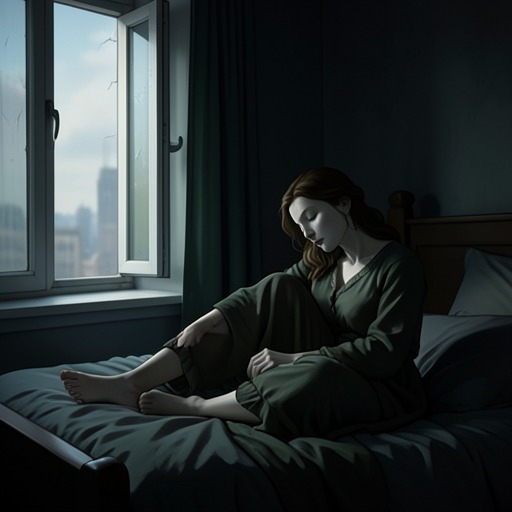
That uncertainty shapes Anna’s attempt to question Ethan Russell about the photograph of her asleep. She says she had been told she imagined something happening in his house and had drawn a picture she had not drawn; now she wants to know who took the photograph because she fears the answer might be herself. Ethan cannot explain how the photographer could have entered. Anna’s question is not only a request for information: it exposes how deeply other people’s claims have destabilized her trust in her own memory and actions.
Later, in the rain, Anna faces Ethan Russell with a letter opener in his hand and tells him that both his parents loved him. She then hugs him. He first stiffens, then slackens, and the embrace shifts their positions until he is holding her upright. The gesture does not erase the danger or resolve every uncertainty between them, but it replaces accusation with physical care. Anna’s willingness to reach toward Ethan, even in a threatening moment, gives their encounter a different outcome from the mistrust that has governed her questions.
Narrative Role and the Limits of Observation
Anna’s gaze is not a neutral camera: she watches strangers and turns fragments of their lives into stories, sometimes with confidence the evidence cannot warrant. Early on, she follows the online traces of the former residents of number 212, then watches a woman lead a contractor into its guest bedroom while anticipating that the woman’s husband is nearly home and may catch her. The scene gives Anna the position of watcher and interpreter at once. She cannot know the people she observes, yet their exposed windows invite her to imagine what is happening inside—and what their actions mean.
That habit of reading lives at a distance gains sharper stakes when Anna reports Jane Russell’s stabbing. Her first-hand observation is real, but her illness and the instability of her memory give others grounds to question her account, while Anna herself fears that she may have imagined events or acted without remembering. The novel thus makes watching both her means of connection and a source of uncertainty: what she sees can demand action, but seeing alone cannot guarantee that she will be believed, or that she can fully trust her own conclusions.