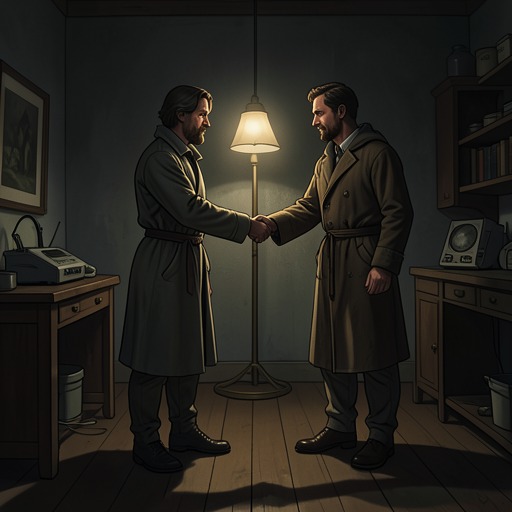
Anna Fox—David
The Woman in the WindowThe relationship between Anna Fox and David begins as an explicitly practical exchange: David lives downstairs at reduced rent and helps maintain Anna’s house. Yet the arrangement brings them into close contact at moments when ordinary domestic tasks acquire emotional weight. Anna appreciates his labor, but his visits also expose her discomfort with being seen and the uncertainty she feels about his presence in her home.
The tenancy and its terms
David has been living downstairs for two months when Anna explains how the arrangement began. Dr. Julian Fielding had suggested that a tenant could be useful: someone to run errands, take out the trash, and assist with general upkeep in return for reduced rent. David answered Anna’s Craigslist advertisement first. His email struck her as terse, even curt; meeting him changed that impression, since she found him chatty. Recently relocated from Boston, he described himself as an experienced handyman and nonsmoker and said he had $7,000 in the bank. Anna and David agreed on a lease that afternoon.
These details establish the relation as negotiated and reciprocal, rather than simply a friendship or an act of charity. The work is concrete, the rent reduction is its exchange, and David’s handyman experience suits the needs Anna has identified. At the same time, the arrangement places him inside the household: he occupies the basement, comes upstairs, and is expected to help with work that would otherwise remain Anna’s responsibility. Their closeness grows from the terms of the lease, not from an announced intimacy.
Help inside Anna’s house
Anna recognizes the work David does for her, though gratitude does not come easily in their exchanges. When he is already moving toward the basement door, she tells him that she appreciates the trash removal and housework and calls him a lifesaver. The timing makes her thanks feel awkward to her; David answers briefly and continues on. The scene shows both the importance of his labor and the limits of what can be inferred from his response. He provides help, but the exchange does not establish a matching emotional disclosure.
The household itself also shapes their encounters. David asks why the lights are kept so dim and whether there is a medical reason. Anna explains that people in her position can feel exposed when the light is too bright, then points out that the house receives plenty of natural light. His question brings her vulnerability into an ordinary conversation about lighting: he notices a feature of the space, while she explains the personal need behind it. The home is where David works and lives, but it is also an environment Anna manages around her sense of exposure.
Their practical dealings include unfinished household tasks and personal belongings. Anna asks David to let her know if he finds more of Ed’s blueprints downstairs because she is saving them. She also begins asking him to call someone to deal with the ceiling. These requests place David in the role the tenancy created, while the blueprints show that the work of maintaining the house sits alongside Anna’s attachment to what she has kept from Ed.
A visit that changes the distance between them
A later visit begins with David coming upstairs through the basement. Anna tells him that this is acceptable and that he is welcome to do it, then asks what he needs. He is looking for an X-Acto knife. When Anna asks what he intends to do with it, David explains that the man next door, Alistair Russell, has asked him to do some work: open boxes and put things away. David leaves for the stairs after explaining the job.
The knife makes the encounter more charged for Anna than its practical explanation might suggest. Standing in the dark with David, who is holding a blade, she realizes that this is the closest she has ever been to him. She considers two possibilities—he could kiss her, or he could kill her. That immediate contrast records the intensity of her perception, not evidence that David intends either action. His stated reason for needing the knife is work for Alistair Russell. The scene nevertheless reveals how a routine request can unsettle the boundary between David as a helpful tenant and David as a man close enough to inspire competing imaginings of intimacy and danger.
Courtesy, distance, and uncertainty
At the end of an earlier visit, David emerges from the bathroom, wipes his palms on his jeans, and heads for the door with his hands in his pockets. He tells Anna that he will see her around. Anna privately thinks that he will not, but answers that she is sure he will. The exchange leaves the relationship suspended between an ordinary farewell and her unspoken expectation that their contact may end. Her spoken reassurance does not erase the thought she keeps to herself.
Across these encounters, the relation remains defined by an imbalance of knowledge rather than by a clearly stated bond: Anna knows the terms of David’s lease and depends on the services he provides, but she also measures his movements and wonders what his nearness means. David’s arrival, work, questions, and departures are all grounded in everyday household business. The tension comes from Anna’s experience of that business—gratitude mixed with awkwardness, welcome mixed with exposure, and practical proximity briefly shadowed by the possibility of intimacy or harm. The arrangement gives them a reason to share a house; it does not settle what they are to one another.