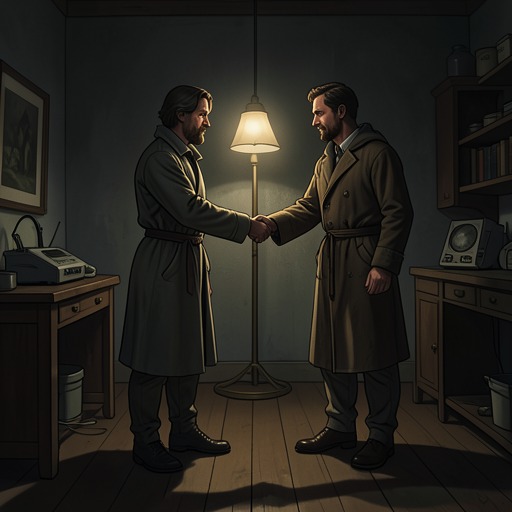
Anna Fox—David Winters
The Woman in the WindowAnna Fox’s relationship with David Winters moves from a guarded landlord-and-tenant arrangement into physical intimacy, then back toward uncertainty when Anna considers whether he could enter her home without her knowledge. The basement makes that shift tangible: it is both David’s separate living space and a part of Anna’s house that she can investigate, bar, and fear may no longer be secure. Because the events are filtered through Anna’s perceptions, the relationship’s closeness never cancels the questions surrounding trust and access.
The Tenant in the Basement
When Detective Little asks whether Anna is alone in her five-story house, she answers that she has a tenant. He presses for the tenant’s location, and Anna says he lives in the basement. Asked whether he is there, she replies that he is there sometimes. Her brief answers establish David as part of the household while keeping him at a distance: he is present in the house, but not continuously visible to Anna or to the detective.
Detective Little then approaches the basement door and asks permission to knock. Anna nods. He taps out a familiar rhythm on the wood, waits, and asks for the tenant’s name. Anna identifies him as David. Little knocks again, but there is no answer. The exchange is a small but revealing encounter around a boundary: Anna controls whether the detective may approach the door, yet neither she nor Little can establish David’s presence simply by calling for him. The unanswered knock gives the tenant arrangement an element of absence without explaining why David is not there.
Two months later, Anna descends the stairs and turns on the basement light. She recalls that David had arrived for a tour two months earlier and had looked over the living area, sleeping alcove, kitchenette, and bathroom before nodding. The space is furnished with Ed’s sofa and drafting table; Anna notes that the table has been leveled. Toolboxes stand by the outside door, and a plate with plastic utensils rests on the table. These details make David’s tenancy concrete, while also emphasizing how little he has changed the room: much of its furnishing remains associated with Anna’s household rather than with a distinct life of his own. A framed photograph of Anna and Olivia, taken when Olivia was five, hangs on the wall, placing an image of Anna’s family inside the tenant’s separate quarters.
From Distance to Physical Intimacy
David’s usual quietness makes his sudden anger a marked change. When Anna encounters him in the basement, he swears at her, and she registers that she has never heard him swear and has barely heard him speak. The outburst breaks the restrained pattern she associates with him. It does not, by itself, explain his anger, but it establishes that the quiet tenant can become forceful and unpredictable in her experience.
The relationship then shifts into intimacy. Anna asks whether David has met Jane Russell, the woman across the park. He responds by asking who she is, and Anna begins to identify her by name and address. In another exchange, David asks whether Anna is feeling all right and checks whether she is mixing something with alcohol. His questions show attention to her condition, though the scene does not establish what he knows or what prompts his concern. Before Anna decides whether to tell him about Jane, David kisses her.
Anna experiences the kiss as a return to feeling after a long period of emotional numbness. Later, in the dark, she touches his chest and stomach as he breathes quietly beside her. She drifts away and dreams partly of sunsets and Jane; when she hears soft footsteps on the landing, she is surprised to hope that David will return to bed. The scene connects intimacy with vulnerability: Anna welcomes his presence, but the moment is not presented as a settled commitment or as the resolution of her other concerns. Her attention remains divided between this new closeness and the woman she has been considering telling him about.
Intimacy and the Question of Access
After the night they share, Anna reconsiders the security of her house. She wonders whether David made a copy of her key and recalls hearing sounds on the landing on the night she led him to bed. She considers whether he could have taken the key from the kitchen and replaced the original. At the same time, she remembers seeing the key on its hook an hour earlier and having barred the basement door after he left. Her reasoning moves through competing possibilities rather than reaching a confirmed conclusion: the familiar key appears to be where it should be, but that does not, in her mind, rule out a duplicate.
When asked who might have photographed her, Anna names her tenant as the only person who might have a key. She also says she does not know where David is, adding that he had said he was going out of town. This creates a sharp contrast with the earlier scene of physical closeness. The man Anna had hoped would return to bed is now the person she identifies as a possible source of access to her private space. The evidence establishes her suspicion and uncertainty, not that David copied a key, entered the house, or photographed her.
Narrative Significance and Unresolved Trust
The relationship’s significance lies in how quickly its apparent categories change. David first appears through practical facts—his room, the basement door, and the unanswered knock—then through a kiss and a shared night, and finally through Anna’s suspicion that he could possess an unobserved means of entering her home. Neither closeness nor fear supplies a definitive account of his actions. The domestic arrangement that permits intimacy also makes the question of access consequential: the basement belongs to the house, and David’s presence there connects him to spaces Anna regards as private.
The account also remains limited to what Anna observes, remembers, and fears. Her recollection of sounds on the landing and her reasoning about the key are presented as possibilities, not as externally confirmed events. That distinction matters to the relationship: the narrative shows trust becoming unstable without resolving whether David has betrayed it. In the available scenes, he is simultaneously a tenant who checks on Anna, a man with whom she becomes physically intimate, and the person she suspects may have been able to enter her house. The relationship ends here in evidentiary uncertainty rather than a clear verdict about either David’s conduct or their future.