Anna Fox—Dr. Julian Fielding
The Woman in the WindowAnna Fox’s relationship with Dr. Julian Fielding is marked by a telling split: he is the psychiatrist associated with her treatment and medication, yet she hesitates to turn to him when she needs help and later conceals her concerns during their contact. The relationship connects her long struggle with agoraphobia and panic to a quieter conflict over whether she can trust him with what is happening to her.
Identity and Treatment
Dr. Julian Fielding is Anna’s psychiatrist, and his care forms part of the account she gives medical staff after she is found unconscious in a park and taken to Morningside. Asked whether there is a doctor she can contact, Anna names him automatically. The answer comes before she can reconsider it, suggesting how firmly he occupies the role of her doctor; she then interrupts herself and decides against contacting him. The moment establishes both the practical fact of their professional relationship and its limits: knowing whom she would ordinarily name does not mean she believes he is the person to call now.
When Anna describes her medical history to the doctor at Morningside, she includes her agoraphobia, depression, panic disorder, drug regimen, and ten months indoors. She also identifies Dr. Julian Fielding with her aversion therapy. This account places him within a substantial course of treatment rather than a single consultation. The therapy is part of the history she considers necessary to explain her condition, while the immediate hospital encounter shows that other clinicians are assessing her in circumstances where he is not present.
Naming Him, Then Withholding Contact
Anna’s reflexive answer at Morningside is followed by an explicit reversal: she names Dr. Julian Fielding, then says no. The change is brief but significant. In a moment when she is urgently trying to make others respond to a woman who has been stabbed, her attention is divided between that emergency and the medical questions being put to her. Her instinct supplies the familiar doctor’s name; her reconsideration draws a boundary between her ongoing treatment and the help she believes is needed at that moment.
A later decision makes that boundary more concrete. After returning pill bottles to the bathroom medicine cabinet, Anna considers Dr. Julian Fielding’s medical qualifications and prescription authority but concludes that he cannot help her in the situation she faces. She uses the phone to ask another person to come over, without naming that person in the passage. The contrast matters: the doctor has professional authority over her care, but Anna does not treat that authority as a solution to every problem. Her judgment is not a general rejection of psychiatric treatment; it is a decision, in this particular moment, that his role does not meet the need she has identified.
Disclosure and the Limits of the Clinical Account
At Morningside, Anna does eventually disclose her history in detail. She tells the attending doctor about her diagnoses, medication, confinement at home, and aversion therapy with Dr. Julian Fielding. The disclosure takes time; she is still struggling to speak clearly and drinks water as she explains herself. The physical effort of telling the story gives the exchange weight: this is not effortless background information but an account she has to bring out while recovering from a panic attack.
Once she finishes, Anna sinks back into the pillow. The doctor consults a clipboard, acknowledges what she has said, and asks Detective Little to speak with her outside the room. Dr. Julian Fielding is not part of that exchange, but his treatment remains one of the facts through which Anna’s condition is presented to the medical staff. The contrast between naming him and then giving a full account of his treatment suggests that he remains central to her medical history even when she does not choose to involve him directly in the present emergency.
Concern, Medication, and Evasion
Later, Dr. Julian Fielding calls after receiving a voicemail from Anna and says she sounded concerned. Anna has prepared herself to tell him the whole story, but changes course. Instead, she tells him it was nothing. Her decision to withhold the story is especially revealing because he is initiating contact out of concern, and because the narration indicates that she had been ready to disclose more. The relationship therefore includes an opportunity for openness that Anna herself closes off.
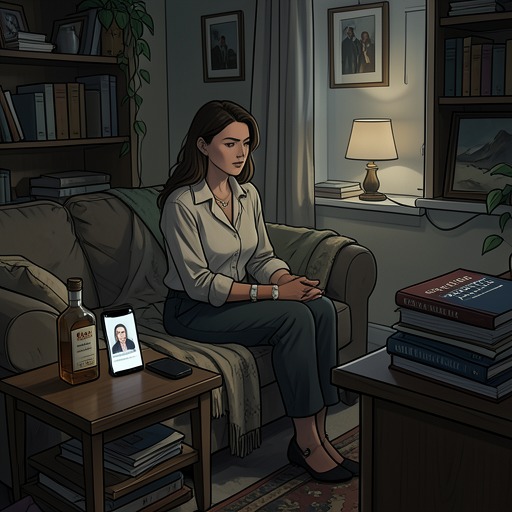
Her hesitation is linked to medication. Anna thinks of Dr. Julian Fielding as the person who adjusts or supplies her medication, but her thought trails off before she spells out the concern. The unfinished qualification matters: the account points to unease without establishing precisely what she believes he has done or why. He suggests discussing the matter at their Tuesday appointment, and Anna agrees that it can wait. When he asks whether she is sure she feels all right, she says that she is completely fine while selecting a bottle of merlot and getting a glass. He then asks whether she is mixing medication with alcohol. The passage stops at the question, so it does not establish Anna’s answer or confirm that she has combined them. It does, however, set her reassurance against the visible wine and the medication concern she has not explained.
An Uneasy Professional Bond
Across these encounters, Dr. Julian Fielding is neither absent from Anna’s life nor an uncomplicated source of security. His aversion therapy and medication belong to the history she discloses; his name is the first one that comes to mind when she is asked about a doctor; and he later checks on her and proposes a time to discuss her concerns. At the same time, she declines to contact him at Morningside, judges him unable to help in a separate immediate situation, and minimizes her distress on the phone.
The relationship’s central tension is thus between treatment and disclosure. Dr. Julian Fielding has a continuing clinical role, but the scenes do not show that role guaranteeing candor. Anna can name the treatment, recount it to other clinicians, and still withhold what she had planned to tell him. The medication-and-wine exchange sharpens that tension without resolving it: concern is voiced, but the decisive information remains unspoken.