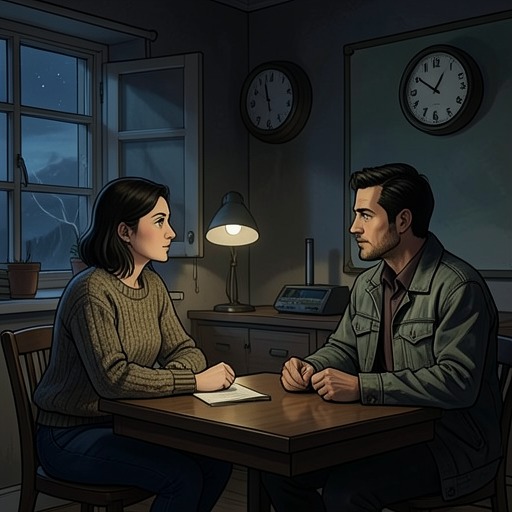
Anna Fox—Ed
The Woman in the WindowAnna Fox and Ed are separated spouses whose exchanges hold affection and estrangement in the same frame. Anna longs for his presence and misses him deeply, but their conversations also expose the limits of their trust: when she reports a violent event, Ed questions what she saw, and she must defend both her perception and her credibility. The relationship is defined less by a clean break than by the strain of continuing to need one another after their shared life has fractured.
Marriage and Separation
The separation is described as a decision made ten days before Anna recounts it. Although Ed had decided to separate and Anna had agreed in principle, she admits that she did not believe it would actually happen, even after he summoned a broker. That gap between an abstract agreement and its practical consequences marks the change in their marriage: Anna consented to the idea while remaining unprepared for the reality of separation.
The narrative identifies Vermont in the previous December as a point of reference for their life together. Ed and Anna packed Olivia into an Audi and drove out of Manhattan, crossing the Henry Hudson Bridge and continuing through upstate New York. Ed presented the back roads as a family pleasure, promising Olivia diners and pancake places. The recollection preserves a specific, ordinary image of the three of them travelling together, set against Anna’s later recognition that she and Ed are no longer together.
That changed status becomes difficult for Anna to state aloud. When asked whether a family member can be contacted, she looks down at her wedding ring and says that she and her husband are not together anymore. Her right hand moves over her left as she answers. The ring remains visible, but the answer names the separation plainly; the gesture makes the account feel less like a settled declaration than an admission she has to compose carefully.
Longing and Unintended Confession
Anna’s longing surfaces while she watches a family move into a nearby house. Pressing her forehead against the cold window glass, she makes out a man, a woman, and a tall teenage boy carrying boxes to the front door. The sight prompts her to tell Ed that she wishes he were there. The confession catches her off guard, and the pause that follows registers its effect on both of them. Ed replies that she needs more time, a response that acknowledges her recovery or adjustment without answering the longing itself.
In another conversation, Anna tells Ed that she misses him. She explains that the admission was not planned and describes it as coming from her subconscious; her attempt to make light of the confession does not undo its directness. She then says that she misses his heart and repeats how much she misses him. The progression moves from the general absence of a husband to a more intimate expression of what she misses in him. Her words reveal continuing attachment, while their unguarded, repeated quality contrasts with the formal fact that they have separated.
Ed’s response in these exchanges is restrained. At one point he asks why Anna does not invite the new people over, and she drains her glass and says that she has had enough for the night. The conversation offers no resolution of their separation; instead, it shows Ed proposing a possible social connection while Anna withdraws from the subject. Their contact can sustain emotional closeness, but it does not make her ready to accept the specific invitation he raises.
Co-Parenting and Shared Family Life
Olivia remains a point of connection between Anna and Ed. In one conversation, after uncertainty about whether Ed believes Anna, he asks whether she has anything to say to Olivia. Anna exhales in relief and says that she does. A moment later she hears Olivia address her as Mommy. The exchange briefly shifts away from the dispute between the spouses and restores Anna to a parental relationship that can still be reached through their conversation.
That moment also shows Ed facilitating contact between Anna and Olivia, without resolving the distance between the adults. Anna’s relief at the question and attention to Olivia’s voice give the call an emotional importance distinct from the argument that precedes it. The earlier Vermont drive, with Ed, Anna, and Olivia travelling together, and this later exchange form contrasting glimpses of family life: first a shared outing, then a connection maintained across separation.
Disputed Credibility
The relationship becomes openly adversarial when Anna insists that she witnessed a violent event. Ed says that her recent heavy medication complicates his response. Anna interprets this as disbelief and shouts about how frustrating it is to be questioned. She acknowledges that she was medicated but insists that she did not imagine what she saw. Her anger is directed not only at Ed’s uncertainty but at the possibility that her account will be dismissed because of her condition.
Ed then asks whether she is sure the person she saw was the husband. This question shifts the disagreement from whether an event occurred to whether Anna identified the person responsible correctly. Anna asks whom he means, and Ed clarifies that he means the husband who committed the act. The exchange leaves the couple divided over the interpretation of her evidence: Anna argues from the force of having witnessed it, while Ed raises doubt about the identity of the assailant. The conversation does not establish that either accepts the other’s position.
Later, Anna tells Ed about the impostor’s message, the earring in David’s apartment, the box cutter, and the phone call with Alex. She says that the experience feels like something from a film and finds Ed insufficiently alarmed. When he asks whether she thinks she may be paranoid, she insists that what she fears is really happening. She also describes the frustration of being questioned and trapped in the house. In this exchange, the domestic separation and the dispute over her perceptions meet: Ed is a person to whom she tries to report events, but his questions make him another audience whose belief she cannot take for granted.
The Accident and the Relationship’s Narrative Role
A remembered scene of the car plunging over a gorge connects Ed’s name with the rupture of Anna’s family life. Olivia cries out; Anna sees a phone screen trembling on the floor, with Ed’s name displayed. Ed breathes Anna’s name, and then the road vanishes as the car goes over the edge into darkness. The scene places a brief act of address immediately beside catastrophe. It does not supply a long exchange or reconciliation; the force of the moment lies in the nearness of their names and voices to the sudden loss of the road.
Across these episodes, the relationship is presented through contrasts rather than a single verdict: a family trip and a separated household, longing and withdrawal, a shared conversation and a sharp challenge to Anna’s credibility. Ed remains emotionally present to Anna even when their marriage has formally changed, while Olivia’s voice preserves a parental bond within that distance. Their exchanges therefore register both the persistence of attachment and its limits: affection can be confessed, and contact can continue, without restoring the trust or togetherness that the separation has broken.