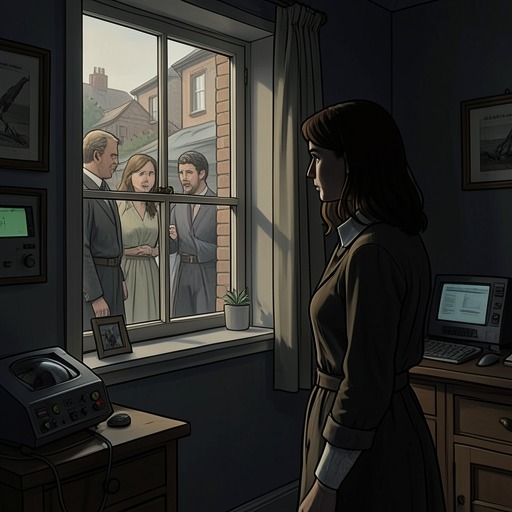
Anna Fox—Jane Russell
The Woman in the WindowAnna Fox’s relationship with Jane Russell is both a fragile friendship and a test of what Anna can trust herself to have seen. Anna remembers a woman from across the park helping her, visiting her at home, sharing wine and conversation, and playing chess with her. Later, she identifies that woman as Jane and reports seeing Jane stabbed. But when the Russells deny that Anna ever met Jane, the visitor’s identity becomes uncertain: Ethan Russell identifies the woman Anna met as his mother. The friendship matters not only for its intimacy, but for the way that uncertainty draws Anna into a dangerous effort to establish what happened and protect Ethan.
First Encounter
Anna’s first remembered meeting with the woman she calls Jane begins at a moment of physical and emotional disarray. After Anna has lurched through the door and fallen, she cups her hands over her nose and mouth and tries to calm her breathing. At the kitchen sink stands a woman with a rope of dark hair trailing down her back. The woman explains that she had been heading next door when she saw children throwing eggs and had gone to intervene; Anna’s collapse interrupted her errand. The encounter therefore starts not with a planned introduction but with a neighbor responding to Anna’s vulnerability.
Anna recognizes the woman as someone from across the park and then names her as Jane Russell. The woman is surprised and laughs, asking how Anna knows her. Anna connects the encounter to the fact that her son has already come by. From the outset, recognition and uncertainty sit together: Anna knows the woman through her view of the neighboring house and through Ethan’s visit, while their face-to-face acquaintance is still new. The woman’s help gives Anna a reason to trust her before either has established the terms of a friendship.
Visits and Intimacy
On a later visit, the woman addresses Anna’s isolation directly, joking that she must be bored of black-and-white films. She folds Anna into a hug, then moves into the house and brings out a bottle of Riesling, cold from her bag. The greeting is physically warm and unceremonious; the wine makes the visit feel companionable, though it also becomes part of the pattern of drinking surrounding Anna’s attempts to manage distress.
Their conversation moves from small talk toward the condition that shapes Anna’s life. The visitor says she will not ask what made Anna the way she is, then names agoraphobia. Anna answers with jokes about her weight and premature gray hair, but the exchange makes clear that the woman sees the fear beneath those deflections. She does not demand an explanation or treat Anna’s condition as a spectacle. In Anna’s recollection, that restraint helps make the relationship feel unusually candid: the visitor acknowledges Anna’s isolation without insisting that Anna account for it.
The relationship acquires a more concrete shape when Anna later admits that the woman sat at her table and played chess with her. Chess is not simply a detail of the visit; it becomes evidence Anna offers when challenged about whether she has ever met Jane. The game gives her memory a specific setting and shared activity, even as other people refuse the identity she attaches to her companion.
The Stabbing and Anna’s Testimony
Anna’s view of the relationship changes when she watches the woman she identifies as Jane through her Nikon camera. Jane enters the frame slowly and strangely, with a dark crimson stain spreading across the top of her blouse toward her stomach. Anna sees a slender silver object lodged in her chest, recognizes it as a hilt, and watches Jane reach toward the window. The distance between the two women is suddenly literal: Anna is at her own window, watching a neighbor in distress, and cannot make the sight into a private misunderstanding simply by looking away.
When Anna later speaks to Detective Little, she says that her neighbor was stabbed and names her as Jane Russell. She cannot identify the attacker. Her report joins two kinds of knowledge that the investigation will pull apart: the vivid image of a woman bleeding with a knife in her chest, and Anna’s certainty that the woman is the neighbor she befriended. Anna repeats the claim to Val Norelli, who asks who the neighbor is, and again supplies Jane’s name. For Anna, the name connects the woman at the window to the woman who had been in her home.
Anna’s account becomes more difficult to sustain when Val Norelli tells her that Alistair Russell says his wife has been away and that Anna has never met her. Anna answers that the woman was in her house twice: first after helping her off the street, and then on a later visit. She acknowledges that she lied when she previously said no one had been there, and identifies the chess game as a detail of their time together. She also tells Alistair that he came looking for the woman and made her scream. These admissions give the investigators more circumstances to assess, but they do not resolve the central question of whom Anna met.
Identity and Credibility
The discrepancy between Anna’s memories and the Russells’ account is not a small correction to an otherwise settled friendship. Anna says she met Jane on two different days, saw her with her family in the house repeatedly, and saw her bleeding with a knife in her chest. The woman she remembers visiting is not merely a figure glimpsed from a distance; Anna recalls conversation, a hug, wine, and a chess game. Those concrete memories make her insistence emotionally forceful without proving that the visitor was Jane Russell.
A later exchange with Ethan sharpens the uncertainty. Anna asks him who the woman is, and he answers that she is his mother. Anna responds that she has met his mother. The exchange establishes the woman’s relationship to Ethan, but the supplied account does not make the woman’s identity equivalent to Jane Russell’s. Consequently, Anna’s friendship remains bound to a distinction the investigation has exposed: she may accurately remember a woman’s visits and still be mistaken about who that woman was. The distinction unsettles both her claim to know Jane and the meaning of the intimacy she recalls.
This uncertainty also gives the relationship its unusual narrative form. The reader receives the friendship through Anna’s first-person account, where physical detail and emotional conviction coexist with disputed identification. The knife’s hilt, the wine bottle, the chess game, and the remembered visits are specific; the name attached to the visitor is contested. The relationship is therefore neither safely confirmed nor simply erased by the Russells’ denial. It persists as a real sequence of experiences whose interpretation remains in question.
Protection and Aftermath
Even as Anna’s confidence in her own account is under pressure, her concern shifts toward Ethan. Looking across the park at the Russells’ empty windows, she remembers him saying that he was scared and thinks of him as a child in distress. She feels responsible for helping him and says she must protect Jane’s son, whatever has happened to Jane. Her friendship with the woman thus becomes a motive for action beyond the visits themselves: Anna’s concern for Jane extends to the child she believes may be left vulnerable.
Anna tries to work out how to reach Ethan without exposing him to his father or the woman in the house. She cannot call his landline, he has no personal phone, and he has told her he has no email address or Facebook account. Faced with those limits, she logs on to a chess forum and starts to play, although an hour passes without bringing her an answer. Chess, first a shared activity at Anna’s table, returns as part of her effort to think through how to help Ethan. The relationship’s aftermath is therefore active rather than merely nostalgic: what Anna believes she shared with Jane becomes part of her attempt to protect the family’s child, even while the identity of the woman she befriended remains unresolved.