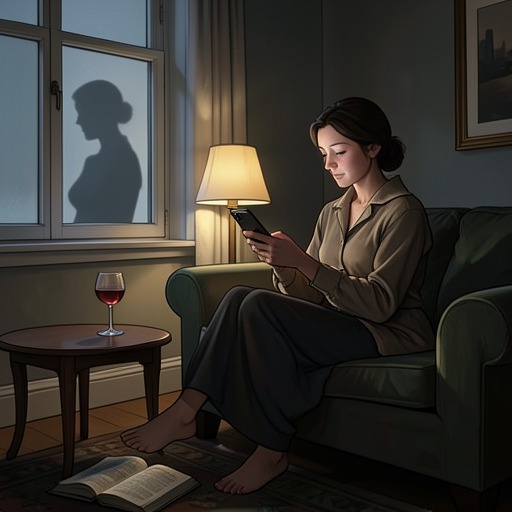
Anna Fox—Olivia
The Woman in the WindowAnna Fox’s relationship with Olivia is the emotional center of a story in which ordinary maternal exchanges persist after the family has been broken by death. Their bond appears first as teasing, advice, and concern across a separation; later, Olivia’s remembered presence becomes part of Anna’s denial and, finally, a continuing inward connection Anna can hold only after admitting her daughter is gone.
Family Position and Separation
Anna speaks of Olivia as her daughter and addresses her with affectionate names such as “pumpkin.” Their family life is already divided: Ed is no longer Anna’s partner, although he remains Olivia’s father. When Anna remarks that the newcomers live across the park at 207, Olivia asks which house, making the move-in a subject they share even at a distance. Olivia suggests that Anna go and greet the neighbors; Anna answers that she would like to, then describes the pumpkins outside and wishes she could choose one for her daughter. She asks Olivia to tell Ed to get two pumpkins, one for each of them. The small request keeps their shared family language alive while acknowledging that Anna is not there to carry out the gesture herself.
That intimacy includes friction. During a conversation over lo mein, Olivia calls her “Mommy,” a form of address Anna says Olivia has whittled down against her wishes. Ed advises Anna to let it go, but he is still “Daddy”: the exchange registers both the parents’ separation and the family roles that remain. Olivia’s suggestion that Anna greet the neighbors also contrasts with Anna’s confinement and difficulty going outside. Anna would like to act on her daughter’s encouragement, but can only describe what she sees from upstairs.
Concern, Memory, and Maternal Care
Anna asks Olivia whether she is happy and whether she is lonely. She recalls that Olivia had no real friends in New York City because she was too shy and too small. The questions turn Anna’s attention outward, toward her daughter’s well-being, even as Anna’s own life narrows to the house. Her wishes about the pumpkins likewise make care concrete: she imagines Olivia and herself each having one, a paired arrangement that briefly restores the sense of being together.
Olivia also remains vivid in Anna’s bodily memories. When Ethan Russell enters Anna’s house in distress, Anna opens her arms to him. Holding him brings back the sensation of holding Olivia before her first day of school, in a swimming pool during their vacation in Barbados, and amid silent snowfall. Anna remembers her daughter’s heartbeat against her own. The embrace is not a replacement for Olivia; it is the occasion that makes the lost closeness physically present in memory, with Anna’s recollections moving through distinct stages of their shared life.
Separation and the Limits of Support
The distance between Anna and Olivia becomes explicit when Anna is questioned after the crisis surrounding Jane. Asked whether a family member can be contacted, Anna looks to her wedding ring and says that she and her husband are no longer together. Asked for a friend, she cannot identify one she can call; she says Bina might be possible, but insists that she is fine, while Jane is not. Olivia is not available to her in that moment either. Later, when a visitor notices Olivia’s photograph on a side table and asks whether she is there, Anna says that she is with her father. The photograph makes her daughter visible in the house while confirming that she is elsewhere.
Anna’s fear of others disbelieving her also shapes what she wants kept from Olivia. In a conversation with Ed, Anna insists that the central problem is that no one believes what she says. She adds that she does not want him to tell Livvy about it. Ed says he will not. The request shows Anna trying to protect her daughter from the crisis as she understands it, even while her own isolation and uncertainty make that protection difficult to sustain.
Loss and the Continuing Bond
Anna’s professional losses and family loss become entangled. Ten months after losing her child patients, she searches for former patients online and counts nineteen children; she adds that the total would be twenty if Olivia were included. The phrasing places her daughter within the same catalogue of absences, without making the relationships interchangeable. Anna knows where Olivia is in the immediate sense, but the broader language of loss foreshadows how grief has overtaken her understanding of family.
At first, Anna’s contact with Olivia takes the form of a live-seeming exchange. When Ed asks whether she has anything to say to their daughter, Anna exhales in relief. She hears Olivia’s voice, greets her as “pumpkin,” asks whether she is doing well, and says, “I miss you.” Olivia answers, “Mm.” The spare exchange offers little information about Olivia’s life, but it gives Anna a moment in which maternal address and response still seem possible.
The truth eventually becomes explicit: Ed and Olivia are dead. Anna says that she does not deny their deaths, while Dr. Julian Fielding identifies her continuing conversations as denial. Anna’s account complicates that diagnosis. She hears her family’s voices when she is overwhelmed by their absence, when she needs someone to talk to, and unexpectedly; they say “Guess who,” and she answers. The voices let her experience the intimacy of recognition, but their recurrence also shows how difficult it is for her to separate present life from the family she has lost.
Recurrence and Narrative Significance
The imagined family conversation returns in small, ordinary forms rather than as a single dramatic revelation. On her birthday, Anna hears Ed and Livvy chorus “Happy birthday,” then rolls away. She remembers that Jane’s birthday is the same day, a date Anna had given her: November 11. The moment binds memory of her daughter to the calendar and to another relationship, while showing that the birthday greeting cannot make the absent family present in ordinary time.
Near the close of the arc, Olivia’s voice asks Anna what she is going to do. Anna turns her face into the pillow and tries to focus on Jane instead. The question carries the warmth of a daughter addressing her mother, but Anna’s effort to redirect her attention shows that the bond is also a source of pain she cannot simply follow. Olivia therefore remains central not only as the person Anna loves and mourns, but as the voice through which the narrative makes the movement from denial toward acknowledgment audible. Recognition of death does not erase the relationship; it changes the conditions under which Anna can continue to feel it.