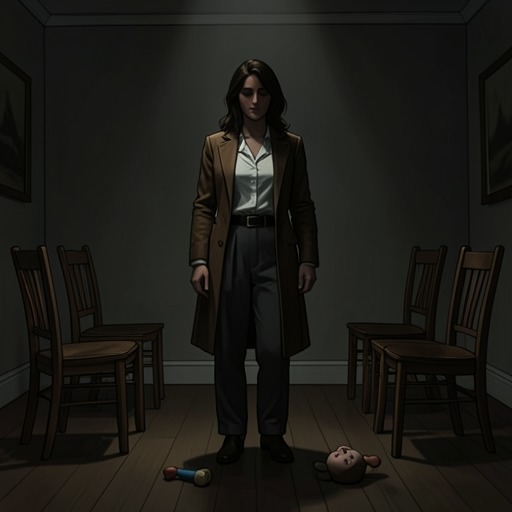
Anna Fox’s persistent post-bereavement depression
The Woman in the WindowAnna Fox’s persistent post-bereavement depression shapes both her private habits and her sense of who is still present in her life. Although she acknowledges that her husband Ed and daughter Olivia are dead, she continues to hear and answer them, while using alcohol and medication in ways that concern her doctor and impair her judgment. The story’s eventual change is not the disappearance of grief, but Anna’s decision to seek help and resume contact with the outside world.
Grief and continuing presence
Anna’s grief is bound to the ordinary intimacy of family life. In one memory of Ed, she recalls a family cranberry harvest in New Jersey, with Olivia laughing in her waders and Ed beside them. When she looks at Ed during a difficult conversation, she still finds his eyes beautiful. The memory preserves affection even as their marriage is under strain; depression and loss do not cancel the attachment that preceded them.
Later, Detective Val Norelli’s blunt confirmation of the deaths breaks through Anna’s denial. Anna can say plainly that Ed and Olivia are dead, and Dr. Julian Fielding identifies her continued refusal to live with that fact as denial. Yet recognition does not end her inward conversations. When pain or loneliness overwhelms her, she hears familiar voices, including those of Ed and Olivia, and responds to them. Their recurring family habit of greeting her becomes a private form of connection: it comforts her, but also shows how grief remains woven into her daily perception.
Alcohol, medication, and worsening judgment
Anna knows the risks of combining alcohol and medication. She recalls having coauthored a paper on juvenile depression and alcohol abuse with Wesley Brill and understands Dr. Fielding’s concern, but uses that knowledge to rationalize continuing her own behavior. Her claim that she has been mixing medicines for nearly a year is followed by a visit to the Agora forum, where she advises others not to take drugs with alcohol even as she drinks merlot herself.
The gap between advice and practice becomes more dangerous. On one occasion, Anna counts two empty bottles of merlot and four medication canisters on her coffee table, recognizes that she has drunk a great deal, and worries that she has taken the wrong pills or quantities. She admits she has been careless. When questioned by a nurse after reporting that she saw Jane bleeding, Anna minimizes how much she has drunk before acknowledging that it was a lot. These episodes connect her depression to concrete risks without making alcohol a cure: her own awareness coexists with impaired self-management.
Family voices and the difficulty of change
Anna’s imagined family presence continues into moments of ordinary routine. On her birthday, she hears Ed and Olivia wish her well, then remembers that Jane’s birthday is the same date, a birthday Anna assigned her. Later, while looking across the park at the darkened Russell house, Anna is interrupted by the imagined question of what she will do. Her attention shifts away from the present and back toward Jane, showing how loss, isolation, and fixation overlap.
The voices are not the only sign that Anna’s condition has become visible to others. Jane tells her that the crisis is over and that Anna is making a mess of her life. Ethan, during his attack on her, uses Anna’s sadness and the pills on her coffee table to consider disguising her death as an overdose or a fall. His words are a threat, not a reliable clinical account, but they point to the isolation in which Anna’s decline has become legible to those around her.
Stabilization and re-entry
Six weeks later, Anna describes a more stable and clear-headed state. The skylight has been repaired, the house professionally cleaned, and she is taking medication properly and no longer drinking. She credits some of that change to Pam, who has been helping her. Anna has also tried repeatedly to reach David, without success, and keeps his earbuds in a drawer in case he calls back; recovery does not erase her concern for the relationships left unresolved.
Her decisive shift is to stop waiting passively for her family to return or for depression to lift by itself. With Bina guiding her toward the door, Anna prepares to step outside. The movement is small but consequential: grief remains part of her life, yet she recognizes that rejoining the world requires action rather than waiting.