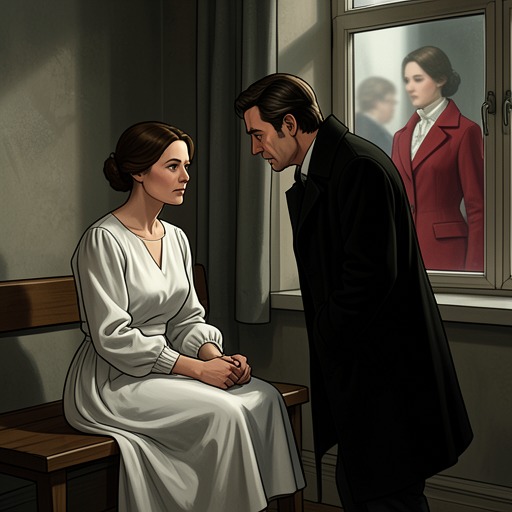
Anna Fox’s post-traumatic stress
The Woman in the WindowAnna Fox’s post-traumatic stress takes shape after a family catastrophe: the experience of watching her family die and spending two nights in an alien wilderness leaves her seeking safety in the familiar, controllable confines of home. The text traces a progression from shock into fear and panic, while the diagnosis of agoraphobia gives a name to the way trauma has narrowed her world.## Identity and Symptoms The account defines Anna Fox’s condition through both its origin and its consequences. At the hospital, she is told she is in shock. That state does not simply pass: shock becomes fear, and fear mutates into panic. When Dr. Julian Fielding arrives, he supplies the concise diagnosis, “A severe case of agoraphobia.” The naming clarifies the severity of her difficulty going outside, but the narrative also insists on the history beneath it. Her response is not presented as an unexplained aversion; it is linked to what she has survived.
The passage distinguishes the stages of her distress without making them interchangeable. Shock belongs to the immediate aftermath; fear and panic describe how that aftermath develops. Agoraphobia then identifies the condition through which the fear governs her relationship to the outside. In this account, the label is significant, but it does not replace the causal story. Anna’s need to remain at home is made intelligible through the remembered ordeal that precedes it.## The Trauma Behind the Confinement Anna identifies two connected reasons for needing the familiar confines of home. She spent two nights in what she calls an alien wilderness, beneath huge skies; she also watched her family slowly die. The first experience places her in a setting stripped of familiarity and control. The second makes the catastrophe intimate and irreversible. Together, they explain why home matters not merely as shelter but as an environment she can control.
That need for control is set against what she had to witness. She could not prevent her family’s deaths, and the memory of watching them die supplies the starkest contrast to the security she now seeks indoors. The vastness of the skies and the unfamiliarity of the wilderness stand opposite the bounded home she knows. The account does not suggest that returning indoors undoes what happened; instead, home becomes the place she needs because the earlier experience made the world outside feel alien and unmanageable.## Recognition and Narrative Framing Detective Little identifies the practical change in Anna’s life by pointing to the onset of her problems going outside. His observation frames the condition as a turning point: the issue is not simply that she prefers to stay home, but that going out has become a source of trouble. The passage then gives that observation its underlying cause, moving from the visible restriction to Anna’s account of shock, fear, panic, and the family tragedy.
Anna’s narration also turns the question of cause inward. She considers the question of what made her this way, then answers herself that life did. This answer resists reducing her condition to a single diagnostic word or one isolated moment. The surrounding account nevertheless gives the answer concrete shape: the two nights in the wilderness, the death of her family, and the escalating emotional response afterward. The movement between an observer’s description and Anna’s self-explanation makes the condition legible from outside while preserving the force of her lived history.## Effects on Daily Life The need for home is shown as an active requirement rather than a general preference. Anna says she needs familiar surroundings because she has endured an alien landscape and needs control because she watched her family die. The two explanations align place with psychological safety: the home offers familiarity and control, precisely what the remembered ordeal denied her. Her difficulty going outside is therefore tied to the conditions in which she can feel secure.
A brief present-time scene makes that restriction concrete. Hours pass; a candle burns down, and Anna remains slumped where she sits, her fingers cradled between her thighs. Her phone lights up and shivers with a call from Dr. Julian Fielding, who is supposed to see her the next day. Anna concludes that he will not. The scene places an expected appointment beside her immobility and the approaching night, showing how the consequences of her condition reach into ordinary plans and contact with her doctor. The passage does not specify what prevents the meeting, but the blunt certainty of her response gives the missed future a sense of resignation.## Significance The account presents post-traumatic stress through a sequence of belated consequences: the catastrophe has passed, but its effects continue to organize Anna’s emotions, movement, and sense of safety. The progression from shock to fear to panic gives that continuation a temporal shape, while the diagnosis marks the point at which the difficulty has become recognizable to Dr. Julian Fielding. Yet the remembered event remains central; clinical language does not eclipse the deaths she witnessed or the wilderness in which she spent two nights.
The contrast between the familiar home and the alien outdoors condenses the condition’s central conflict. Home is a refuge because Anna can control its environment, but her reliance on that refuge is also evidence of how thoroughly the trauma has altered her relation to the world beyond it. Detective Little notices the problem as difficulty going out; Anna’s own explanation leads back to loss and survival. Her declaration that life made her this way leaves the injury neither abstract nor easily separated from experience: the present restriction is the continuing shape of what happened.