Anna’s Halloween panic attack and first meeting with Jane Russell
The Woman in the WindowAnna’s Halloween panic attack and first meeting with Jane Russell turn a small act of vandalism at the front door into a decisive encounter with the limits of Anna’s world. When Anna tries to cross the threshold to confront the children who have thrown an egg at her window, panic overwhelms her and she falls. Jane, who is heading next door, helps her recover; in the aftermath, Anna introduces herself and names her agoraphobia to a neighbor she has just met.
The Egg at the Window
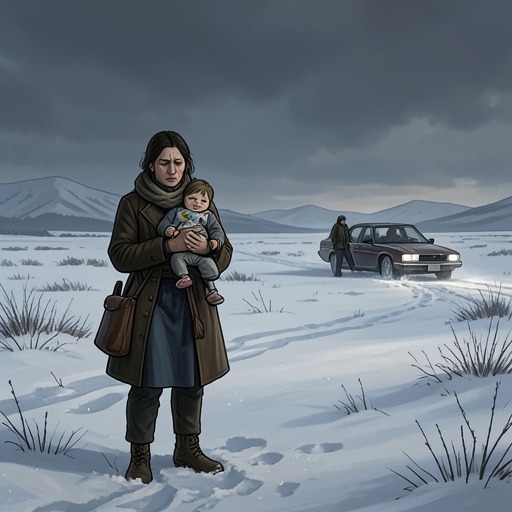
The incident begins in the hall, which Anna experiences as a threatening border between the safety of her home and the outside. At dusk, she sees three children through the leaded glass in the front door. An egg strikes the window, bursting across it in yolk and shell. One child is poised with another egg. The attack is small in scale, but it lands on a place Anna regards as hers: the window belongs to her home, and the children’s act makes the boundary feel exposed.
Anna’s first response is bodily shock. She gasps and sways, steadying herself with a hand against the wall. Anger follows, but anger does not give her an easy route into action. She cannot fling the door open, drive the children away, or rush outside to confront them. Instead, she raps sharply on the window and slaps the door with the heel of her hand. Those gestures register both protest and confinement: she can answer the children from inside, but cannot yet make herself cross the threshold.
The contrast between the protected interior and the street becomes especially sharp because the hall itself is not comforting to Anna. It is a dim, cool in-between space, and the walls seem to close around her. The egg has not entered the house, yet its impact on the glass unsettles the division on which her sense of safety depends. What follows is not simply a confrontation with children; it is an attempt to move from the enclosed side of that boundary to the exposed one.
The Attempt to Go Outside
Anna suddenly rushes downstairs and reaches for the door. Anger grips her, her sight swims, and she tries to steady herself by taking breaths and counting. She opens the door. Light and air meet her, and for an instant the scene outside seems suspended: the houses opposite, the children, and the street appear still. The pause does not last. The world seems to swell and rush toward her, and the opening that might have allowed her to confront the children becomes the point at which she is overwhelmed.
The attack is rendered as a physical collapse rather than a detached diagnosis. Anna folds as if struck in the gut, slides against the brick, and reaches into empty space. Her vision changes from the red of leaves to darkness and then to a bleaching whiteness. She tastes grit and blood, feels herself on the ground, and experiences the ground and air as unstable around her. The door-opening is thus a reversal: the action she undertakes to reclaim control over her home and its boundary leaves her unable to remain upright outside it.
The fall also recalls an earlier episode on the same steps. Anna remembers voices and a few sharply audible words from that previous occasion, including references to a fallen neighbor and to someone being crazy. The memory makes the present collapse part of a recurrence rather than an isolated mishap, but the circumstances do not become easier to bear for being familiar. This time, Anna hears nothing. The recollection briefly links the two falls while the immediate experience leaves her disoriented and alone on the ground.
Jane Russell’s Intervention
A woman finds Anna and tells her, “You took a tumble!” Anna’s vision gradually clears as she lies looking up at a ceiling light. By the kitchen sink, the woman has her back turned, her dark hair trailing down her back. Anna covers her nose and mouth with her hands and concentrates on breathing in and out. Her aching lip gives the collapse a concrete consequence, while the effort to breathe marks the beginning of her return to composure.
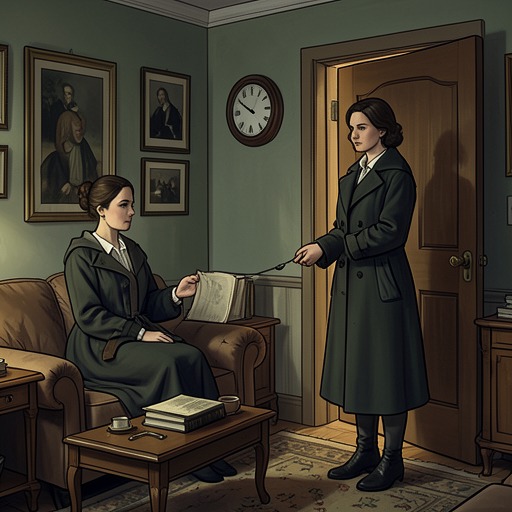
The woman explains that she was on her way next door when she saw the children throwing eggs. She had challenged them, then watched Anna lurch through the door and fall. Her account establishes how Jane came to be present: she has intervened with the children and then turned her attention to Anna. She brings two glasses, one containing water and the other a thick golden liquid that Anna hopes is brandy. Jane admits she does not know whether brandy works and jokes that she feels like Florence Nightingale. Her humor sits beside practical care rather than replacing it.
Jane asks Anna what happened outside. Anna closes her eyes and answers, “Panic attack.” That direct naming follows the bodily confusion of the fall, giving the event a term without undoing its physical force. Jane asks for her name, and Anna replies, “Anna. Fox.” Their exchange is brief, but it changes the scene from rescue by an unidentified passerby into a first encounter between neighbors.
Naming the Boundary
Anna says that she should not have gone outside. Jane questions the prohibition lightly, asking whether Anna is a vampire. Anna assesses her own pale arm and says, “I’m agoraphobic?” The question mark matters: she names the condition tentatively, then admits she had not been sure Jane would know what the word meant. Jane asks whether Anna is asking a question; Anna clarifies that she is not, but had doubted the term would be familiar.
The scene does not present the fall as a cure or as a successful confrontation with fear. Anna opens the door, but the attempt ends in panic and injury; the children remain outside the encounter, while Jane becomes the person who helps Anna after it. Its change is more modest and more immediate: Anna is no longer alone with the consequences of the episode, and she has disclosed her condition to someone who lives next door.
The egg’s impact, Anna’s unsuccessful effort to cross the threshold, and Jane’s arrival make the front door both the site of danger and the point of contact. The window first separates Anna from the children; once the door opens, that separation gives way to physical exposure. After the fall, however, the same neighborhood boundary permits an unexpected connection. Their first meeting begins with Jane helping Anna off the ground and ends with Anna naming the fear that had made going outside so difficult.