Anna’s house at 213
The Woman in the WindowAnna’s house at 213 is a multi-level Harlem townhouse whose carefully differentiated rooms record a shared life with Ed even as that life has become divided. During Anna’s long confinement, the house is not merely a residence: its arrangement makes movement between rooms and the outdoors consequential. When Anna believes her neighbor has been stabbed, the locked side door that has kept her inside becomes the threshold she finally crosses to go out and help.
Layout and Domestic Setting
The house contains a basement maisonette, a garden, and three floors of living space. The basement, which a broker called a maisonette, has its own entrance and is arranged as a kitchen, bathroom, bedroom, and tiny office. It had served as Ed’s workspace for eight years, where blueprints covered the table and contractor briefs were pinned to the wall; by the time Anna describes it, it is tenanted. The space thus retains a practical trace of Ed’s former work while serving a different use.
The garden is a limestone-tiled patio reached from the first floor. Two Adirondack chairs have fallen out of use, and a young ash tree stands in a far corner. Anna describes it as gangling and lonely and admits that she sometimes longs to hug it. That response gives the garden a particular place in her account: it is part of the house, but also an outdoor space that she can look toward and imagine approaching.
On the first floor, an open-plan kitchen has a rear door to the garden and a side door leading directly to the park. White-birch flooring is blotched with merlot, and a small powder room is painted Tomato Red. The living room has a sofa and coffee table on a Persian rug that remains plush underfoot. These details establish a lived-in interior rather than a neutral floor plan; the kitchen, in particular, connects the house to two different routes outside.
Rooms and Traces of Shared Life
The second floor separates Ed’s library from Anna’s study. His library is densely packed with books, their cracked spines and dust jackets pressed together on full shelves. Her study is spare and airy, with a desktop Mac on an IKEA table that serves as her online-chess battlefield. The contrast is visible in the rooms themselves: one is crowded with accumulated books, the other organized around a computer and a solitary activity.
A second half-bath is painted Heavenly Rapture, an expansive name for a room with a toilet. Nearby, a deep utility closet could potentially become a darkroom if Anna moved from digital photography to film, though she says she is losing interest. The detail makes the closet a contemplated possibility, not a project she has begun; it also places a possible future pursuit inside a house where many of her plans remain bounded by its rooms.
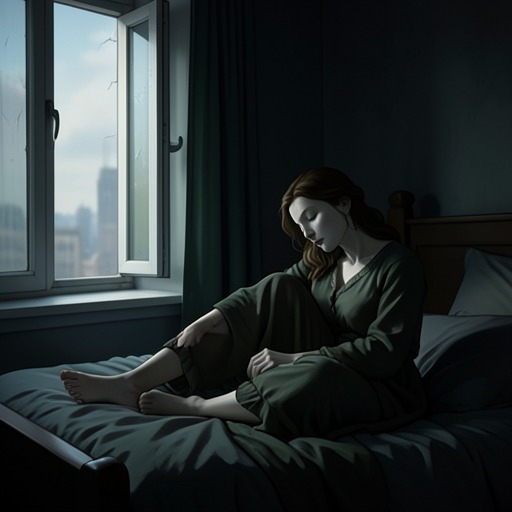
The third floor contains the main bedroom and bathroom. Anna has spent much of the year in bed on a sleep-system mattress with separately adjustable sides. Ed programmed his side for a soft setting, while hers is firm. His remark that she was sleeping on a brick marks the difference through an ordinary exchange about the mattress. Even the shared bed is described as divided into individually set spaces, a small domestic arrangement that echoes the separation elsewhere in the house.
The House as a Boundary
The side door from the kitchen opens directly toward the park, but Anna has kept it locked for almost a year. A recycling bin stands in front of it, its bottle necks protruding above the rim. When she needs to reach her injured neighbor, she pushes the bin aside; the glass inside chinks as it moves. The obstacle is both physical and familiar, part of the accumulated arrangement that has kept the door inaccessible in practice as well as locked.
The emergency makes this domestic threshold urgent. From inside, Anna can see the Russells’ cheerful parlor and a smear of blood across its window. She has an umbrella in hand and recalls her psychotherapist’s oath to do no harm, promote healing, and put others’ interests first. Yet the neighbor is across the park, still inside the house, and Anna has to decide whether she can leave her own. Before opening the side door, she worries that it might close behind her and that she might not get back in. She notices the key hanging beside the jamb, takes it, and puts it in her robe pocket.
Crossing into the Park
The house’s significance changes as Anna acts. For nearly a year, the side door has marked the limit of her movement; now she clears the recycling bin, unlocks it, takes the key, and steps outside. The sequence turns an ordinary kitchen exit into a consequential passage from enclosure toward a neighbor in danger. The park is not simply scenery beyond the house: reaching it requires Anna to confront the possibility of being unable to return.
That crossing brings together the house’s domestic history and its immediate crisis. Rooms still carry the outlines of Ed’s work, Anna’s study, and their divided sleeping arrangements, while the kitchen door leads to an action neither room could accomplish for her. The house has functioned as shelter and confinement; at this moment, its most important feature is the exit Anna chooses to use. Her step outdoors is therefore both a rescue attempt and a breach in the nearly year-long pattern of remaining inside.