Anna’s smartphone
The Woman in the WindowAnna’s smartphone is an intimate archive that becomes evidence of how thoroughly her privacy has been breached. Anna believes its passcode protects the device; instead, Ethan Russell uses information she has shared to enter it, photograph her asleep, and change the code. Its screen also brings up a sunset photograph in which a reflected figure unsettles Anna’s understanding of the woman she had known as Jane Russell. The phone’s significance lies in this reversal: what seems private and familiar becomes a record of watching, and a means of exposing what Anna cannot see directly.
Identity and Everyday Use
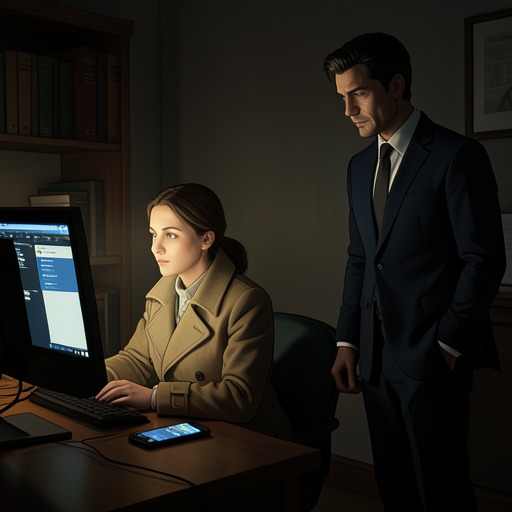
Anna’s smartphone appears first as a convenient personal device. When she considers taking a selfie, she sets aside the bulkier Nikon D5500 camera, takes her phone from her robe pocket, enters its passcode, and opens Photos. That ordinary sequence places the phone close to her body and within her everyday routines. It is small enough to keep at hand, yet its contents are personal enough that Anna believes the passcode makes them hers alone.
The screen immediately complicates that sense of ownership. At the top of Photos is the image of Anna asleep: her open mouth, loose hair, and pillow visible alongside the timestamp, 02:02 a.m. The precise time makes the picture more than an unsettling likeness; it records that someone was present, or had access to the phone, while Anna slept. She then reminds herself that no one else has the passcode. That assurance does not resolve the danger. It sharpens the gap between her belief in the device’s security and the evidence displayed on it.
A Private Archive Turned Against Anna
The asleep photograph gives the phone a double role. It is where Anna encounters the proof of a violation, but it is also the device Ethan Russell used to make that violation. Later, he says that he took her picture with her own phone. Anna’s private device has therefore not merely stored an image made elsewhere: it was recruited into the act of watching her. The familiar boundary between personal possession and external intrusion collapses at the moment she views the picture.
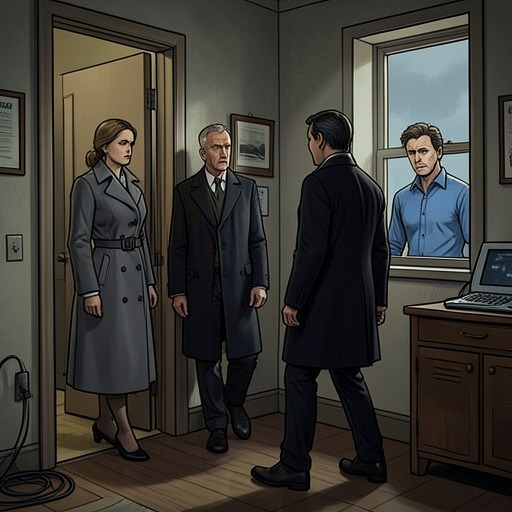
Another image on the phone carries a different kind of revelation. Anna recalls taking a sunset photograph from the kitchen window: the sky is sherbet-orange, distant buildings cut into it, the street glows, and a bird is fixed against the sky. In the glass, however, the photograph also preserves the reflection of the woman Anna had known as Jane Russell. The image’s importance depends on what Anna had not consciously made its subject. A photograph intended to capture the view outward also records the person inside it, making reflection an accidental form of evidence.
Ethan Russell’s Access
Ethan explains that he had been coming into Anna’s house at night for a couple of weeks, walking around and watching her. He describes the quiet, dark house as a place where he could observe her and compares his attention to doing research for a documentary. His account turns the phone into part of a larger pattern of surveillance, but the device gives that pattern a particularly intimate reach: he can make an image of Anna asleep using the object she keeps with her.
He also explains how he got in. Anna had told Lizzie to make passwords harder to guess by substituting numbers for letters, and Ethan connects that advice with what he knows about Anna’s daughter, Olivia, who was born on Valentine’s Day. He uses the date, 0214, to unlock the phone, then changes its code for his own amusement. The detail reveals how information shared in one context can become a vulnerability in another. The phone’s protection depends not only on its passcode but on the secrecy and unpredictability of the knowledge behind it; Ethan turns personal knowledge into a key.
Ethan says he also accessed Anna’s desktop and email, where he found passwords based on Olivia’s name with letters exchanged for numbers. Those are separate accounts, but his explanation makes clear that the smartphone breach belongs to a broader failure of Anna’s password strategy. The phone is the immediate instrument of the asleep photograph, while the reused pattern lets Ethan extend his access beyond it.
Narrative Significance
The phone’s role changes from useful object to compromised witness. Its Photos display gives Anna evidence that her home and body have not been as private as she assumed; Ethan’s confession then supplies the method and duration behind the image. The apparent contradiction between Anna’s confidence that nobody else knows the passcode and Ethan’s successful entry is not a technical puzzle alone. It exposes how trust in a device can rest on a mistaken estimate of what another person knows.
The images also make the phone an archive of unintended disclosures. The sleeping photograph records Ethan’s intrusion; the sunset photograph preserves a reflection that Anna did not recognize at first. One image makes the unseen watcher visible through what he did, while the other makes a familiar figure newly uncertain through what the glass happened to capture. In both cases, the phone presents more than Anna meant to see. Its ordinary function as a place for personal images becomes inseparable from the novel’s concerns with surveillance, perception, and the fragile boundary between private life and what can be observed.