Box cutter
The Woman in the WindowThe box cutter is an ordinary tool that acquires unusual weight in Anna Fox’s account: its movements between a toolbox, David’s living space, and Anna’s kitchen make it a clue she cannot confidently interpret and a possible means of defending herself. Its return to its place does not settle who used it or why; instead, each appearance sharpens the uncertainty around David and changes what the object might allow Anna to do.
Appearance and Changing Locations
When Anna visits David’s basement living area after two months away, she finds the borrowed box cutter on top of a toolbox beside the outside door. Its blade catches the overhead light. The room also contains Ed’s sofa and drafting table, a plate with plastic cutlery, and toolboxes stacked against the wall. In this setting, the cutter is one detail among the signs of David’s sparse, practical occupation of the space, but its exposed blade draws Anna’s attention.
Later, Anna enters another dark room and recognizes Ed’s toolbox on a shelf. She opens it and finds the box cutter back in place, its blade gleaming. The return is concrete, but its meaning is not: the tool’s location confirms that it has been put away, not who put it there or what happened while it was absent. The contrast between the cutter left atop a toolbox in David’s space and the cutter restored to Ed’s toolbox gives its whereabouts the force of a small, unresolved plot.
Borrowing and Anna’s Suspicions
Anna tries to reason out when David borrowed the cutter and whether that timing connects him to a scream she heard from the Russell house. She wonders whether he encountered Jane Russell and whether he threatened her with the tool, while recognizing that the possibility may be a conclusion she has built from incomplete information. Her uncertainty is intensified by what she believes she knows about David: that he served time for assault and is a serial offender. She also holds to her own observation despite disagreement from the police, Bina, and Ed.
The cutter therefore operates as evidence that seems both tangible and insufficient. Anna can identify it, track its return, and remember David having it; she cannot establish from those facts what he did with it. Its physical clarity—the blade, the toolbox, the remembered borrowing—stands against the disorder of her recollection and the competing accounts of other people.
Dispute and Use in Conflict
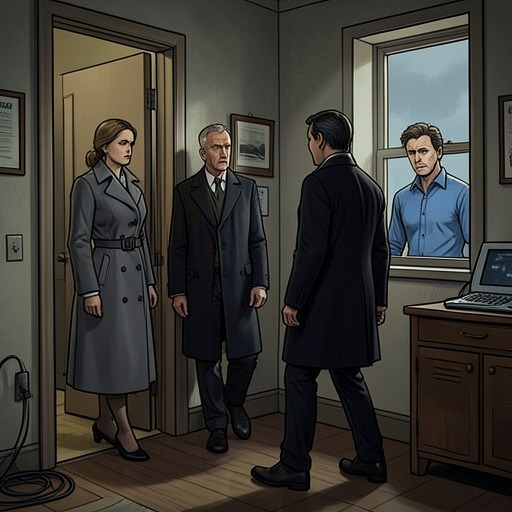
When Detective Val Norelli questions Anna about being in David’s bedroom, David characterizes her presence as snooping. Anna answers that he took the box cutter from her. David disputes that account, saying she gave it to him, then explains that he had it in his pocket and returned it to its original place after going to the bathroom. Anna’s reply distinguishes returning the tool from telling her he had done so. Their disagreement turns on a small but consequential difference: whether the cutter was lent, taken, or simply put back without explanation.
In a later confrontation, Alistair Russell attacks Anna. She swings the box cutter toward his side but misses, and it falls to the floor; Alistair steps on it. The attempted use does not stop him. The scene changes the cutter from an object Anna is trying to interpret into one she tries to use, while its fall removes it from her reach at the moment she needs protection.
Afterward, as Anna clears broken glass from the floor, she handles the box cutter at the kitchen table and listens to its blade slide in and out. Looking toward the Russell house, she wonders where its occupants are and imagines that a better-aimed, harder swing might have cut Alistair. The reflection keeps the failed attempt present: the tool is no longer merely a clue about another person’s actions but a reminder of Anna’s own response and of what she wishes she had managed to do.
Role in the Final Crisis
During a later emergency, Anna identifies the unsheathed box cutter on the kitchen table as one of the things she needs to reach, alongside glass slivers in the recycling bin, the intercom, and the doors. The evidence does not establish that she succeeds in reaching or using it in that moment. Its place among these items nevertheless gives it a practical role: it belongs to a set of possible resources as Anna considers how to respond and whether she can get outside.
Across these appearances, the box cutter shifts from borrowed household equipment to a disputed clue, a failed defensive instrument, and a possible option in a crisis. Its repeated return to view does not resolve Anna’s suspicions; instead, the object makes uncertainty material. The blade can be located and handled, but neither its presence nor its movement supplies a complete account of what happened.