Chess as a metaphor for reasoning
The Woman in the WindowChess as a metaphor for reasoning links a real encounter between Anna Fox and Jane Russell to Anna’s later effort to investigate what happened to Jane. The game gives Anna a vocabulary of positions, moves, and strategy when she feels unable to act physically. Yet its promise of orderly deduction is unstable: Anna’s clues are incomplete, her recollections uncertain, and her own proposed explanations remain questions rather than established facts.
A Game and a Confession
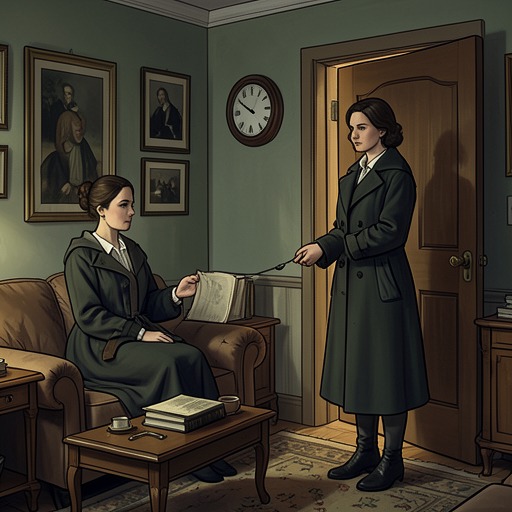
Chess first enters this thread of the story as something Anna and Jane actually play. When Alistair Russell says he had been looking for his son, not his wife, and recalls Anna saying that nobody had visited, Anna admits she lied: Jane sat at her table and they played chess. The confession makes the game more than a private pastime. It confirms contact between the women that Anna had denied, and it changes the account Alistair and Val Norelli are hearing about Jane’s visits. Anna’s looking helplessly toward Val Norelli underscores the difficulty of explaining herself once the missing visit has become part of the inquiry.
That earlier game also gives later chess imagery a particular personal charge. Anna does not invoke an abstract puzzle: she remembers Jane across the table, and she remembers claiming Jane’s white queen. When she later studies a chessboard on her computer, that piece calls up the image of Jane in a white blouse marked by blood. The association turns a familiar game object into a reminder of Jane and of the crisis Anna is trying to understand. The queen belongs both to the remembered game and to the mental picture through which Anna approaches the mystery.
The Board as Method
Anna explicitly treats chess as a discipline for thought when she feels unable to move. After the appearance of a woman in Jane’s kitchen jolts her and sends her out of the study, she settles in the library and watches the clock approach noon. She notes that she has not had a drink that day, then insists that physical immobility does not prevent her from thinking. In her formulation, the situation is a chessboard: she knows the game, and the next task is to concentrate and move mentally.
The metaphor gives her a procedure. A board presents a bounded arrangement; a move must respond to the positions already there. Anna tries to apply that logic to the people and incidents around her, asking what sequence could connect them rather than settling immediately on one explanation. The game’s structure is especially appealing in a moment when her own house has acquired forbidden zones and her capacity to go out is restricted. Thought can still travel across the board even when she cannot readily cross the room or leave home. This is not proof that reasoning will solve the problem, but it explains why she turns to chess as a usable form of agency.
Pieces, Clues, and Missing Information
The investigation does not provide Anna with a complete position. She reconsiders what David said about never meeting Jane and notices that Jane never told her about meeting David. She then asks herself when David borrowed the box cutter, whether it was the day she heard Jane scream, and whether he threatened Jane or did more. These possibilities are presented as questions in Anna’s reasoning, not as conclusions the evidence has confirmed. The chess comparison clarifies both her method and its limit: she can test possible sequences, but missing information leaves crucial squares unaccounted for.
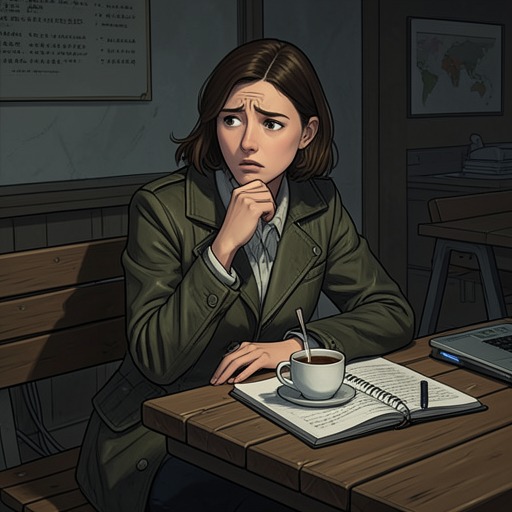
The search for information about Jane gives that problem a public dimension. At a desk with Bina, Anna scrolls through twenty-two pages of photographs associated with Jane Russell, consulting Pinterest, Instagram, Boston newspapers and websites, and a photography gallery. The extensive search produces nothing that can establish Jane’s public identity through those channels. Bina remarks on how the Internet can make some people seem not to exist. By contrast, Alistair is readily traceable through a consulting-magazine article, a LinkedIn profile, and a Dartmouth alumni newsletter. Anna’s contrast between the two searches reveals an asymmetry in what can be found: a visible record of Alistair does not supply the missing account of Jane. Like a chess player confronting a board with pieces absent or obscured, Anna has to reason from an arrangement that cannot show everything she needs to know.
Strategy Under Pressure
Chess also shapes Anna’s transition from speculation toward a plan. After finding the glass and bottle she left in Ed’s library, she brings them to her study and looks at a computer chessboard whose pieces are already positioned for battle. The image leads her back to Jane and the white queen. When she later tries to think through the case, she presents herself as a machine capable of ruthless logic, linking that self-image to her academic identity as a PhD. The metaphor helps her claim competence, but it also makes clear how much she wants a reliable method in a situation that resists certainty.
Her next move is not to announce a solution. Anna decides that someone must be able to confirm what happened, or at least clarify to whom it happened. Unable, as she sees it, to begin with Jane, she chooses Alistair because he has the deepest footprint and a history she can investigate. As she walks toward the study, the plan develops; seeing a woman in the parlor with a phone to her ear makes her flinch, but she settles at her desk and forms a script and strategy. Chess therefore marks a shift from passive, circling uncertainty to an attempt at purposeful inquiry. The novel does not make the metaphor a guarantee of mastery: a planned move is still only a move, and the board remains incomplete. Its significance lies in Anna’s effort to think and act within that incompleteness.