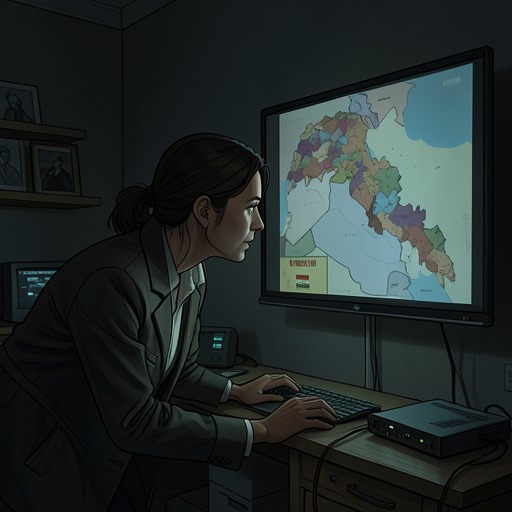
Classic films as a framework for understanding reality
The Woman in the WindowClassic films as a framework for understanding reality is both a personal history and a way of organizing what Anna Fox sees. Thrillers and noir connect her early life to her relationship with Ed, structure her solitary routines, and supply images that overlap with her view of the Russell house. Yet the films do not make that view complete: when Anna watches a scene unfold through a window, the familiar screen language sharpens the moment while leaving its cause partly hidden.
Inherited film vocabulary
Anna Fox traces her attachment to old thrillers and classic noir to her mother, who introduced them to her in childhood. As a teenager, she preferred the company of Gene Tierney and Jimmy Stewart to that of her classmates. Films thus appear in her account not simply as entertainment but as early companions and a lasting vocabulary for thinking about suspense, danger, and people’s hidden motives.
That vocabulary also shapes her first meeting with Ed. They met at an art-house screening of The 39 Steps and compared their histories: Anna Fox spoke about the films she had grown up with, while Ed had never seen a black-and-white movie. He called her history sweet or sad; within two hours, their first meeting had become the beginning of a romantic relationship. The scene establishes an early contrast between Anna Fox’s familiarity with cinematic conventions and Ed’s lack of experience with them, while making film the setting for their connection.
A shared practice and private archive
In the years before Olivia, Anna Fox and Ed watched a film together at least once a week. Their choices included Double Indemnity, Gaslight, Saboteur, and The Big Clock, among other suspense films from Anna Fox’s childhood. For her, revisiting them meant returning to old friends; for Ed, the films were new acquaintances. The same shared viewing therefore held different meanings for each partner, bringing Anna Fox’s remembered past into their life together.
Watching also led them to make lists. They ranked the Thin Man films, selected favorites from 1944, and catalogued Joseph Cotten’s strongest performances. These lists turn film appreciation into a recurring activity between them: memory and judgment become things the couple can compare, order, and revisit. Anna Fox also makes lists by herself, including one devoted to the best Hitchcock films not directed by Hitchcock. Its range—from Le Boucher and Dark Passage to Niagara, Charade, and Wait Until Dark—shows her interest in films as both a collection of styles and a storehouse of suspenseful situations.
Her list reaches beyond the older films associated with her childhood. The Vanishing appeals through its startling ending, while Frantic is described as an homage to Hitchcock; Side Effects interests her because it shifts from a story about the pharmaceutical industry into another genre. Her attention is alert to changes in tone and to the way a film can lead its viewer toward one expectation before moving elsewhere. That habit of noticing shifts becomes especially significant when she later tries to read events outside the screen.
Films in solitary life and online connection
Film viewing continues after Anna Fox’s former patients are no longer part of her working life. Following a visit from Ethan, she watches Laura again, responding to the film despite its performances and returning to its music. Later, she visits a film website and reads a Pauline Kael essay about Vertigo. Andrew is online, making a list of noir films suitable for holding hands through; Anna Fox sends him a message, but he logs off five minutes later. The exchange briefly turns shared film taste into a possible social connection, while his departure leaves her thinking about how long it has been since someone held her hand.
Another viewing session centres on Rififi. Its extended heist sequence runs for half an hour without dialogue or music, relying instead on diegetic sound. Anna Fox notes that Yves had encouraged her to spend more time with French cinema, though this nearly silent sequence was presumably not what he had in mind. The episode shows her treating films with a critic’s attention to form—sound, silence, and duration—not only as stories. At the same time, watching is part of the repeated domestic routine through which she passes her hours.
The screen and the Russell house
The most consequential overlap between cinema and observation occurs while Anna Fox watches Dark Passage and looks toward the Russell house. On the television, Lauren Bacall appears in a scene involving a character played by Humphrey Bogart, a surgery sequence, and the repeated appeal “Let me in.” The film supplies an audible pattern just as Anna Fox notices Jane in her living room. Jane is standing and shouting, but the wall of the house blocks Anna Fox’s view of the rest of the room; she cannot tell who Jane is addressing.
Anna Fox rises, takes her camera to the window, and brings Jane into focus. Through the lens, Jane’s face and locket become clearer. Jane points into the room and repeats a gesture associated with the film’s question about light; then she moves out of sight. The parallel between the screen and the window is concrete: Anna Fox moves between the film’s voices and Jane’s silent-looking gestures, and the camera improves the image without revealing the room beyond Jane. Cinema gives the scene a frame of reference, but not the missing information.
That limitation is central to the concept. Anna Fox’s film knowledge helps her identify echoes, shifts, and suspenseful arrangements, while her camera lets her inspect details from a distance. Neither medium, however, grants her a complete account of what is happening. The films are therefore more than a pastime or a shared marital ritual: they shape how she attends to reality, even as the novel’s screen-and-window parallels keep observation distinct from certainty.