David Winters
The Woman in the WindowDavid Winters is the tenant in the basement of Anna Fox’s home and eventually becomes intimately involved with her. His appearances are defined by that downstairs space and by brief, revealing exchanges: he says he worked for Alistair Russell without knowing Russell’s wife, checks whether Anna is all right and mixing medication with alcohol, and challenges police officers who arrive at the house. These fragments give him a place in Anna’s private life while leaving much of his own background unstated.
Identity and Introduction
David lives in the basement apartment of Anna Fox’s home. Anna recalls that two months have passed since she last visited the apartment, when David first arrived for a tour. She showed him its living area, narrow sleeping alcove, chrome-and-walnut kitchenette, and bathroom. His initial inspection is concise: he scans the rooms with dark eyes and nods. The scene establishes him as a tenant entering a domestic space already marked by another household’s history.
When Anna returns, the apartment has changed little. Ed’s sofa remains where it was, and his drafting table is still there, now level. A plate sits on the table, with a plastic fork and knife crossed over it; toolboxes stand beside the outside door. The borrowed box cutter is on the top toolbox, its exposed blade catching the overhead light, and a copy of Siddhartha rests nearby with its spine broken. These particular objects show the apartment as an occupied but sparsely altered space; the evidence does not explain what David has done with the tools or why the book is there.
The Basement and Its History
The room also preserves reminders of Anna’s family. Opposite the framed photograph of Anna and Olivia at age five, on the front steps with Anna’s arms around her daughter, the furnishings associated with Ed remain in view. David’s apartment is therefore not presented as a separate, neutral dwelling: it contains the practical traces of its current tenant alongside the belongings and image of the family life above. The contrast is visible in the room itself, without any stated explanation from David.
As Anna turns to leave, she hears a scratch at the outside door. It opens, and David is standing there, staring at her. The encounter makes the door a point of contact between Anna’s upstairs home and David’s downstairs quarters. The evidence records his sudden appearance and gaze, but gives no further account of what either of them says at that moment.
Disclosures and Relationship with Anna
In a later conversation, David explains that he worked for Alistair Russell and never met Russell’s wife; he says he did not even know Russell had a wife. When Anna points out that Russell has a son, David answers that single men can have children. He adds that he had not thought the matter through that far and asks whether that was what she wanted to know. His account is narrow and matter-of-fact: it confirms a work connection with Russell while emphasizing how little David says he knew about Russell’s family.
David also asks Anna whether she is feeling all right. When she says she is, he asks whether she is mixing her medication with alcohol. The exchange shows him attending to her condition and raises a concrete concern about the combination, but it does not establish what he knows about her medication or how often she drinks. In the broader relationship, the canonical account identifies David and Anna as becoming intimate; the scenes preserved here show the domestic proximity and personal concern around that relationship, rather than detailing its development.
Encounter with the Police
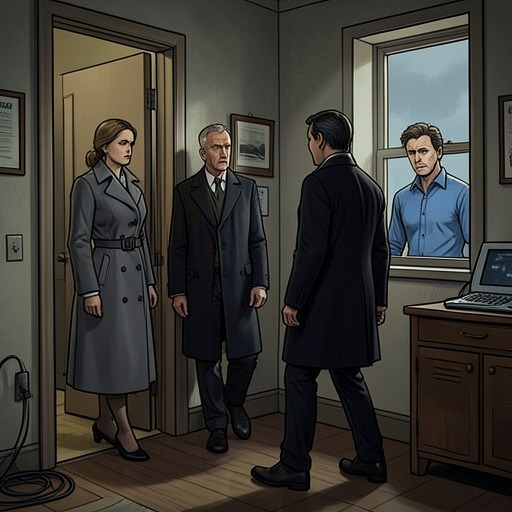
When police officers are present, Anna supplies David’s surname as Winters, retrieving it from her memory. David ignores her and asks who the visitors are. Val Norelli identifies herself as a detective and names Detective Little as her companion. David’s question puts him in direct contact with the investigation, but these lines do not establish what he knows about its subject or what role, if any, he has in the matter.
The surname exchange also offers a small but pointed reversal: Anna is the person who identifies David to the officers, while David does not acknowledge her contribution and instead addresses the strangers himself. The moment places him inside Anna’s tense encounter with authority, although the available evidence leaves his thoughts and later response unspecified.
Narrative Role
David is introduced through a tour of rooms and later reappears at the threshold, in conversation, and during a police encounter. The recurring settings make his connection to Anna tangible: the basement is close to her living space, its door opens directly into the household’s wider world, and its objects include both David’s belongings and remnants of Anna’s family. His sparse disclosures preserve uncertainty around his knowledge of the Russells, while his check on Anna’s medication and alcohol gives their relationship a specific note of concern. The evidence establishes these points without supplying a full account of his past or his perspective.