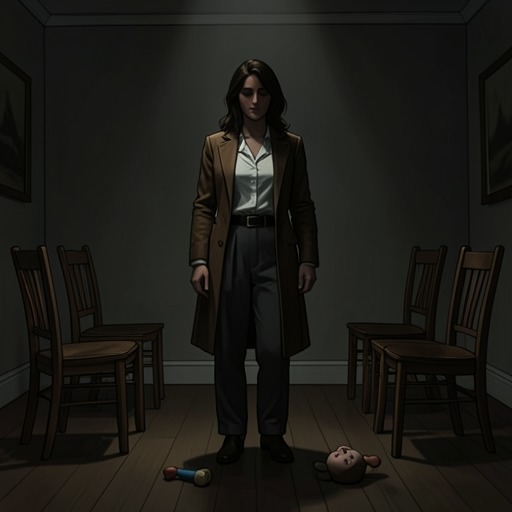
Ed and Olivia’s car accident
The Woman in the WindowAnna Fox’s car accident is the fatal event at the center of her later guilt and agoraphobia: during a fight with Ed about her affair, she drove off the road, leaving the family at the bottom of a cliff in a winter storm. Anna survived thirty-three hours outdoors, Olivia was still alive when rescuers reached them, and Ed was dead. The accident is presented not only as a catastrophe but as a memory Anna struggles to reconcile with her own responsibility and the losses that followed.
Causes and Background
The account connects the crash to a specific conflict in Anna and Ed’s marriage. In an online disclosure, Anna says she had an affair and that she and Ed were fighting about it when the car went off the road. She first describes the event as something they did together, then makes her own role unmistakable: she drove off the road. That correction matters. The accident is not framed for the reader merely as an unexplained loss of control; Anna identifies herself as the driver and places the crash within the argument about the affair.
The available account does not detail the argument, the road, or the precise mechanics of the crash. Its focus is instead on the connection Anna makes between marital conflict, her decision behind the wheel, and the deaths and injuries that followed. Her disclosure that she sees a psychiatrist to address both guilt and agoraphobia shows how the event continues to shape her life. The crash is therefore both a physical disaster and the origin of a burden she carries into the later narrative.
The Crash and Rescue
Anna remembers the aftermath through the facts later related to her by Detective Little and Dr. Julian Fielding. A state trooper found her at the bottom of a cliff. By then, she had spent two nights outside in the middle of winter, amid a snowstorm. Anna’s more exact measure of the ordeal is thirty-three hours, counted from the moment the car left the road to the moment a helicopter appeared overhead. The two descriptions convey the same prolonged exposure, while the precise duration fixes the experience as an interval she can still count.
When rescuers reached the family, Olivia was alive. Anna remembers Olivia calling her mother as she was placed on a stretcher and wrapped in a blanket. Ed, by contrast, was already dead. His body was cooling in the snow; Anna was told that internal injuries, compounded by exposure, had killed him and that nothing she could have done differently would have changed the outcome. The rescue thus brought radically different news about the two people Anna had lost or feared losing: Olivia survived, while Ed did not.
The helicopter’s arrival marks the end of the thirty-three hours outdoors, but not the end of the event’s consequences. The remembered sequence moves from the car leaving the road, to the family stranded below the cliff, to the trooper and rescue team reaching them, and finally to the discovery that Ed had died. The rescue could recover Anna and Olivia from the ravine; it could not undo the death or settle Anna’s sense of responsibility.
Loss, Guilt, and Aftermath
Anna’s recollection resists the reassurance that there was nothing more she could have done. Although she has been told that Ed’s injuries and exposure left no possibility of a different outcome, she answers that there was much she could have done differently. The distinction is central to the event’s emotional aftermath: the reported medical explanation concerns whether Ed could have been saved after the crash, while Anna’s self-reproach reaches back to the decisions and conflict that preceded it.
The accident also explains the change in Anna’s relationship with the outdoors. In the account recalled to her, her trouble going outside begins after the crash and is associated with post-traumatic stress. Her online admission likewise connects the accident with her agoraphobia and says that psychiatric treatment is intended to help her confront both that condition and her guilt. The evidence does not make recovery simple or complete; instead, it establishes the accident as the event to which these continuing difficulties are tied.
Narrative Role
The accident is disclosed through a layered recollection rather than a continuous scene of the crash itself. Anna hears the rescue account from another person, closes her eyes, and remembers Detective Little’s voice and the details of the search. Her memory supplies what the spoken account cannot soften: Olivia’s call from the stretcher, Ed’s body in the snow, and the duration of Anna’s exposure. Elsewhere, Anna’s online admission adds a crucial piece of personal responsibility, explicitly naming herself as the driver.
These forms of telling create a tension between external account and private judgment. Rescuers and medical explanations establish what happened to the family and why Ed died; Anna’s own account establishes how she connects the crash to her affair and her actions. Her continuing guilt does not alter the known outcome, but it determines how the event persists in the story: as a rescue that saved Anna and Olivia, a death that could not be reversed, and a memory against which Anna measures what she believes she should have done.