Loneliness and social isolation
The Woman in the WindowLoneliness and social isolation are not merely circumstances surrounding Anna Fox; they organize how she experiences absence, seeks company, and understands what happens beyond her windows. The novel moves between the inward presence of people she has lost and the outward fact of a life so confined that others notice it. That tension gives solitude two contrasting forms: a refuge from a frightening outside world and a barrier that can deepen grief, distort perception, and expose Anna to unwanted attention.
Housebound Life and the Outside World
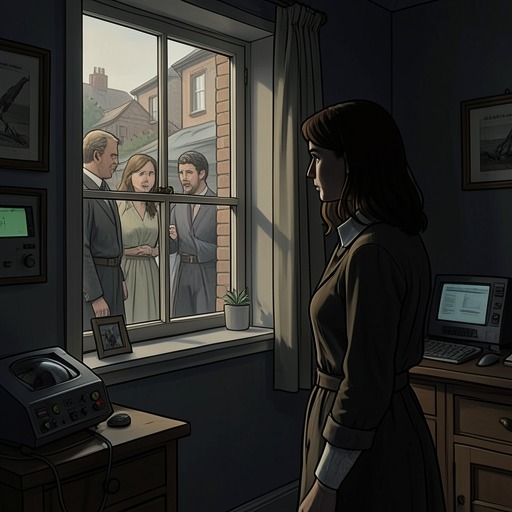
Anna’s confinement is visible to people around her. Ethan Russell tells her that a neighbor had described her as someone who stayed inside, and he says that this information interested him enough to make him seek her out. The detail turns private isolation into public knowledge: even when Anna is alone in her home, other people can observe and discuss the boundaries of her life. Ethan’s account also gives that observation a consequential edge. Her housebound routine becomes part of what attracts his attention, so the condition that separates Anna from ordinary contact also makes her a subject of someone else’s curiosity.
The novel does not present the house as a simple sanctuary. At one point Anna shuts the curtains and stands in darkness, feeling fear alongside a longing for connection. The gesture closes off the view, but it does not settle the conflict inside her. She wants protection from being seen and, at the same time, is painfully aware of being alone. The window and curtain thus mark a shifting boundary: the outside is something to fear, yet the separation from it carries its own emotional cost.
Anna’s isolation also complicates the distinction between being physically alone and being without company. She hears the voices of people whose absence overwhelms her, including people she identifies with loss and death. Those voices may answer a need to speak and may arrive when she least expects them. The experience offers a form of imagined companionship, but its source is grief rather than renewed human contact. Solitude is therefore not empty in a straightforward sense: memory fills it, while also reminding Anna of whom she has lost.
Bereavement and the Difficulty of Speaking
Anna’s grief for Ed and Olivia is especially hard to articulate. In a conversation with Wesley Brill, she begins to acknowledge that she has been having a difficult time, but the thought of her husband’s and daughter’s deaths remains something she wants to say rather than something she readily completes. When Wesley prompts her, her answer falters. The exchange shows how isolation can persist even in conversation: another person is present and asking, but the loss at the center of Anna’s distress does not become easy to express.
That difficulty matters because Anna’s other internal conversations do not remove the need to be heard by someone living. She experiences familiar voices as company when their absence hurts or when she needs someone to talk to, yet the experience remains bound to loss. The contrast is not between a lonely Anna and a fully consoling inner world. Instead, remembrance both supplies a sense of presence and renews awareness that the people she hears are absent. The recurring voices reveal how strongly she longs for connection, without suggesting that imagined contact can replace the relationships she has lost.
A separate account of an affair with Wesley Brill adds another form of distance within intimacy. Anna recalls that the relationship had lasted four months and involved lies to Phoebe and to Ed. By the time the house had been on the market for a week and a broker was arranging viewings, Anna was pleading with Ed, who struggled to look at her. She recalls having thought Wesley was the girl next door. The confession places emotional separation inside a household and a marriage, rather than locating loneliness only in physical solitude. Even closeness can coexist with concealment, regret, and the inability to face another person.
Isolation, Perception, and Exposure
Anna’s solitude also shapes how she interprets what she sees. Looking back on a night that she had understood as a killing, she recognizes an empty sitting room and a vacant sofa rather than a confirmed victim or killer. She describes her perception through the language of old thrillers, naming Rear Window, Body Double, and Blow-Up. The films offer a framework for viewing and interpreting scenes, but Anna’s retrospective account exposes the gap between what she believed she witnessed and what was present. Her isolation does not, by itself, explain that perception; the passage instead connects her loneliness and need to see with her admission that she saw what she wanted or needed to see.
This recognition changes the meaning of watching from the safety of home. The window may seem to give a solitary observer access to other lives, yet looking is not the same as knowing. Anna’s account acknowledges that she bent the facts and resisted the truth, making her solitude part of a wider uncertainty about observation and credibility. The empty room becomes significant not as proof of a murder, but as evidence of the distance between an intense experience and an accurate account of it.
Narrative Significance
The novel gives loneliness a double movement. Anna’s grief draws absent people inward, where their voices can feel like an answer; her confinement makes her outwardly noticeable to Ethan Russell and invites attention she did not seek. In both cases, solitude is connected to how others are present in her life, whether as remembered voices, a husband she struggles to face, a conversation that cannot immediately reach its subject, or a neighbor who regards her isolation as intriguing.
These episodes also resist treating isolation as a single, stable condition. Anna can long for connection while closing her curtains; she can be in conversation while struggling to name her loss; and she can watch other people while misunderstanding what she sees. The novel’s treatment of loneliness therefore links emotional deprivation to the limits of perception without equating them. Solitude heightens the importance of contact, but it does not guarantee that contact will be safe, truthful, or sufficient to overcome grief.