Marital breakdown and family loss
The Woman in the WindowMarital breakdown and family loss are intertwined in Anna Fox’s story, but the losses do not all mean the same thing: Ed has decided to separate, Olivia is no longer living with Anna, and the children Anna once treated have become former patients she follows from a distance. Across these absences, Anna’s love persists. Her efforts to say so—sometimes indirectly, sometimes with startling candor—make the separation feel less like a settled agreement than a rupture she is still trying to understand.
Separation and Its Uncertain Beginning
The separation is first given a clear starting point in retrospect: ten days earlier, Ed had decided that he and Anna should separate, and Anna had agreed in principle. The qualification matters. She admits that she did not believe the decision would become real, even after Ed summoned a broker. Her assent and her expectation were therefore not the same thing: she could agree to the proposal while still imagining it might not be carried through.
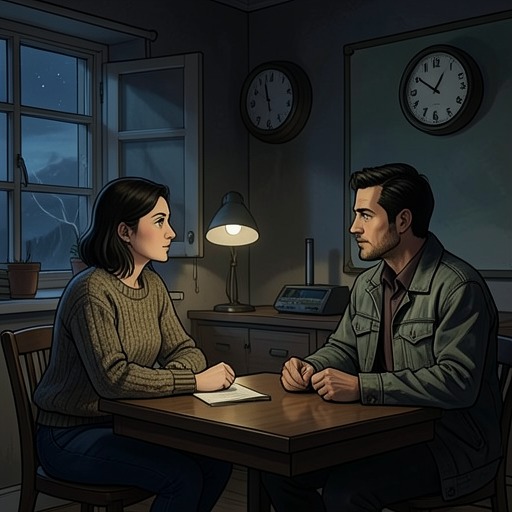
When Ed later explains the state of the marriage, he does not offer Anna a neat account of what has gone wrong. He says he cannot take the situation any longer and that, for now, he can barely look at her. The passage gives the decision its force through the pause around it: Anna looks down at ice cubes softening on the ground, and neither of them speaks or moves. The separation is a decision stated plainly, but its causes are not fully unpacked in these scenes. What is made unmistakable is its consequence: the relationship has reached a point at which Ed says continued closeness is unbearable.
Ed and Anna: Distance, Attachment, and Speech
Physical and emotional distance do not stop Anna from reaching toward Ed. In one conversation, she tells him she wishes he were there. Ed answers that she needs more time and invokes the doctors’ view that too much contact is unhealthy. His response places a boundary around their communication, while Anna’s wish exposes how little that boundary has quieted her longing. He later apologizes that he and Olivia are not there with her; Anna answers that she is sorry too. The brief exchange makes their absence mutual in feeling, even though it does not undo the separation.
In another conversation, Anna says she misses Ed, then tries to explain that the confession was unplanned. She moves from missing him to saying that she misses his heart, and then tells him that she loves him and Olivia. Her words arrive without the orderly pattern she might expect of herself; she recognizes that she cannot discern a pattern in them, only the fact that she misses and loves both. The repeated declarations do not produce a reported reconciliation. Instead, the pauses and silence that follow keep the distance present inside the conversation itself.
Anna’s manner of speaking makes the separation an ongoing experience rather than a fact she can simply file away. She often begins a call with the familiar prompt “Guess who,” but the easy ritual can lead into disclosures she had not meant to make. On one such evening, after drinking, she asks what Olivia is preparing for, then asks about her costume. The small, ordinary question carries the ache of a mother trying to remain connected to a daughter whose daily life she no longer shares.
Family Loss and the Lost Work of Care
Anna’s sense of loss extends beyond her marriage. Ten months earlier, she lost her patients when her work with them ended. She remembers nineteen children, each with particular struggles: divorce, bereavement, fear of the dark, bullying, or depression. She counts Olivia as a twentieth loss. That formulation gathers professional and family separation into one painful reckoning, while still distinguishing their circumstances: the children are former patients, and Olivia is her daughter.
The loss of her work is not presented only as a change in occupation. Anna remembers the children’s tears, troubles, anger, and relief—the emotional material of a relationship in which they had trusted her with their difficulties. She continues to search for news of former patients online, though she knows a psychologist is not supposed to investigate them. Roughly once a month, longing draws her back to the internet. Reading about their lives brings her to tears, after which she drinks wine. This pattern shows care continuing after the professional relationship has ended, but in a form that cannot restore the work or the closeness she has lost.
Memory, Silence, and What Remains
When Ed says he can barely look at her, Anna’s mind turns to an ordinary family memory rather than to their wedding or Olivia’s birth. She recalls harvesting cranberries in New Jersey: Olivia laughing in her waders, Ed with his hands full, and Anna holding their daughter’s sticky fingers among the rose-red fruit. The scene matters because its pleasure is domestic and specific. It gives the lost family life a texture beyond the bare fact of separation, and makes the present distance legible through what the three once did together.
Anna’s memory does not cancel Ed’s decision. Looking back at him, she still finds his eyes beautiful, while the ice machine thrums between them. That contrast holds the article’s central tension: tenderness survives, but tenderness alone does not reverse the breakdown. Across her calls, memories, and searches for former patients, Anna keeps naming bonds that separation has altered without erasing. Her grief is therefore not a single event with a clean ending; it recurs as a wish for Ed’s presence, concern for Olivia’s ordinary activities, and longing for the children she once cared for.