New York City
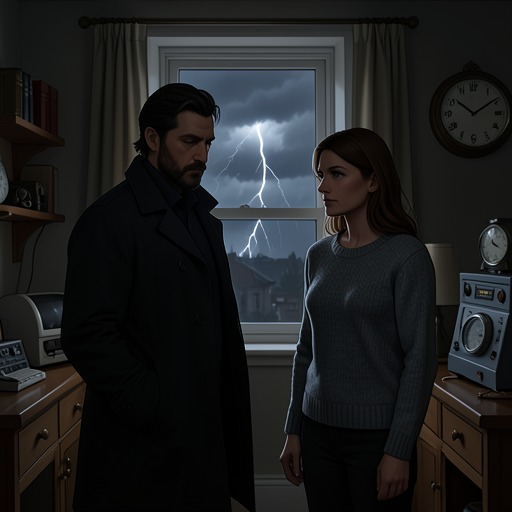
The Woman in the WindowNew York City is more than a backdrop: its tightly connected homes and shared park place private lives within sight of one another, while Anna Fox’s agoraphobia makes the open city difficult for her to reach. The contrast between her carefully observed interior and the neighborhood beyond it gives the setting its central tension. In Harlem, the Russell family’s house stands across the park from Anna’s home, so distance is short in physical terms even when it becomes consequentially difficult to cross.
Setting and Domestic Space
The city is presented through the rooms and thresholds of Anna Fox’s townhouse. Its first floor joins an open-plan kitchen and living room to a rear door leading to the garden and a side door leading to the park. White-birch floors are marked by wine stains, while the living room retains a Persian rug and the hall has a red-painted powder room. These specific domestic details make the house a lived-in place rather than an abstract refuge; its doors also establish the points where the interior meets the outdoors.
The upper floors divide domestic and individual space. The second floor contains Ed’s library, with its tightly packed, worn books, and Anna’s spare study, where a desktop computer stands on an IKEA table used for online chess. A second half-bath and a utility closet that Anna has considered turning into a darkroom complete the floor. Above them, the main bedroom and bath occupy the third floor. Anna has spent much of the year in bed, and the mattress is adjusted differently on each side: Ed’s setting is soft, while hers is firm. The layout gives the house an everyday history, including Ed’s former work and Anna’s habits, even as it becomes the bounded environment in which she spends much of her time.
The townhouse also has a basement apartment, described as a maisonette, with its own entrance, kitchen, bathroom, bedroom, and small office. Ed used it as a workspace for eight years, spreading out blueprints and posting contractor briefs; at the time described, it is rented. Above ground, the garden is a paved patio with unused chairs and a young ash tree. The account’s attention to these distinct rooms and entrances shows how the house contains several separate modes of living, work, and retreat within one address.
The City as a Boundary
For Anna, the difficulty of New York City is not simply that it contains crowds or traffic. She describes the open sky, distant horizon, exposure, and pressure of being outdoors as the sources of her fear. In her account, the clinical category of agoraphobia does not merely interrupt her ordinary life; it has come to define that life. The city’s public spaces therefore have a double meaning: they are part of the setting around her home, but they are also spaces she cannot readily inhabit.
The scale of the house intensifies that contradiction. Anna describes navigating roughly four thousand vertically arranged square feet while wondering how she could meet anyone through an application designed to connect people whose paths have crossed. The question is not whether New York City contains other people, but whether movement through it is available to someone whose routes remain confined to home. When David appears as the first profile she sees, she immediately deletes her account. The brief episode links the city’s promise of connection to the limits of her actual, housebound routine.
Anna’s online participation offers another way of locating herself in a wider world without physically moving through it. On the Agora boards, she reads accounts from other people who are housebound, compares circumstances, and responds to a user seeking support. Those exchanges place her within a dispersed community, while also sharpening the contrast between contact through a screen and access to New York’s outdoor spaces. The city is present in these passages partly as the environment beyond the home’s doors, and partly as the larger social world that remains difficult for Anna to enter.
Harlem and the Russell House
Harlem supplies the clearest neighborhood geography in the account. The Russell family has bought a large house there after a planned company transfer brought them to New York City. A colleague explains that the move took place even though the transfer itself did not: the family bought a house, and the colleague found it online. Later, Ethan Russell tells Anna that Katie learned of the move by reading about his father’s transfer and followed the family to New York. The city is thus a destination chosen by the family and also a place Katie reaches by tracking their movements.
The Russell house is situated across the park from Anna’s. From her point of view, the park and the two homes create a visible neighborhood landscape: the family’s windows are within her field of observation, and she has seen domestic activity inside their house. The arrangement makes watching possible without making the private lives behind those windows fully knowable. When Anna hears Ed’s concern about David, Ed advises her to contact the police because David has a record, while cautioning that this does not establish his involvement in the events troubling her. The exchange brings the city’s ordinary residential proximity together with the uncertainty of what a neighbor can know about another person.
The Russell house later becomes empty. After the police have arrived and emergency medical workers have removed Ethan’s body, Detective Little visits Anna and tells her that Alistair Russell has been arrested and charged as an accessory to murder. He has confessed, and the account he gave matches Ethan’s description. The house’s vacancy changes its meaning: the home once observed across the park is no longer a scene of family life but the remaining address of a family broken by the events revealed in the investigation.
The Park, Neighbors, and Aftermath
Snow makes the shared space between the homes newly visible. After fourteen inches fall on the city, Anna watches from her bedroom window as the street becomes white and neighbors emerge. The Gray family moves together through the snow and out of sight; Sue, a neighbor whose real name Anna learns from Detective Little, stands on her stoop with a mug before her husband embraces her and kisses her cheek. These brief observations show the park and street as communal spaces where other people’s routines continue in public view.
Across the road, the park lies under the snow, and the Russell house stands beyond it with its windows shut. Newspapers have sensationalized the property as a four-million-dollar house, although Anna knows the figure is closer to $3.45 million. That correction anchors the spectacle in the concrete neighborhood she has watched from indoors, while the now-empty house marks the consequences of the family’s story. New York City’s significance rests in this juxtaposition: the same short distances that permit observation also hold private histories, misread appearances, and losses that only become clear over time.