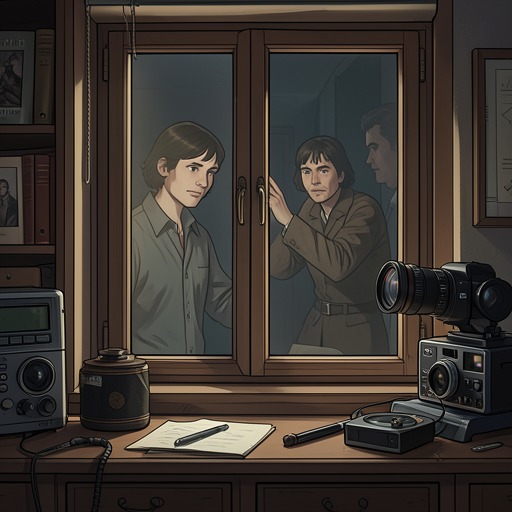
Nikon D5500
The Woman in the WindowAnna Fox’s Nikon D5500 is the chief instrument through which she watches life beyond her window, turning distant neighbors into sharply observed images and those images into an accumulating private archive. Its zoom offers reach and apparent control, yet the camera’s most consequential use is also its limit: it lets Anna see Jane Russell in danger, but does not overcome the distance between looking and acting.
Optical Reach and Everyday Use
The camera’s power in Anna’s hands comes from its zoom lens. While watching a neighbor’s husband walk toward his house, she first focuses on his polished shoes, then raises the camera to examine his face. The Nikon D5500, fitted with an Opteka lens, allows details at a distance to become legible. The act is selective as well as technical: Anna says she looks away when her lens frames the woman’s body, because her interest lies instead in the life she leads. The camera therefore does not merely extend sight; it gives Anna a way to direct and delimit it.
That reach makes watching feel almost effortless. Anna describes the zoom as superior to binoculars, and when she hears screams from the Russells’ home, she turns the camera from window to window, searching the neighboring house. It is an instrument of pursuit: the movement of the lens follows her attention as she tries to establish what has happened. Her camera can bring distant activity closer, but it cannot show everything. At one point, the wall of the house blocks her view of the room where Jane is shouting, leaving the scene partly hidden even as Anna listens and watches.
Surveillance and the Image Archive
Before the Russells arrive, Anna’s camera has supported a sustained practice of watching without being noticed. She recalls photographing residents, strangers, passing cabs, passersby, and the postman, whom she used to photograph at every door. For months, she revisited those pictures, reliving moments from a world she could no longer keep up with beyond the window. The photographs make observation repeatable: events that have passed can be inspected again, while the people in them remain unaware of the record.
Anna’s archive includes both small gestures and private crises. She remembers a boy playing cello with his eyes closed and fingers trembling, neighbors raising wineglasses in celebration, a woman lighting candles on a cake, and a young couple arguing from opposite ends of a room with a broken vase between them. These images differ in mood, but they share the same unequal arrangement: Anna can watch people in moments they have not chosen to share with her. Her hard drive, swollen with stolen images, makes that private habit materially present. The camera’s photographs do not disappear when the view changes; they gather into an archive that preserves the intimacy of looking while exposing the ethical cost of doing so.
The Camera as an Object in the Room
That arrangement changes when Jane Russell discovers Anna photographing her. Anna has previously felt unseen by the people she watches; now Jane’s direct, unblinking look makes Anna confront the possibility that the watcher can also be watched. Anna thinks of the images she has taken and of the hard drive that stores them, and interprets the moment as a discovery that she is not invisible. The camera’s presence is no longer simply an extension of her sight. It belongs to a relationship between two people, and Jane’s awareness turns Anna’s private practice into a source of shame.
Anna reacts by fleeing the room, leaving the camera to tumble to the floor. When she returns several minutes later, she picks it up carefully and finds it undamaged. The detail is important to the object’s role: the camera survives the abrupt movement, while Anna’s confidence in her position as an unnoticed observer does not. It remains ready to use, but its apparent neutrality has been unsettled. The device that once seemed to place Anna outside the lives she watched has become part of the exposure she feels under Jane’s gaze.
Witnessing Jane’s Stabbing
During the later crisis, the Nikon D5500 becomes the means by which Anna sees Jane’s stabbing at The Russells’ house at 207. When a commotion draws her attention, Anna finds the camera on the kitchen counter, picks it up, and moves to the window. The image first appears blurred; she adjusts the lens until Jane comes into clear focus. Anna can distinguish Jane’s locket and follow her gestures, though part of the house remains beyond her view.
Jane then reappears moving unsteadily, and Anna recognizes that she has been stabbed. Jane points toward the window, making Anna the person she is trying to reach. The camera has converted a distant, partially obscured scene into something unmistakable, but it has not brought Anna physically to Jane. Anna drops it; its strap catches in her fingers as it falls along her leg. Jane presses her hand against the window and collapses, leaving a smear of blood on the glass. The camera has enabled recognition at the critical instant, while the window and the distance beyond it remain obstacles to rescue.
Narrative Significance
Across these episodes, the Nikon D5500 shifts from a tool that appears to grant mastery over distance into an object implicated in Anna’s exposure and helplessness. Its zoom makes unnoticed lives available for inspection, and its photographs let Anna return to scenes after they have passed. Yet neither optical clarity nor stored images can make her an unobtrusive, consequence-free observer: Jane sees her, and Anna becomes ashamed of the archive she has built.
The crisis sharpens the distinction between seeing and intervening. The camera lets Anna identify Jane’s peril in time to understand it, but it cannot erase the physical separation between the two women. When Anna drops it, the instrument’s usefulness is interrupted at precisely the moment its evidence matters most. The Nikon D5500 is therefore more than a recurring prop: it organizes the story’s movement between observation, recognition, and action, while revealing that a clearer view does not necessarily provide control over what happens next.