Post-traumatic stress disorder
The Woman in the WindowPost-traumatic stress disorder is one part of Anna Fox’s lived experience of prolonged confinement and difficult efforts to go outdoors. The evidence does not offer a clinical account of the disorder; instead, it shows how Anna names its force, relies on small, structured steps, and uses her experience to encourage another person facing a hard day.
Experience and Duration
In an online exchange, Anna describes PTSD as formidable while insisting that she remains tough. Elsewhere, she measures her confinement in two ways: she reflects that she has not left the house in nearly a year, and later tells GrannyLizzie that she has been housebound for ten months. These statements convey the extended nature of her isolation without reducing it to a single, fixed measure.
The account also makes clear that being housebound is not absolute at every point. Anna says she has managed to go outside into the garden five times in eight weeks. The narrow setting and limited frequency give concrete measure to the difficulty: these outings are significant efforts, not a return to ordinary freedom of movement.
The Garden and the Umbrella
Dr. Julian Fielding stands in the garden while Anna pushes open the door. Her aid is Ed’s umbrella, a rickety London Fog model that she opens and studies closely: its dark tartan canopy has four black squares and four white lines in each repeated pattern. She uses the visual pattern to organize her breathing, inhaling and counting to four, then exhaling and counting to four. The repeated count makes the umbrella part of a deliberate coping routine rather than merely protection from weather.
The umbrella points ahead of her like a saber or shield. Anna’s progress culminates in the small but consequential act of stepping outside. The scene presents courage as measured movement through a frightening threshold, supported by a clinician’s presence and a repeatable focus for attention.
Support and Shared Experience
Anna’s online contacts provide another setting in which the condition is acknowledged. When Sally4th checks on her progress, Anna answers that PTSD is difficult but that she is tough; the exchange meets the challenge with encouragement rather than denying it. The support is reciprocal and ordinary in form: a check-in, an honest response, and reassurance from another participant.
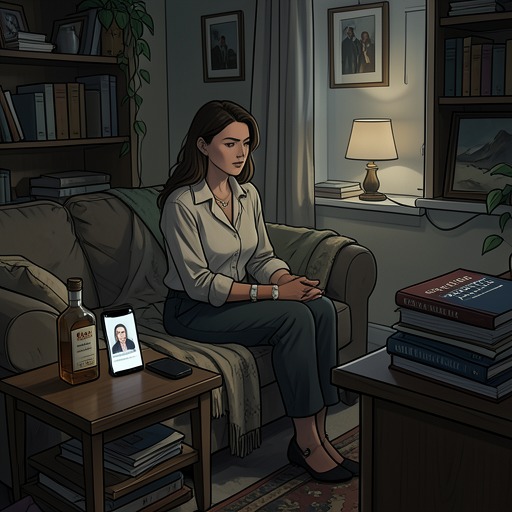
Anna later applies that same hard-won perspective to GrannyLizzie, who admits that the day has been difficult and fears being a freak. After sipping wine, Anna responds emphatically that GrannyLizzie is a victim of circumstance, not a freak, and describes her as tough, resourceful, and brave for asking for help. She also reminds her that her sons should be proud of her and that she can be proud of herself. Anna acknowledges that the message is imperfectly typed, but insists on the truth of its words. The exchange shows her experience serving as testimony: her own months of confinement let her answer stigma with recognition and solidarity.