Small park between the two houses
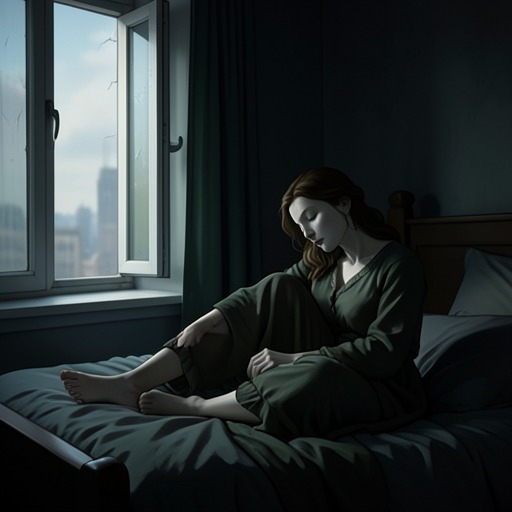
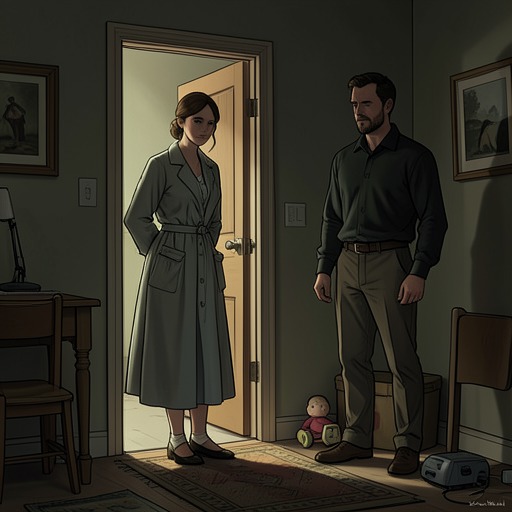
The Woman in the WindowThe Small park between the two houses is a compact Harlem space whose everyday position between Anna Fox’s home and the Russells’ house at 207 becomes crucial during Anna’s attempt to reach Jane Russell. Its low fence, narrow path, and apparent nearness make it seem like a simple link between two streets; in the crisis, that same open ground becomes an exposed barrier Anna must cross on foot.
Setting and Layout
Anna describes the park as tiny, occupying two lots across and two lots deep. A narrow brick path runs through it, connecting her street with the one directly north, while a sycamore stands at either end and a low iron fence hems in both sides. The details give the space an orderly, almost quaint appearance: a small passage between blocks, bounded but not enclosed, with trees marking its limits.
The park sits directly west of Anna’s home. Beyond it stands number 207, whose former owners, the Lords, had sold the house and left two months before the Russell family moved in. The spatial arrangement therefore organizes Anna’s first view of her new neighbors: from her own window, she sees a man, a woman, and a tall boy carrying boxes toward their front door. The family appears first as silhouettes across the park, before Anna knows them as Alistair Russell, Jane Russell, and their son, Ethan Russell.
The first view is set at night, when the street has no sodium lamps and the moon provides the only light Anna describes. Even at this distance, she identifies the boy as a teenager. The park is not yet a place she has entered; it is a strip of ground across which she watches a household arrive, turning the small green space into part of her private map of the neighbors.
A Nearness That Does Not Guarantee Access
The park’s position makes the houses look close, but the route between them is not as direct as Anna initially imagines. During the later emergency, she stands at her door and measures the street as a deep, broad canyon, too exposed to cross. Jane is only steps away, across the park, and Anna repeats the direction to herself as she tries to overcome her fear and leave the house.
Anna’s own side door opens directly onto the park, but it has been locked for almost a year. A recycling bin blocks it, with bottle necks protruding from its opening. This accumulated domestic obstruction matters when Anna turns toward the kitchen and discovers the door: the park has long been visible and physically adjacent, yet her household has been arranged to prevent passage into it. The blocked entrance makes the boundary between indoors and outdoors concrete rather than abstract.
The apparent shortcut also proves misleading. Once Anna has crossed into the park, she realizes that the Russell house has no door opening onto it; entry is possible only from the street. Her destination is therefore not accessible from the side she has chosen. The park connects the two properties visually and links the streets by its path, but it does not provide a private entrance to the Russells’ home. That practical fact arrives only after Anna has committed herself to the crossing.
The Emergency Crossing
Anna enters the park carrying the Umbrella, attempting to reach the woman she has met only twice. As she moves across the open ground, she recalls a girl who had grown unusually affectionate toward strangers and wonders what became of her and her family. The memory accompanies Anna’s decision to act: she thinks of the girl’s warmth toward the unknown while crossing the park to help Jane Russell.
The crossing is interrupted when the Umbrella’s tip catches between the planks of a bench. As Anna gently frees it, she remembers that the Russells’ house cannot be entered from the park. The snag turns an ordinary object into an obstacle at the moment her mistaken plan becomes clear. She is in the middle of the park, with no direct entrance to her destination, and Jane has been stabbed.
Anna experiences the park’s scale differently from her earlier description of a tiny, quaint space. In the emergency it becomes a quarter-acre of exposed ground, with only the Umbrella’s nylon and cotton between her and the night. She counts to four and urges herself upward as her knees slacken. The path that once connected streets now measures the distance between the impulse to help and the physical difficulty of moving through open space.
Narrative Significance
The park changes from a setting for observation into a test of action. At first, Anna watches the Russell family bring boxes into number 207 from the safety of her home; later, she must leave that protected position and cross the same intervening ground. The early view establishes proximity without intimacy, while the rescue attempt makes proximity a demand: Jane is close enough to seem reachable, but fear, exposure, and the absence of a park-side entrance complicate that apparent closeness.
Its smallness is part of the contrast. The park is physically modest, bounded by low fencing and marked by a narrow path, yet Anna’s experience expands it into a dangerous open space. The shift does not require the park itself to change. Instead, the place is reframed by Anna’s condition and purpose: as a watcher, she can survey it from indoors; as a would-be rescuer, she must cross it without the protection of a wall or a direct route into the house.
The park consequently serves as a threshold between enclosure and exposure, but not as an easy passage out of isolation. Its path joins the streets, while its layout withholds the direct access Anna needs. In the stabbing crisis, the gap between the houses is both short enough to make rescue imaginable and open enough to make the attempt frightening. The location gives that contradiction a physical form.