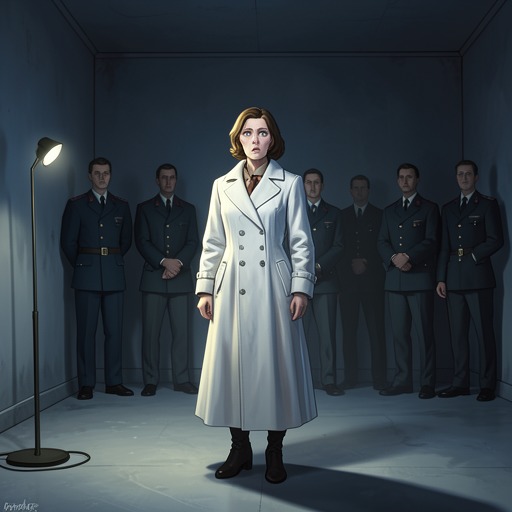
Someone secretly photographs Anna asleep and sends her the picture
The Woman in the WindowSomeone secretly photographs Anna asleep and sends her the picture is a turning point in Anna Fox’s perception of danger inside her home. An email apparently from Jane Russell, paired with a photograph timestamped 2:02 a.m., seems to prove that an intruder entered Anna’s bedroom and watched her sleep. Yet the picture’s apparent certainty does not settle what happened: the police challenge its origin, and Anna’s later recollections raise the possibility that the image and other encounters were part of her own unreliable experience.
The message and the photograph
At 12:12, Anna checks her inbox after waiting for a call from Wesley Brill. The inbox contains one new message, with no subject line and Jane Russell’s name displayed as the sender. Anna’s teeth strike the rim of her wineglass; her hand shakes as she sets it down. The message itself is blank except for an attachment, and opening it first leaves the screen black before a grainy image loads in bands.
The picture resolves into a face lying on its side, then into Anna herself: eyes closed, mouth slightly open, cheek pressed into a pillow, a strand of hair across her brow. She bolts upright, knocking over her chair. The photograph’s timestamp reads 2:02 a.m. that same morning. Its presence in a message from Jane leads Anna to conclude that Jane has been inside her house and bedroom and has watched her sleep. The attached image is not merely a claim about surveillance; to Anna, it is physical evidence that makes an otherwise unseen intrusion seem undeniable.
The sender address, guesswhoanna@gmail.com, adds a personal, taunting quality to the message. But it does not identify who created or sent the photograph. Anna’s first interpretation fills in that gap: she treats the sender name as confirmation that Jane is responsible and the timestamp as proof of a nighttime visit. The distinction between what the screen shows and what Anna infers from it becomes crucial as the incident is investigated.
Reporting the intrusion
Anna calls Detective Little and tells him that someone has been in her house. She is in the kitchen, holding the phone in one hand and her wineglass in the other, looking toward the basement door. As she says the words aloud, they sound to her flat and unreal. When Detective Little asks how she could know someone entered while she was asleep, Anna explains that the person took a picture and emailed it to her; when he asks what it shows, she says it shows her sleeping.
When Detective Little and Detective Val Norelli arrive, Ethan Russell is also present. Detective Little recalls Anna’s report that someone had been in the house. He searches the home, including the closet, and then summarizes the problem: someone appears to have come in by an unknown means, taken a picture of Anna, and taken nothing else. Anna confirms the account and points again to the phone, treating the image as the answer to the questions that the physical search cannot resolve.
The lack of other apparent losses sharpens the uncertainty rather than removing it. The photograph supports Anna’s claim that she was asleep in the image, but it does not show how the photographer entered, establish who took it, or explain why nothing else was taken. The investigation therefore turns from the fact of the image to the reliability of its provenance.
The police challenge the image
Detective Val Norelli explains that a Gmail account cannot be traced in a way that establishes who sent the message. She raises the possibility that Anna herself sent it from her phone, a suggestion Anna meets with disbelief. Norelli describes the picture as looking like a midnight selfie. Anna objects that she is asleep; Norelli points to the closed eyes visible in the photograph. That detail establishes Anna’s appearance in the image but cannot, by itself, prove that another person took it.
The exchange changes the meaning of the same piece of evidence. For Anna, the sleeping face demonstrates a violation of her privacy; for the detectives, the untraceable account and the absence of a verifiable sender leave open the possibility of self-staging. Their suggestion does not prove that Anna made the image, and the episode does not immediately resolve the question. Instead, it places Anna’s confidence in tension with the limits of what the photograph can establish.
Retrospective doubt
Later, Detective Little questions other parts of Anna’s account, including whether the woman she remembers as Jane helped her into the house and visited to play chess and draw. Anna begins to picture herself dragging herself up the front steps and into the hall. She also recalls bottles, pill canisters, chess pieces, and her ink-stained hands hovering over the board. In another image from this period, she remembers practicing Jane’s name on the shower door, where the letters ran down the glass and disappeared. These recollections make the presumed visits—and consequently Anna’s original certainty about Jane’s involvement—less secure.
Anna considers whether she acted out the photograph episode as a way of asking for help. The email’s guess-who address takes on a different significance when she connects it to the greeting she used with Ed and Olivia. This is a possibility she recognizes, not a confirmed account of how the picture was made. The narrative leaves a gap between the initial conviction that Jane entered the bedroom and Anna’s later suspicion that she herself may have produced or misinterpreted evidence.
Anna also replays the first exchange with the woman she knew as Jane. She recalls that the woman said she was heading next door, after which Anna supplied the identification, telling her that she was Jane Russell. The remembered scene suggests that Anna may have assigned the name rather than learned it from the woman. A separate sunset photograph taken from Anna’s kitchen window contains the woman’s reflection in the glass, dated almost two weeks earlier. That image gives Anna a concrete visual record of the woman’s presence, but it does not establish her identity or explain the sleeping photograph.
Narrative significance
The episode turns looking into a source of both apparent knowledge and doubt. Anna sees herself in the attachment with exceptional intimacy, yet cannot see the photographer or the circumstances behind the camera. The timestamp, sender name, and image invite a coherent explanation of intrusion; the police’s questions expose how much of that explanation rests on assumptions beyond the pixels themselves.
The later recollections do not simply erase the threat. They make the event harder to classify: a genuine photograph and a genuine woman can coexist with mistaken identification, uncertain memory, or an image Anna may have created herself. By making the reader revise an apparent piece of proof alongside Anna, the episode establishes the novel’s recurring uncertainty over whether danger has been witnessed, inferred, remembered, or imagined.