Surveillance and voyeurism
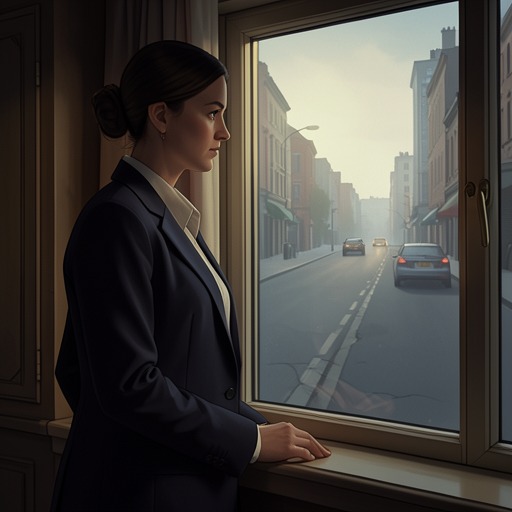
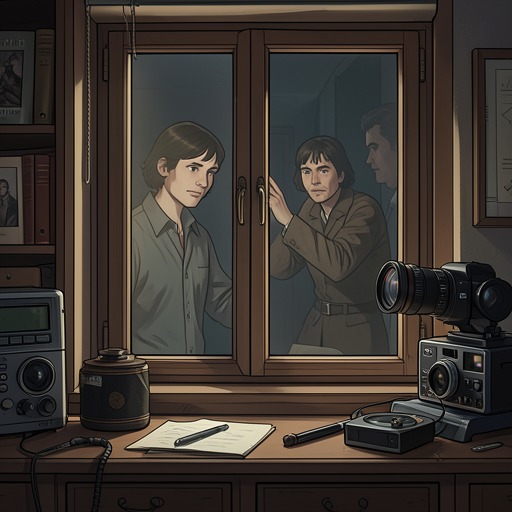
The Woman in the WindowSurveillance and voyeurism in the novel are reciprocal rather than safely one-sided: Anna Fox uses her camera and windows to observe a neighboring house, only to find her own privacy exposed and her interpretations called into question. Watching begins as an attempt to make sense of what happens across the park, but gradually unsettles the boundary between observer and observed.
Watching Across the Park
With the blinds up across the park, Anna studies the neighboring house through her gaze and camera, scanning its windows and the parlor. She finds the room spotless, with a love seat and lamps, then photographs a man as he approaches and enters. She has no plan and does not expect him to confess; watching is itself the action she can take. The camera lets her follow his movements from the doorway to the kitchen, turning a private interior into a sequence of glimpses. Yet the images do not give her the certainty she seeks: they show a person entering and moving through rooms, not what those actions mean.
The watching reverses when a woman appears at the parlor window with a phone to her ear and looks directly toward Anna. Anna retreats from her seat, still holding the camera, while the woman maintains her gaze. The scene makes the window more than a viewing point: it is also a surface across which the watcher can be seen. Later, in a coffee shop, the woman confronts Anna over watching and following her, making explicit the intrusion that Anna’s distant observations had left at the edge of her awareness. Anna’s surveillance is therefore not presented as detached observation; it crosses into another person’s sense of privacy and becomes a source of conflict.
The Watched Subject and Unstable Evidence
The camera’s direction eventually turns inward. Anna encounters an image of her own sleeping face, a photograph that makes her private, unguarded self into an object of someone else’s observation. Her reaction is immediate: she rises so abruptly that her chair falls. The image changes the meaning of her earlier surveillance. The camera had seemed to offer a controlled view into another household; now its evidence establishes that the boundary around Anna’s own private life has also been crossed.
As Anna replays events, looking and remembering become difficult to separate. She pictures herself dragging herself into the house and recalls bottles, pill canisters, chess pieces, and a signature practiced on the shower door. These scenes lead her to question whether some encounters she attributed to another person may instead have been imagined or enacted by herself. The uncertainty does not simply erase what she saw: it makes the source and meaning of each image part of the problem. Her mind, like her camera, can replay a scene, but replay alone cannot certify its interpretation.
That doubt reaches back to her first meeting with the woman she knew as Jane. Reconstructing the conversation, Anna recognizes that she may have supplied the name herself after hearing the woman say she was headed next door. The correction exposes a crucial limit in her gaze: observation is already shaped by expectation, and a mistaken identification can organize everything that follows. Yet a later sunset photograph preserves the woman’s reflection in the window, with a timestamp indicating it was taken almost two weeks earlier. The image complicates rather than settles Anna’s uncertainty, keeping the woman present in the photographic record while leaving the identity Anna assigned her in question.
Cinema and the Gaze
Anna’s way of seeing is shaped by the thrillers she knows. When she tries to account for what she witnessed, she recognizes the scene through Rear Window, Body Double, and Blow-Up: familiar stories of looking become a ready-made grammar for interpreting ambiguous images. That framework gives her suspicions a coherent, cinematic shape, but it also risks making events conform to a genre before their meaning is established. The tension is not simply between truth and falsehood; it is between what an image shows and the story Anna’s trained gaze builds around it.
The novel gives that tension a formal counterpart in Anna’s mental editing. She rewinds conversations, switches between memories, and runs through the week in reverse, moving from visitors and investigations back toward the moment the woman she knew as Jane faced her. These rapid cuts make recollection resemble surveillance footage, assembled from fragments and replayed for clues. Yet the sequence offers no neutral vantage point: each return is guided by what Anna now suspects, so replay can expose an earlier assumption without automatically resolving every uncertainty.
From Looking to Contact
The exchange across the park becomes more than a contest of sight when the woman calls Anna Fox. Anna wonders how she obtained Anna’s number, then recognizes the parallel: Anna had found the woman’s number through directory assistance. In Anna’s imagination, the woman has asked to be connected and spoken her name, crossing the distance between houses by a route much like Anna’s own. Surveillance thus extends beyond the camera and the window into the ordinary systems that make private people reachable. The unsettling symmetry does not make their actions identical, but it reveals how easily watching can become an intrusion—and how the watcher may experience that same intrusion as a threat when attention turns back toward her.