The Russells’ house at 207
The Woman in the WindowThe Russells’ house at 207 is the home across the park that Anna Fox first notices when new neighbors arrive. Initially seen from a distance, it later becomes the scene of an emergency that Anna witnesses through her window. The address therefore changes in narrative importance: it begins as a point in the neighborhood and becomes the focus of Anna’s uncertain, limited view of events and her effort to understand whether someone inside needs help.
Location and Introduction
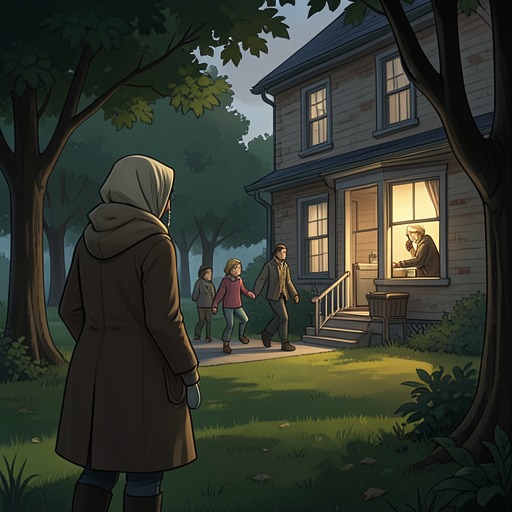
Anna identifies the house by its number and position: it is across the park, at 207. The first glimpse comes as a car passes slowly through the dark and stops there. From Anna’s perspective, the people arriving are indistinct figures unloading boxes from the trunk. The small amount of visible activity establishes 207 as a new presence in her immediate surroundings, while the park marks the space separating it from her own home.
When Anna later clarifies which neighbors she means, she distinguishes them from the Millers at 212 and again points to 207 across the park. The exchange places the house within a small, legible neighborhood map: house numbers identify residents, and the park serves as the intervening space. Anna notices that the newcomers have brought little beyond a car, a detail that keeps the move provisional and observed from outside rather than explained through the newcomers’ own perspective.
From Address to Neighborly Presence
The house is introduced before Anna knows much about the people associated with it. Its early significance is consequently spatial and visual: it is the residence opposite her, recognizable by number and distance, not yet a place she has entered or knows from within. The brief exchange in which Anna responds positively to Ethan Russell’s account of teaching swimming gives the neighboring family a human connection beyond the initial sight of boxes. The house’s occupants are no longer only figures arriving across the park, though the available scenes still offer little access to the household’s private life.
That limited knowledge matters when Anna later tries to interpret what she sees. The address is familiar enough for her to identify where a sound is coming from, but familiarity with the location does not give her certainty about what is happening inside. The contrast between a known house number and an unknown domestic crisis shapes the tension of the later scenes.
The Scream and the Open Windows
On a warm day, Anna hears a scream that seems to come from number 207. The house’s parlor windows are open, and the curtains move in the breeze. This detail links the sound to a specific part of the building while also emphasizing how much of the interior remains beyond Anna’s reach. She looks between her own kitchen and parlor and toward Ethan’s bedroom, trying to orient herself as she considers whether Ethan might be attacking someone. Her question is an interpretation, not a confirmed account of what has happened.
The open windows make the house appear accessible to sound and sight, but they do not remove the distance between the two homes. Anna remains outside the Russells’ rooms, following fragments from across the park and through the windows. The setting thus provides a physical basis for her suspicion and concern while preserving uncertainty about the people and actions within.
The Parlor and Anna’s View
During the later crisis, Anna watches the Russells’ parlor through her camera. The scene is framed by windows and by her changing distance from the house: the parlor is a story below her, and at first she can make out only the floral-print rug on the floor. She braces herself to look more closely. The interior is visible in pieces, not as a complete or reliable account of what has taken place.
A hand eventually appears at the windowsill. The movement confirms to Anna that the woman she has been watching is still alive. In this moment, the sill is more than a boundary in the building: it is the point at which someone inside becomes visible to the watcher outside. The house’s architecture stages the unevenness of Anna’s position—she can observe a sign of life, but the evidence provided here does not show her entering the house or reaching the woman.
Narrative Significance
The Russells’ house at 207 changes from an observed address into the setting of a life-threatening event, but it remains filtered through Anna’s view. First she sees the arrival of neighbors; later she locates a scream, watches the parlor, and notices a hand at the window. Each scene develops the same spatial arrangement rather than replacing it: Anna is at her own home, the Russells are across the park, and windows provide a partial connection between them.
That arrangement gives the house its narrative force. It is close enough for Anna to identify its rooms and register sounds from within, yet distant enough that she must infer what is happening from fragments. The parlor window offers evidence without full explanation, and the windowsill briefly turns that limited view into a sign that the woman may still be rescued. The address thus anchors the novel’s movement from neighborhood observation to urgent, uncertain witnessing.