The boundary between indoors and outdoors
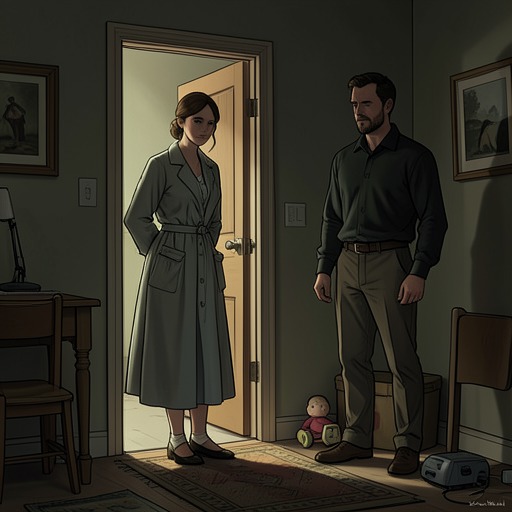
The Woman in the WindowThe boundary between indoors and outdoors is at once a physical feature of Anna Fox’s home and the organizing condition of her agoraphobia. Crossing it means confronting the exposed world she fears; remaining inside offers shelter but can also become confinement. The boundary shifts in meaning as Anna moves from carefully managed attempts to enter the garden to a crisis in which Jane Russell lies wounded across the park. A locked side door, a key carried in a robe pocket, and an umbrella used as both shield and counting aid make the conflict concrete: the threshold is not only something Anna fears, but something she must eventually cross.
Clinical Definition and Lived Experience
The novel places the clinical description of agoraphobia beside Anna’s experience of it. Diagnostic examples include being outside the home alone, in crowds or lines, on a bridge, or in the center of a theater row. These examples suggest a range of situations in which leaving safety or being exposed may become difficult. Anna’s own account narrows the emphasis to open space: she fears the vast sky, the endless horizon, and the exposure and pressure of the outdoors. For her, the threat is not reducible to a particular crowd or journey; open space itself is overwhelming.
Anna speaks from two positions, as a doctor and as someone who suffers from agoraphobia. The clinical view describes a sufferer seeking an environment she can control. Her lived account makes the condition more comprehensive: it has not merely damaged her life but become the circumstances of that life. The indoor-outdoor boundary therefore marks more than a symptom to be managed. It separates a controlled domestic environment from a world experienced as difficult to endure, while also showing the cost of remaining protected from it.
The Umbrella and the Managed Threshold
Anna’s attempts to go outdoors are small in distance but demanding in preparation. She reports having ventured outside into the garden five times in eight weeks. Dr. Julian Fielding accompanies her, standing in the garden as she opens the door. Her aid is Ed’s old London Fog umbrella, which Dr. Julian Fielding calls her secret weapon. Its familiar, bounded surface gives her attention something specific to hold: a dark tartan pattern of four black squares and four white lines. She breathes in and out to a count of four, turning the pattern into part of a repeated coping ritual.
The umbrella’s role is practical and symbolic without ceasing to be an ordinary object. Anna points it ahead like a saber or shield, and its canopy offers a visual limit against the surrounding exposure. On one attempt, she descends the first of four steps and tilts it toward the sky only slightly. She looks down toward Dr. Julian Fielding’s shoes and shins, while the world presses into her peripheral vision. The sequence makes each movement legible: opening the door, deploying the umbrella, counting, and taking a step. What would ordinarily be an unremarkable exit becomes a carefully structured passage through fear.
The umbrella does not make the outdoors safe or erase Anna’s distress. Its usefulness depends on a ritual of counting, controlled attention, and Dr. Julian Fielding’s presence. That dependence also sharpens the contrast between the object’s modest reality and the protection Anna needs it to provide. She resents the idea that it is a secret weapon because it is only an umbrella, yet the scene shows how much work that everyday object performs at the threshold.
Windows and the Refusal of Exposure
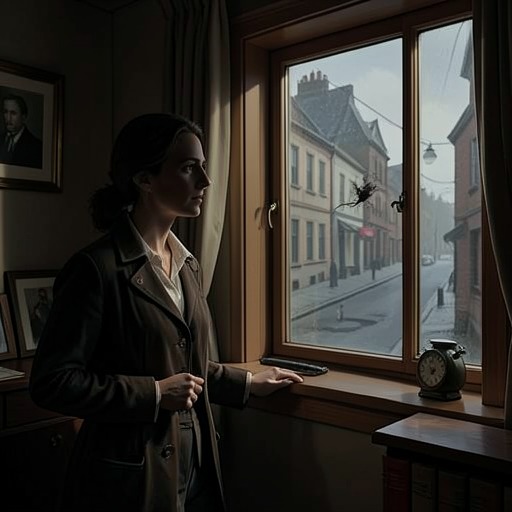
Anna’s resistance extends beyond walking outside. When a visitor suggests opening windows to ventilate the house, she says that she does not open windows anywhere. The refusal shows that the boundary is not confined to the front door or the act of going outdoors: even an opening within the house can admit the outside into a space Anna tries to keep controlled. The distinction between being inside and being exposed is therefore maintained through ordinary domestic choices as well as through her inability to leave.
This detail gives the house’s protection an uneasy double character. Indoors is the environment Anna can control, but that control involves keeping openings closed and limiting contact with the world beyond them. Her home functions as refuge and enclosure at once. The boundary is not simply a line she stands behind; it is something she actively preserves, even when another person regards opening a window as a practical matter of ventilation.
Jane Russell’s Wounding and the Side Door
The boundary changes meaning when Anna sees Jane Russell across the park with a blade in her chest. Anna is only steps away from her own door, but Jane Russell is outside, beyond two doors and across the exposed street. The situation brings Anna’s fear into conflict with her stated obligation, as a psychotherapist, to do no harm and place others’ interests above her own. She opens the hall door and flicks the umbrella open in the darkness, but she cannot move. At the door, she experiences the outside as a force pressing against and threatening to overwhelm the house.
Anna retreats from the hall to the kitchen, where a second exit offers a different route. The side door leads directly to the park, but it has been locked for almost a year. A recycling bin stands in front of it, with bottle necks protruding from its mouth. Anna pushes the bin aside, unlocks the door, and takes the key from its hook, putting it in her robe pocket in case she cannot get back inside. These details show the practical obstacles attached to the threshold: it is not only fear that delays her, but also a door long kept locked and the possibility of losing access to safety behind her.
She aims the umbrella ahead, turns the knob, and pushes the door open. Cold air meets her; she closes her eyes and counts to four before stepping outside. The movement is a decisive change from freezing at the hall door: Anna crosses the threshold while Jane Russell remains the reason she must try. The passage establishes that she steps out, but does not, by itself, establish what happens after that step.
Narrative Significance
The boundary gives spatial form to a conflict that might otherwise remain abstract. The house’s doors, windows, steps, and key register changes in Anna’s capacity to act. Earlier, outdoor exposure is approached through an umbrella, a fixed pattern, repeated breathing, and the support of Dr. Julian Fielding. During the emergency, the same umbrella accompanies her through a dark hallway and toward a door she has kept locked. The coping object recurs, but the pressure around its use has changed: the garden attempts concern her own gradual movement, while the crisis makes another person’s immediate need part of the decision.
The novel’s close attention to these thresholds also limits what can be inferred from Anna’s crossing. Stepping outside is not evidence that her fear has disappeared or that the wider condition is resolved. It is a specific action under extreme pressure, enabled by counting, the umbrella, the key, and the urgency of Jane Russell’s injury. The boundary thus holds two truths together: the outdoors remains terrifying to Anna, and the division between shelter and exposure can be crossed when remaining inside becomes untenable.