Courage
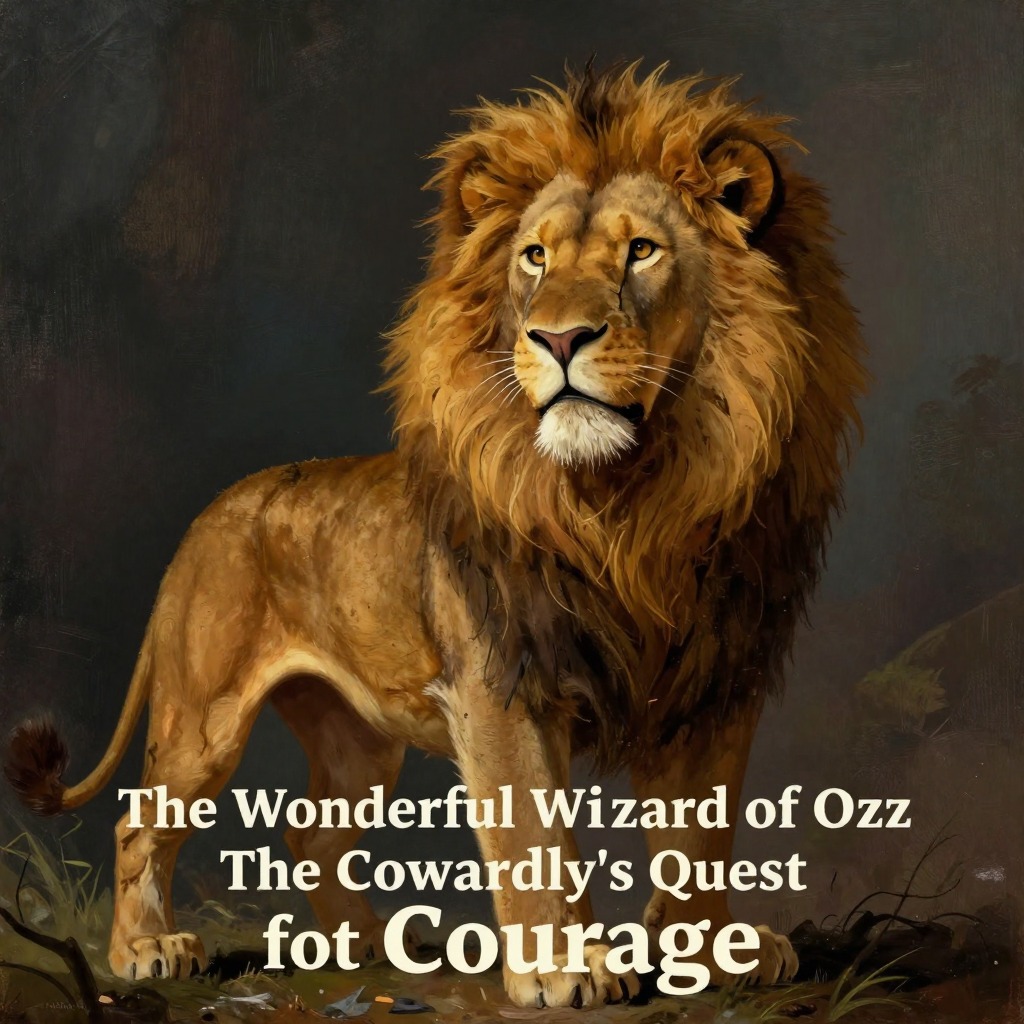
The Wonderful Wizard of OzCourage is one of the three core desires that drive the quest of Dorothy's companions in The Wonderful Wizard of Oz, and it is the attribute most explicitly redefined by the story's outcome. The Cowardly Lion, who joins the party believing himself to be a coward, frames his entire journey as a search for this quality, which he imagines Oz can bestow upon him like a physical gift. Yet the narrative consistently demonstrates that true courage is not the absence of fear but the capacity to act despite it, a distinction that becomes the Lion's real education.
The Lion's Self-Perception and the Quest for Courage
The Cowardly Lion introduces himself through a confession of his deepest shame. When Dorothy slaps him for threatening Toto, he admits, "I know it. I've always known it. But how can I help it?" He explains that he was "born that way" and that his great sorrow is that "the King of Beasts shouldn't be a coward." This self-awareness sets him apart from the Scarecrow and the Tin Woodman, who lack the very organs of self-knowledge. The Lion's fear is not a lack of understanding but an excess of it: he knows exactly what he lacks and feels the gap between his reputation and his inner state acutely. When he asks Oz for courage, he frames it as a necessity for survival: "my life is simply unbearable without a bit of courage." The Wizard, in his various guises, imposes the same condition on the Lion as on the others: he must first kill the Wicked Witch of the West. The Ball of Fire tells him, "Bring me proof that the Wicked Witch is dead, and that moment I will give you courage. But as long as the Witch lives, you must remain a coward." This condition sets the stage for the Lion to earn courage through action rather than receive it as a gift.
Acts of Bravery Before the Bestowal
Long before Oz administers his placebo, the Lion repeatedly demonstrates the very courage he believes he lacks. When the party encounters the first great ditch, the Lion, though "terribly afraid of falling," agrees to jump it, carrying each companion across on his back. When the Kalidahs attack, he turns to face them, saying, "We are lost, for they will surely tear us to pieces with their sharp claws. But stand close behind me, and I will fight them as long as I am alive." This is not the speech of a creature without courage; it is the speech of one who acts despite terror. Later, when the Wicked Witch's wolves attack, the Tin Woodman does the fighting, but the Lion's role in the party is consistently protective. He guards Dorothy's door at night, and when the Winkies are sent with spears, the Lion's roar alone sends them fleeing. Each of these moments contradicts his self-assessment, yet he remains blind to his own bravery, trapped by the idea that courage must be a feeling rather than a choice.
The Placebo and the Reinterpretation of Courage
When the four travelers finally confront Oz and discover he is a humbug, the Wizard gives the Lion a square green bottle of liquid, telling him, "if it were inside of you, it would be courage. You know, of course, that courage is always inside one; so that this really cannot be called courage until you have swallowed it." The Lion drinks, and immediately declares himself "full of courage." The irony is transparent: the liquid has no magical properties, but the Lion's belief in it, combined with his own prior actions, allows him to accept what he already possesses. Oz himself later admits to Dorothy, "It was easy to make the Scarecrow and the Lion and the Woodman happy, because they imagined I could do anything." The gift is a fiction, but the resulting confidence is real. The Lion's subsequent behavior confirms this: he becomes the King of Beasts by single-handedly killing the giant spider that terrorized the forest, an act he undertakes without hesitation and with no further need for external validation.
Thematic Significance: Courage as Action, Not Absence of Fear
The concept of courage in The Wonderful Wizard of Oz is ultimately a lesson in self-knowledge and the power of belief. The Lion's journey mirrors the Scarecrow's acquisition of brains and the Tin Woodman's acquisition of a heart: each receives a symbolic object that represents a quality they already possess but cannot recognize in themselves. The narrative argues that courage is not a substance to be ingested or a charm to be worn but a pattern of behavior that emerges when one chooses to act despite fear. The Lion's final words on the subject, spoken after Oz's departure, capture this understanding: "If Oz had taken a dose of the same courage he gave me, he would have been a brave man." The line is both a joke and a profound insight: the courage Oz gave was nothing but the courage to believe in oneself, and even the giver lacked it. The story thus affirms that true courage is not the absence of fear but the decision to move forward in its presence, a lesson the Lion learns not from Oz but from his own journey.