Humbug
The Wonderful Wizard of OzHumbug is the defining truth at the heart of L. Frank Baum's The Wonderful Wizard of Oz, the revelation that the seemingly all-powerful ruler of the Emerald City is nothing more than a clever impostor. The term is explicitly embraced by Oz himself, who, when confronted by Dorothy and her companions, declares without shame, "I am a humbug." This admission shatters the elaborate illusion he has constructed, transforming the narrative from a quest for magical solutions into a story about the power of self-belief and the nature of true worth.
The Revelation of the Humbug
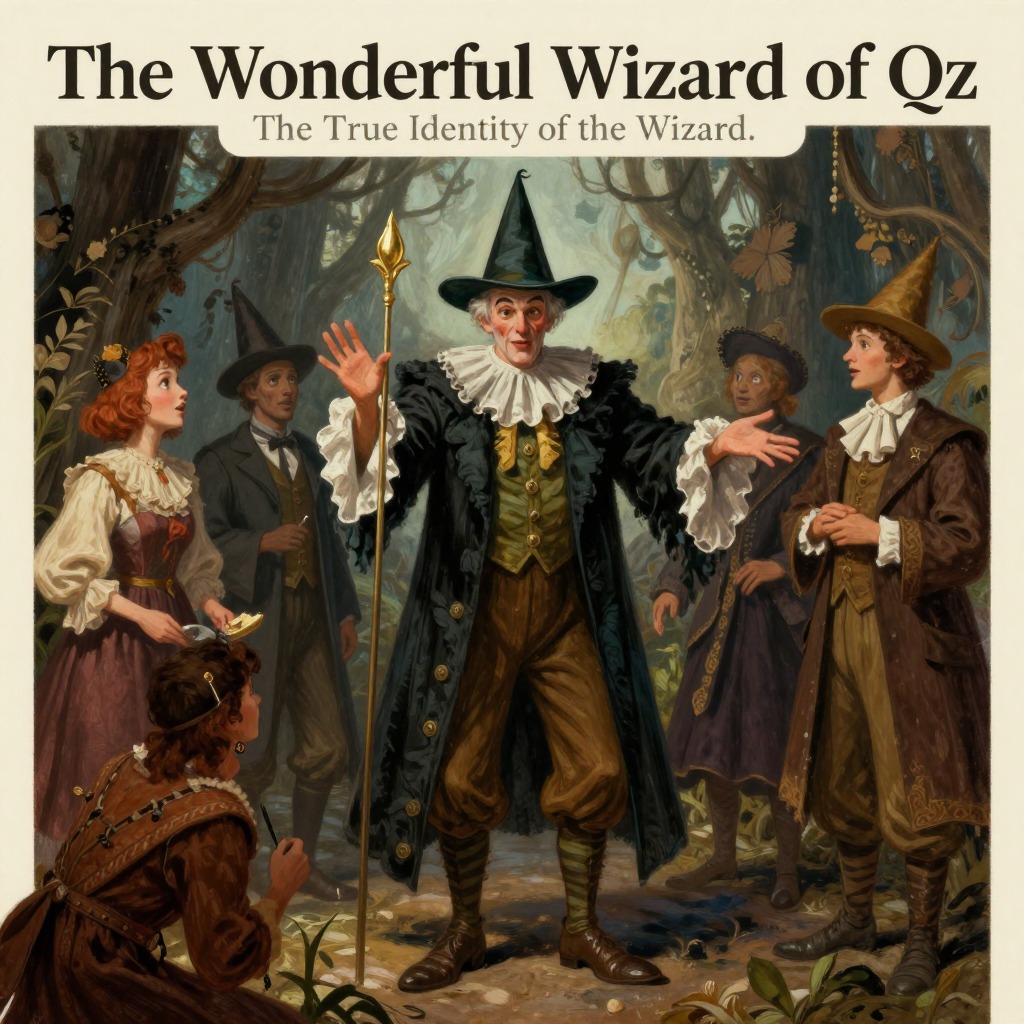
The discovery of Oz's humbug nature occurs in the Throne Room, after Dorothy and her friends have returned from destroying the Wicked Witch of the West. Expecting to see the Great and Terrible Wizard in one of his terrifying forms—a giant Head, a lovely Lady, a terrible Beast, or a Ball of Fire—they instead find an empty room. A solemn, invisible Voice speaks to them, but when the Cowardly Lion's roar accidentally tips over a screen in the corner, they see a "little old man, with a bald head and a wrinkled face." This is Oz, the supposed Wizard, who immediately confesses, "I have been making believe." When Dorothy asks if he is not a Great Wizard, he replies, "Not a bit of it, my dear; I'm just a common man." The Scarecrow, in a grieved tone, states the truth plainly: "you're a humbug." Far from being offended, Oz rubs his hands together as if pleased and confirms, "Exactly so! I am a humbug."
The Mechanics of the Deception
Oz explains the elaborate tricks he used to maintain his fraudulent reputation. The giant Head was made of "many thicknesses of paper, with a carefully painted face," hung from the ceiling by a wire, with its eyes and mouth controlled by a thread he pulled from behind a screen. He was a ventriloquist, able to throw his voice to make it seem to come from the Head. The lovely Lady was a costume and mask, the terrible Beast was a collection of sewn-together skins with slats to hold their shape, and the Ball of Fire was a ball of cotton soaked in oil that burned fiercely. These deceptions, combined with his self-imposed isolation, allowed him to rule for years without anyone discovering his true nature.
The Significance of the Humbug
The revelation of Oz as a humbug is a pivotal moment in the story, fundamentally altering the nature of the quest. It exposes the Wizard's promises as empty, as he admits he cannot magically grant brains, a heart, or courage. However, this very failure leads to a deeper truth: the qualities the travelers sought were already within them. Oz, despite his lack of magic, proves to be a wise psychologist. He gives the Scarecrow a head filled with bran, pins, and needles, symbolically providing "brains." He gives the Tin Woodman a silk heart stuffed with sawdust, and the Cowardly Lion a potion that tastes like courage. These are not real magical gifts, but the characters immediately feel transformed, proving that their belief in themselves was the true source of their desired attributes. The humbug, therefore, is not merely a lie but a catalyst for genuine self-discovery. Oz himself is a complex figure: a good man who became a bad Wizard, a humbug who nonetheless built a beautiful city and ruled it wisely, and a lonely figure who ultimately escapes his own creation in a balloon, leaving the Scarecrow to rule in his place.