Iceberg collision of the Titan
The Wreck of the Titan, or FutilityThe Iceberg collision of the Titan is the catastrophic climax of Morgan Robertson's novella, the moment when the supposedly unsinkable steamship, the largest craft afloat and the greatest of the works of men, is destroyed by a force it was designed to conquer. The event unfolds in the early hours of the voyage, after the Titan has already cut another ship in half without stopping, and it transforms the ship's confident technology into a death trap. The collision kills nearly all of the two thousand passengers and crew, leaves only a handful of survivors adrift on an iceberg, and becomes the pivot for the story's legal battles, moral reckonings, and the redemption of its protagonist, John Rowland.
The Ship and Its Fatal Confidence
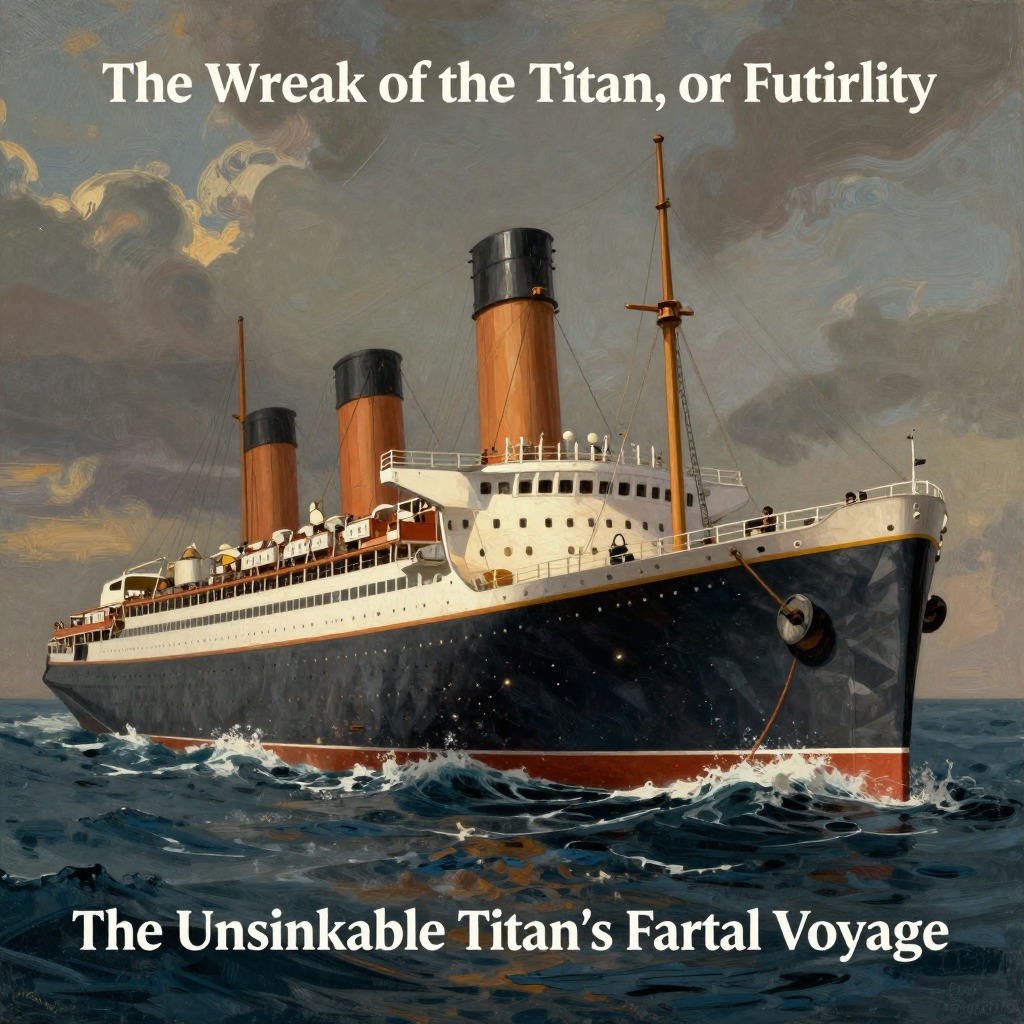
The Titan was built of steel throughout, eight hundred feet long, of seventy thousand tons displacement, and seventy-five thousand horse-power, capable of steaming at twenty-five knots an hour. She was considered practically unsinkable: her ninety-two doors of nineteen water-tight compartments could be closed in half a minute, and with nine compartments flooded she would still float. No known accident of the sea could possibly fill this many, so the company announced a rule of navigation that applied to her alone: she would steam at full speed in fog, storm, and sunshine, on the Northern Lane Route, winter and summer. The reasoning was that if another craft struck her, the force of the impact would be distributed over a larger area, and the brunt of the damage would be borne by the other; if she was the aggressor, she would cut the other in two with no more damage to herself than a paintbrush could remedy. As for an iceberg, the only thing afloat that she could not conquer, the company calculated that at full speed her bows would be crushed in but a few feet further than at half speed, and at the most three compartments would be flooded, which would not matter with six more to spare. This confidence was so absolute that she carried only twenty-four lifeboats, securely covered and lashed down, which if launched would hold five hundred people, far fewer than the three thousand berths aboard. The collision would prove every one of these calculations catastrophically wrong.
The Collision and the Sinking
The collision occurs on the night after the Titan has already run down and sunk the Royal Age, a deep-laden ship crossing her bow in the fog. The first officer, who had not even turned the engine-room telegraph lever during that earlier collision, is on the bridge when the crow's-nest lookout cries out, "Ice ahead. Iceberg. Right under the bows." This time the captain springs to the engine-room telegraph and turns the lever, but in five seconds the bow of the Titan begins to lift. Ahead and on either hand, through the fog, can be seen a field of ice, which arises in an incline to a hundred feet high in her track. Seventy-five thousand tons dead-weight, rushing through the fog at the rate of fifty feet a second, hurls itself at the iceberg. Had the impact been received by a perpendicular wall, the elastic resistance of bending plates and frames would have overcome the momentum with no more damage to the passengers than a severe shaking up, and to the ship than the crushing in of her bows. But a low beach, possibly formed by the recent overturning of the berg, receives the Titan, and with her keel cutting the ice like the steel runner of an iceboat, and her great weight resting on the starboard bilge, she rises out of the sea, higher and higher, until the propellers in the stern are half exposed. Then, meeting an easy, spiral rise in the ice under her port bow, she heels, overbalances, and crashes down on her side, to starboard.
The holding-down bolts of twelve boilers and three triple-expansion engines, unintended to hold such weights from a perpendicular flooring, snap, and down through a maze of ladders, gratings, and fore-and-aft bulkheads come these giant masses of steel and iron, puncturing the sides of the ship, even where backed by solid, resisting ice, and filling the engine and boiler-rooms with scalding steam, which brings a quick, though tortured death, to each of the hundred men on duty in the engineer's department. Amid the roar of escaping steam, and the bee-like buzzing of nearly three thousand human voices, raised in agonized screams and callings from within the enclosing walls, and the whistling of air through hundreds of open dead-lights as the water enters the holes of the crushed and riven starboard side, the Titan moves slowly backward and launches herself into the sea, where she floats low on her side, a dying monster, groaning with her death-wound.
The Aftermath on the Ice
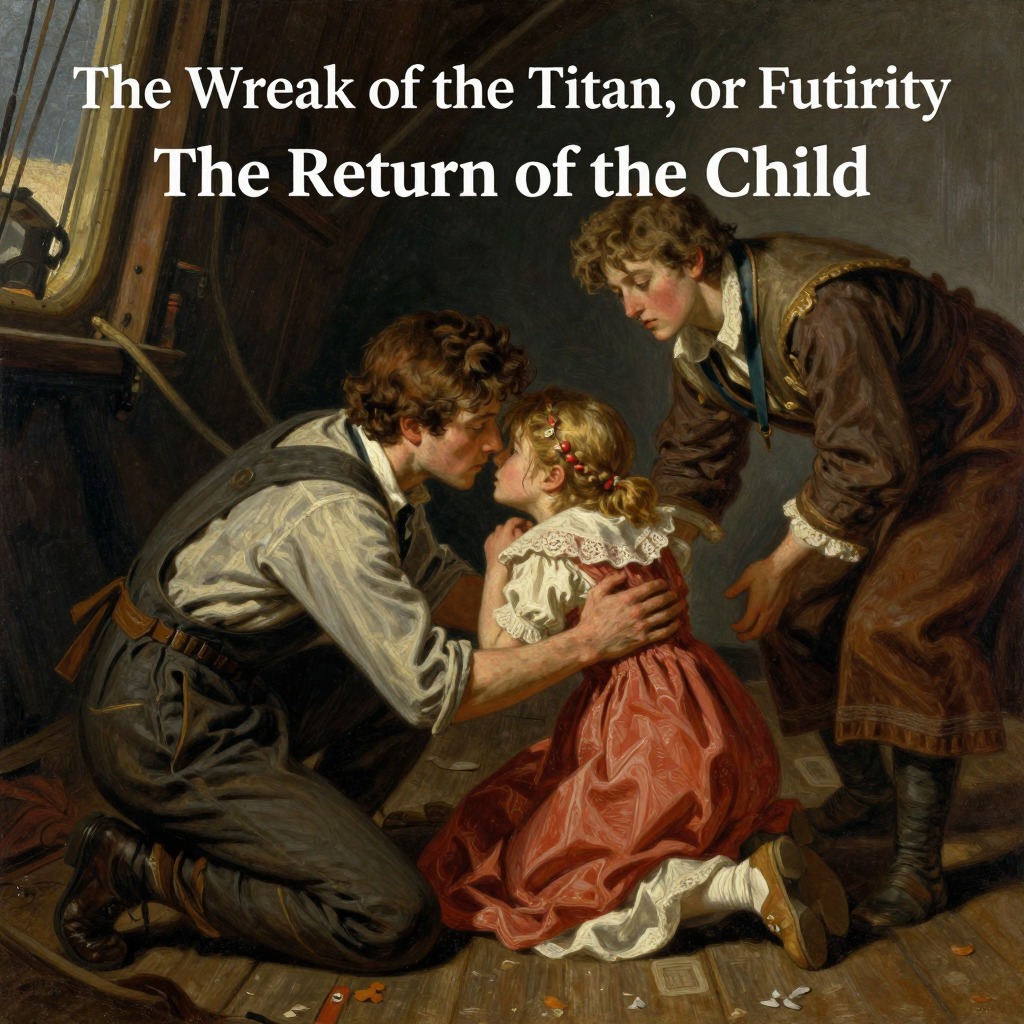
As the ship falls over, a solid, pyramid-like hummock of ice, left to starboard, catches every pair of davits to starboard, bending and wrenching them, smashing boats, and snapping tackles and gripes, until it caps the pile of wreckage strewing the ice with the end and broken stanchions of the bridge. In this shattered, box-like structure, dazed by the sweeping fall through an arc of seventy-foot radius, crouches Rowland, bleeding from a cut in his head, and still holding to his breast the little girl Myra, now too frightened to cry. He had been on the bridge lookout, drugged with hasheesh by the ship's officers, and the child, sleepwalking, had come to him for safety. As the ship sinks, the roaring of steam from her iron lungs ceases, leaving behind the horrid humming sound and whistling of air; when this too is suddenly hushed, and the ensuing silence broken by dull, booming reports as from bursting compartments, Rowland knows that the holocaust is complete, that the invincible Titan, with nearly all of her people, unable to climb vertical floors and ceilings, is beneath the surface of the sea.
Rowland, his faculties benumbed by the drug, is keenly alive to the peril of the woman whose appealing voice he had heard and recognized, the mother of the child in his arms. He hails to possible, but invisible boats beyond the fog, calling on them to come and save the child, to look out for a woman who had been on deck, under the bridge. He shouts her name, the one that he knew, encouraging her to swim, to tread water, to float on wreckage, and to answer him, until he comes to her. There is no response, and when his voice has grown hoarse and futile, and his feet numb from the cold of the thawing ice, he returns to the wreckage, weighed down and all but crushed by the blackest desolation that has, so far, come into his unhappy life. The little girl is crying, and he tries to soothe her, wrapping her in his coat and lying down with her in the wrecked bridge. All night, as he sleeps, a boat with the number twenty-four on her bow, pulled by sturdy sailors and steered by brass-buttoned officers, makes for the Southern Lane, the highway of spring traffic. Crouched in the stern-sheets of this boat is a moaning, praying woman, who cries and screams at intervals for husband and baby, and will not be comforted, even when one of the brass-buttoned officers assures her that her child is safe in the care of John Rowland, a brave and trusty sailor, who is certainly in the other boat with it. He does not tell her that Rowland had hailed from the berg as she lay unconscious, and that if he still had the child, it is with him there, deserted.
The Significance of the Wreck
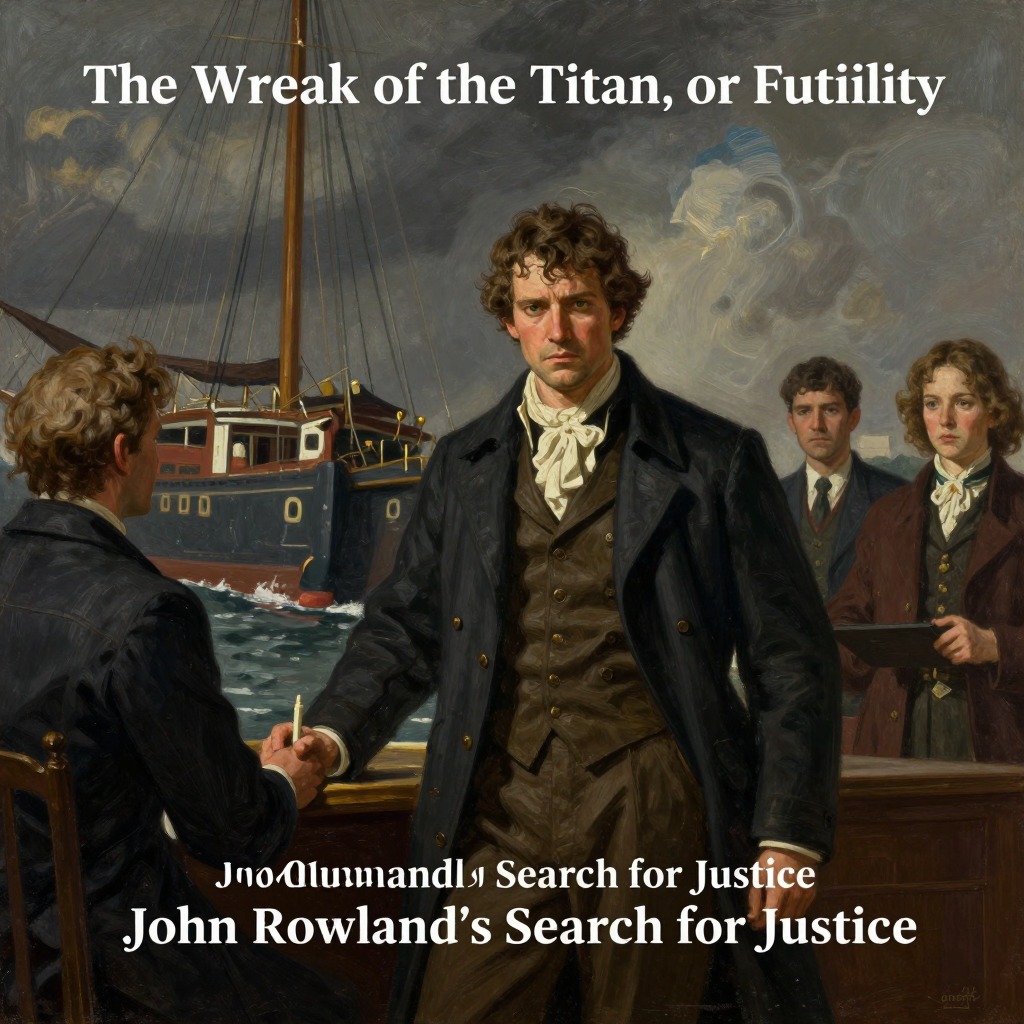
The iceberg collision is the event that exposes the hollowness of the Titan's technological hubris and the criminal negligence of her officers. The ship was designed to be unsinkable, yet it sinks in minutes because the company's rule of full speed in fog, meant to protect her, delivers her directly into the iceberg's path. The collision also reveals the moral bankruptcy of Captain Bryce and First Officer Austen, who had drugged Rowland to discredit his testimony about the earlier collision with the Royal Age, and who now, in the aftermath, lie to save themselves. The wreck leaves Rowland, a disgraced and broken-down naval officer, as the sole protector of the child Myra, and it is on the iceberg that he undergoes his spiritual crisis, praying to the God he denies for the safety of the child and her mother. The event thus serves as the turning point of the novella, transforming Rowland from a drunken outcast into a heroic survivor, and setting the stage for the legal confrontation at Lloyds, where his testimony, or refusal to testify, will decide the fate of the insurance money and the reputations of the guilty men. The collision also carries a broader indictment: the loss of life is not an accident of nature but a consequence of corporate greed, as Rowland later reflects, cursing the company with their water-tight compartments and their logging of the lookouts, and noting that there were twenty-four boats for three thousand people, lashed down with tarred gripe-lashings, thirty men to clear them away, and not an axe on the boat-deck or a sheath-knife on a man.