Law of chance
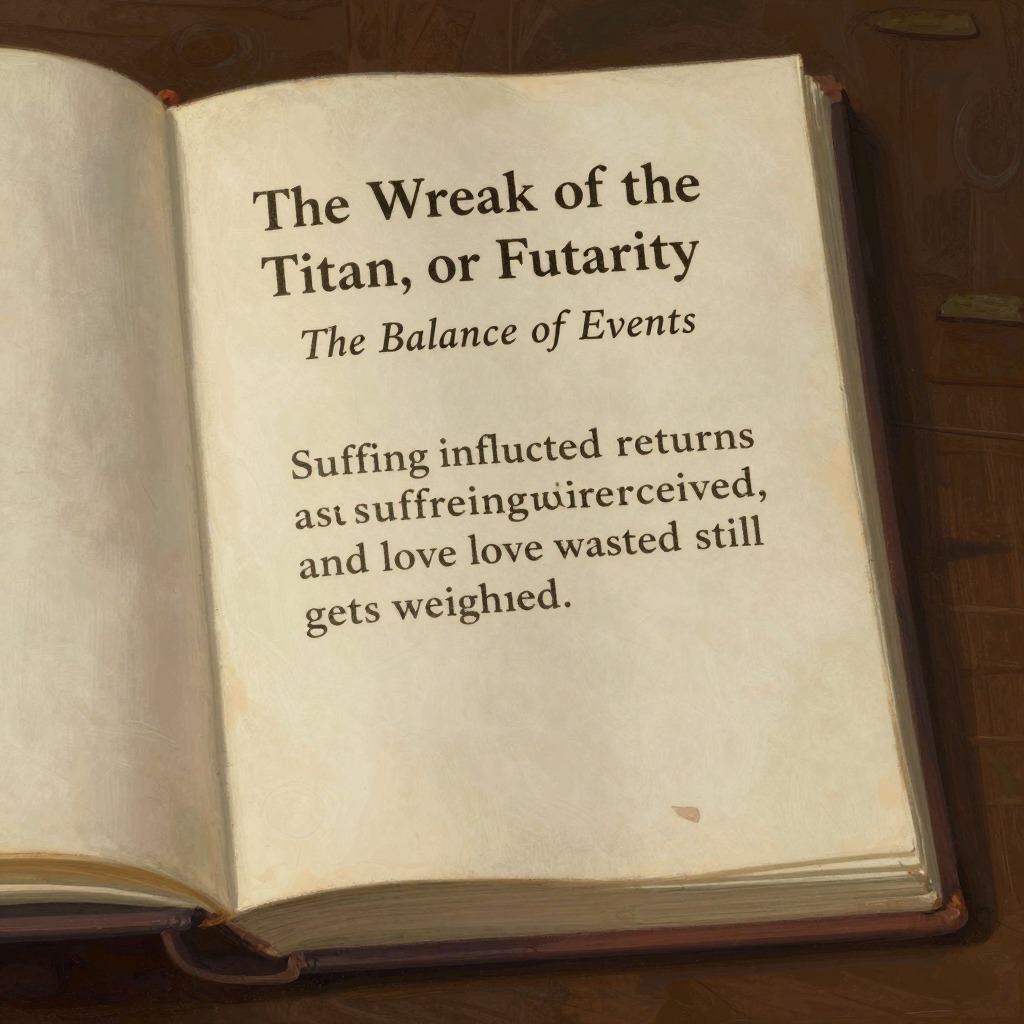
The Wreck of the Titan, or FutilityThe Law of chance, also called the immutable law of chance and the governing balance of events, is a philosophical principle that John Rowland articulates in Morgan Robertson's The Wreck of the Titan. It encapsulates his deterministic worldview: that the universe operates on cause and effect, and that for every suffering one inflicts on others, one receives an equal amount in return. This belief underpins his atheism, his sense of cosmic justice, and ultimately his moral redemption, making it a central concept in the novella's exploration of fate, responsibility, and the possibility of change.
Origin and Meaning
Rowland first invokes the law during a heated confrontation with Myra Selfridge, the woman he loved and lost. Accused of being violent and headstrong, he responds by speaking of "an immutable law of chance, and a governing balance of events," explaining that "for all the suffering we inflict on others, we receive an equal amount ourselves." This is not a casual remark but a deeply held conviction, born from his own experience of heartbreak and disgrace. The law suggests a universe that is morally balanced, where no action goes unpunished or unrewarded, and where chance is not random but governed by an underlying order.
The Law in Rowland's Philosophy
Rowland's adherence to the law is inseparable from his atheism. In his rambling soliloquy on the bridge, he rejects the idea of a merciful God, affirming instead "the integrity of cause and effect — which is enough to explain the Universe, and me." He invokes "the survival of the fittest" and "cause and effect" as the twin pillars of his worldview, dismissing religious faith as a human invention. The law of chance serves as his substitute for divine providence, a rational principle that explains both his suffering and the world's apparent injustices. Yet even as he denies God, he cannot escape the law's moral implications: it holds him accountable for his own actions, just as it holds others accountable for theirs.
The Law and the Dream
During his drugged state on the bridge, Rowland's belief in the law takes on a hallucinatory intensity. He imagines himself poised in a void, seeing his own soul and that of Myra Selfridge on opposite edges of space, calling to each other but unable to understand. He watches as a point of flame and a formless darkness approach, representing "the good and evil of his life," and feels no surprise when the darkness reaches him first. This vision reflects his conviction that his life is governed by an impersonal balance, where his wasted love and suffering will be "gathered, and weighed, and credited" according to the law. The dream underscores his isolation and his sense of being trapped in a deterministic universe, yet it also hints at a longing for connection that transcends the law.
The Law and Redemption
Rowland's actions after the shipwreck reveal a tension between his stated philosophy and his behavior. He risks his life to save Myra's child, fights and kills a polar bear, and prays to the God he denies, begging for the child's life and the mother's safety. This prayer, offered "with the fervor born of helplessness," seems to contradict his belief in the law of chance, which leaves no room for divine intervention. Yet the law also provides a framework for his redemption: by saving the child, he balances the suffering he once caused, fulfilling the principle of equal compensation. His eventual sobriety and his decision to refuse the insurance company's bribe further align him with the law's moral order, suggesting that even an atheist can find purpose in a universe of cause and effect.
The law of chance thus functions as both a philosophical anchor and a narrative device. It explains Rowland's cynicism, fuels his defiance, and ultimately guides him toward a selfless act that redeems his wasted life. In a story filled with collisions, icebergs, and human folly, the law stands as Rowland's only creed — a cold, unyielding principle that, paradoxically, leads him to warmth and humanity.