New York City
The Wreck of the Titan, or FutilityNew York City stands as the great American metropolis in Morgan Robertson's novella, the bustling port from which the supposedly unsinkable Titan departs on its final voyage and the urban stage where John Rowland's story reaches its climax. It is a city of sharp contrasts: a place of immense wealth and opportunity, yet also of harsh judgment and misunderstanding. The city frames the entire narrative, from the ship's departure to Rowland's eventual arrest and vindication, and its streets, institutions, and social dynamics serve as a counterpoint to the raw, elemental drama of the sea.
The Port of Departure and the Floating City
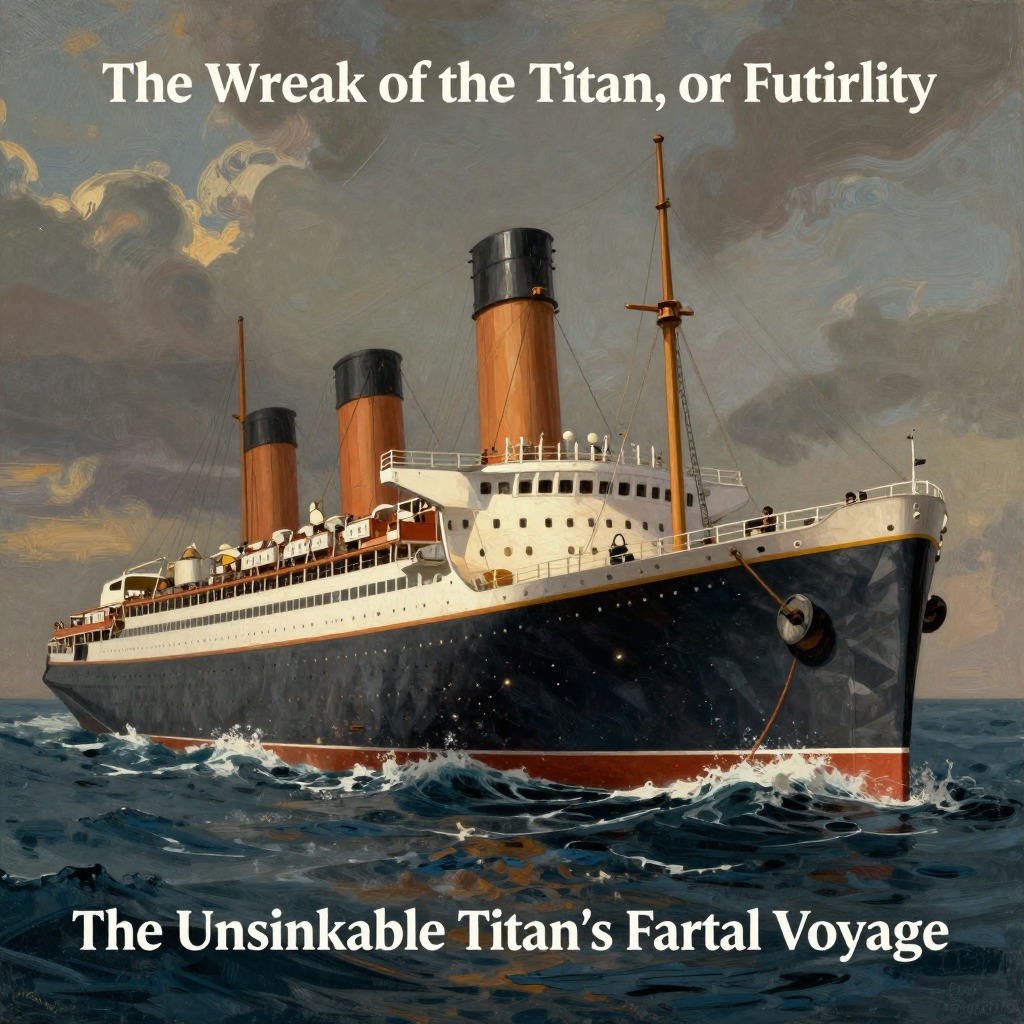
New York City is first introduced as the embarkation point for the Titan, the largest craft afloat and the greatest of the works of men. The ship, described as a floating city, carries two thousand passengers who have embarked at New York, with an unofficial rumor circulating that an effort would be made to break the five-day speed record between Sandy Hook and Daunt's Rock. The city's harbor, with its tugs and pilot services, is the gateway through which the Titan, with its ninety-two water-tight doors and its reputation for unsinkability, moves out to sea. The city thus represents the pinnacle of industrial civilization, a place where human ingenuity and technological hubris are concentrated in the great steamship. The departure from New York sets the stage for the disaster, as the Titan's full-speed rule, announced by the company, is put into practice in the fog and ice of the North Atlantic.
The Return: A City of Misunderstanding and Redemption
After the shipwreck and his rescue, Rowland returns to New York City, where his experiences take a dramatic turn. He arrives at a North River dock with Myra on his shoulder, only to be surrounded by enthusiastic reporters who have heard the embellished story of his polar bear fight. He refuses to talk, escapes them, and enters the office of the steamship company to secure the address of Mrs. Selfridge, the only woman saved. He then takes a car up Broadway and alights abreast of a large department store, where he spends his last sixteen dollars and a half to dress Myra in new finery, declaring, "We're going to see mamma, soon, Myra, and you must go dressed up. It don't matter about me; but you're a Fifth Avenue baby --- a little aristocrat." This act of selfless love is immediately misunderstood: a policeman, marveling at the juxtaposition of rags and ribbons, arrests him for kidnapping. The city, with its suspicion and rigid social codes, fails to recognize the heroism of the ragged sailor, and Rowland is dragged through the streets like a sick animal by a New York policeman, a stark contrast to his triumph over the polar bear. The narrator comments on this irony: "For such is the stultifying effect of a civilized environment."
The Courtroom and the City's Judgment
The next morning, Rowland appears in a New York City police court, disheveled and disfigured by his clubbing. The court is presided over by a magistrate who is a member of clubs and societies, and who often fails to read the papers before court opens. The prosecuting witness, Mr. Gaunt, testifies that Rowland was once a gentleman and a frequent guest at his house, but that he threatened revenge when his request for his daughter's hand was denied. Mrs. Selfridge, with her child in her arms, repeats the accusation, claiming that Rowland attempted to murder Myra and later mutilated her, pointing to the deep wounds in the child's back. The magistrate, puzzled, asks what shipwreck this was, and the newspaper men call out "The Titan." He then reads the morning paper, which contains the story of Rowland's heroism, and discharges him with the words, "This man has merely saved your child's life. If you will read of his defending it from a polar bear when you go home, I doubt that you will tell it any more bear stories." The city's justice, initially blind, is corrected by the press, but the scene underscores the city's fickleness and its reliance on sensational news.
The City as a Place of Renewal
After his discharge, Rowland disappears into the city and begins a remarkable ascent. He starts as a one-armed dock lounger, fishing with an old fish-hook and string, trading and selling his catch. He sleeps under the docks, paying no rent, and gradually saves enough to buy a second-hand suit and a barber's services. His changed appearance leads to work as a tally clerk, then as an envelope addresser, and finally to a Civil Service examination, which he easily passes. Two years later, he is appointed to a lucrative government position, and he reflects, "Now John Rowland, your future is your own. You have merely suffered in the past from a mistaken estimate of the importance of women and whisky." The city, with its anonymous opportunities and its indifference to the past, allows Rowland to reinvent himself, a testament to the American ideal of self-improvement. Yet the city also brings him back to his past: six months later, he receives a letter from Mrs. Selfridge, who writes that Myra will not let her rest, and asks him to come and see Myra. The novel ends with Rowland going to see her, suggesting that the city, despite its harshness, also enables reconciliation and the possibility of a new beginning.
The City's Thematic Significance
New York City functions as more than a mere setting; it embodies the themes of civilization and its discontents. The city is a place of both opportunity and alienation, where Rowland's heroism is initially unrecognized and punished, and where his redemption is achieved through solitary effort. The contrast between the natural world of the iceberg, where Rowland fought a polar bear with a knife, and the urban world of Broadway, where he is arrested by a policeman, highlights the novel's critique of modern society. The city's institutions—the police, the courts, the press—are shown to be fallible and superficial, yet they also provide the means for Rowland's final success. The city is thus a complex symbol: it represents the pinnacle of human achievement, but also the moral blindness that can accompany it. Rowland's journey from the sea to the city, and his ultimate acceptance of a future in that city, suggests that even in the most civilized of environments, the human spirit can find a way to endure and even thrive.