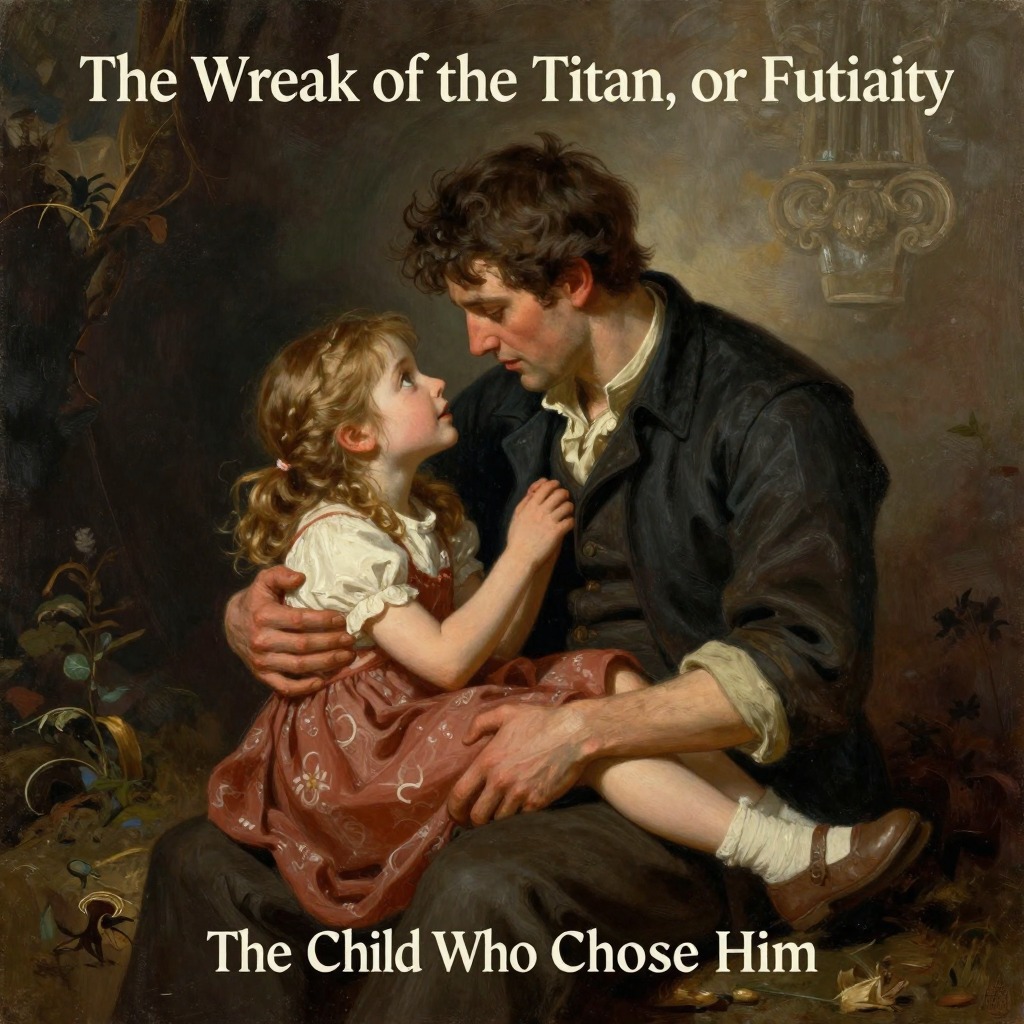
Rescuer-survivor relationship between John Rowland and Myra
The Wreck of the Titan, or FutilityThe bond between John Rowland and the child Myra begins in the chaos of the Titan's final voyage and becomes the novel's most powerful engine of redemption. Rowland, a disgraced and alcoholic former naval officer serving as a common sailor, first encounters the little girl when she playfully runs to him on deck, calling him "Dammy," a nickname she coins that will persist through their ordeal. Their relationship, forged in the wreck of the supposedly unsinkable Titan, transforms Rowland from a broken man haunted by lost love into a heroic protector willing to sacrifice everything—including his own life—for the child's safety. This bond not only saves Myra's life but also redeems Rowland's, leading him from the depths of despair and addiction to a renewed sense of purpose and eventual sobriety. The relationship is marked by a series of escalating trials: the shipwreck itself, a desperate fight with a polar bear, a period of shared illness and delirium on an iceberg, and finally a legal and emotional reunion with Myra's mother. Through these events, Rowland's love for the child becomes the catalyst for his moral and spiritual rebirth, making their relationship the emotional and thematic heart of the novella.
Origins of the Bond: From Chance Encounter to Shipwreck
Rowland's first meeting with Myra occurs by chance on the Titan's deck, where the child, having "wunned 'way" from her mother, clings to his legs in an overflow of spirits. This innocent encounter is charged with irony, as Rowland is the rejected former suitor of Myra's mother, Mrs. Selfridge, and the child's presence reopens old wounds. When Rowland, in a jesting moment, holds the girl above the rail, her mother appears and snatches her away, interpreting the gesture as a threat and reinforcing her fear of him. This incident leads to a complaint to the captain, who considers imprisoning Rowland for attempted murder but instead merely reassigns him to work out of sight. The relationship is thus born under a cloud of suspicion and misunderstanding, yet Rowland's genuine tenderness toward the child is evident from the start.
The bond is sealed during the Titan's collision with an iceberg. As the ship capsizes, Rowland, dazed and bleeding from a head wound, finds himself clutching Myra to his breast, the child too frightened to cry. In the chaos, he becomes her sole protector, and when the ship sinks, he is left with her on a floating iceberg, the only survivor of the wreck in his immediate vicinity. His first instinct is to call out for the child's mother, whom he recognizes as the woman of his dreams, shouting her name and urging her to swim or float on wreckage. When there is no response, he is "weighed down and all but crushed by the blackest desolation," yet he turns his attention to soothing the crying child, telling her, "Hush, baby, hush... so do I—more than Heaven, but I think our chances are about even now." This moment marks the beginning of his transformation from a man consumed by his own suffering to one devoted to another's survival.
The Ordeal on the Iceberg: Fight, Illness, and Care
On the iceberg, Rowland's devotion to Myra is tested to its limits. He wraps her in his coat, builds a shelter from the wreckage of the bridge, and uses the whisky he had found in his pocket—originally planted by the captain to discredit him—to warm her and himself. When a polar bear, attracted by the scent of food, approaches, Rowland, armed only with a jackknife, fights the beast to protect the child. The bear dashes Myra aside with a blow of its paw, leaving her bleeding from four deep scratches, and then turns on Rowland, crushing his left arm and breaking his ribs. In a desperate struggle, Rowland stabs the bear through the eye, killing it, but he is "crippled for life," with his arm mangled beyond repair. Despite his own agony, he immediately attends to Myra, bathing her wounds, binding them with a slab of bear fat, and fashioning clothing for her from the lining of his coat. He even sacrifices his left shirtsleeve to cover her arms, a gesture of selflessness that underscores his growing love for the child.
The following days are a blur of fever and delirium for Rowland, who, with lucid intervals, tends to the fire, cooks bear meat, and feeds and dresses the child's wounds. His own arm swells to twice its size, and he is barely able to breathe due to his broken ribs, yet he persists, driven by the need to keep the child alive. The child, too, suffers, crying for her mother and begging for water, which Rowland provides from a tin can, adding a few drops of whisky to ease her pain. His care is unskillful but heroic, and his makeshift bandaging, though it must have added to her suffering, likely saved her life by keeping her still and allowing her wounds to close. Through this ordeal, Rowland's love for Myra becomes the anchor of his existence, giving him a reason to fight for survival when his own body and spirit are failing.
Rescue and the Journey to Reunion
After three days of delirium, Rowland, now sane but feeble, prays to the God he has denied, begging for the life of the waif in his care and for the safety of her mother. His prayer is answered almost immediately when the bark Peerless appears, and he is rescued along with Myra. The child, now calling him "Dammy," asks, "We goin' to mamma?" and Rowland replies, "Yes, we're going to mamma now," though he privately doubts whether the mother is alive. The crew of the Peerless, moved by the crippled Rowland's devotion, lovingly sew a dress for Myra from bagging-stuff and old flannel shirts, a testament to the bond that has formed around her. Rowland, whose arm has been amputated at Christiansand, is too weak to sew, but he watches as the sailors bestow their care on the child.
In London, Rowland brings Myra to the office of Mr. Meyer, the underwriter, where he is to testify about the Titan's collision with the Royal Age. There, Mr. Selfridge, the child's grandfather, recognizes her and takes her in his arms, murmuring, "Oh, God, I thank thee... I have lost my son, but I have found his child—my granddaughter." Rowland, who has been penniless and without a future, is offered a position by Mr. Selfridge, but he refuses the money, asking only that the mother be telegraphed. When he learns that Mrs. Selfridge is safe in New York, he resolves to bring Myra to her, accepting two first-class tickets from the steamship company's attorney, Mr. Thompson, as a form of compensation for his lost arm. Captain Barry, who has become his friend, urges him to take the passage, saying, "Think of that mother, Rowland. Why, man, I'd travel round the world to stand in your shoes when you hand Myra over." Rowland, though he feels the tickets are a bribe, accepts them for the child's sake, and he and Myra sail for New York.
The Reunion and Its Aftermath
In New York, Rowland, with Myra on his shoulder, is arrested by a policeman who suspects him of kidnapping the child, despite her fine new clothes. He is taken to court, where Mrs. Selfridge, believing he has harmed her daughter, testifies against him, accusing him of attempted murder and of mutilating the child. The magistrate, however, reads the newspaper account of Rowland's heroism and discharges him, declaring, "This man has merely saved your child's life." Mrs. Selfridge, mystified and aggrieved, leaves the courtroom, while Myra shouts profanely for Rowland, calling him "Dammy." Rowland, now free, disappears into the city, and the relationship seems to end in misunderstanding and separation.
Yet the bond endures. Rowland, now one-armed, begins a new life, working as a dock lounger, fishing, and eventually securing a government position through his fine penmanship. He tells himself, "Now John Rowland, your future is your own. You have merely suffered in the past from a mistaken estimate of the importance of women and whisky." But he is wrong, for six months later he receives a letter from Mrs. Selfridge, who writes, "Do not think me indifferent or ungrateful. I have watched from a distance while you made your wonderful fight for your old standards. You have won, and I am glad and I congratulate you. But Myra will not let me rest. She asks for you continually and cries at times. I can bear it no longer. Will you not come and see Myra?" And the man went to see Myra. This final line, with its quiet understatement, affirms that the rescuer-survivor relationship, forged in disaster and tested by adversity, has become an enduring bond of love and gratitude, transcending the misunderstandings and social barriers that once separated them.
The relationship between Rowland and Myra is thus not merely a plot device but the moral center of the novella. It transforms Rowland from a man who, in his own words, was "a broken-down wreck with a temporarily active conscience" into a selfless hero who finds redemption through his love for a child. It also serves as a critique of a society that judges by appearances, as Rowland, the "hang-dog ruffian," proves to be the true savior, while the respectable captain and officers are exposed as liars and murderers. Through this bond, the novella suggests that genuine human connection, born of shared suffering and selfless care, can overcome even the deepest personal and social failures.