The survival of the fittest
The Wreck of the Titan, or FutilityThe survival of the fittest is a phrase that John Rowland, the disgraced former naval officer turned sailor, invokes during his drugged delirium on the bridge of the Titan, and it crystallizes his bleak, evolutionary worldview—a worldview that the novella tests and ultimately complicates through his selfless rescue of a child and his own survival against a polar bear. The phrase appears at a moment of extreme psychological and physical duress, when Rowland, having been secretly dosed with hasheesh by his superiors, is hallucinating and speaking his thoughts aloud. It is not a casual scientific reference but a philosophical anchor for his atheism and his sense of cosmic indifference, and it recurs in his later reflections on the iceberg wreck, tying his personal tragedy to a larger, impersonal order of cause and effect.
The Phrase in Rowland's Delirium
Rowland first utters the phrase during his drugged watch on the starboard bridge lookout, when the hasheesh has already produced terrifying visions—the windlass transformed into a monster with cable-chain tentacles, the anchor-davits into dancing serpents, the anchors into hairy caterpillars. In the midst of this phantasmagoria, he regains a fragment of sanity and mutters, "They've drugged me," but then slips into a memory of a garden where a young girl flees from him. Struggling to return to the present, he groans about the woman who "could have saved me, but she chose to damn me," and then, staring into the fog, he rambles: "The survival of the fittest," he says, "cause and effect. It explains the Universe---and me." The phrase is thus not a triumphant affirmation of strength but a resignation to a mechanistic universe that offers no mercy, no divine plan, only the cold operation of natural selection and physical law. It is the intellectual counterpart to his earlier, more emotional cry about "the unspeakable hunger of a love that had failed."
The Evolutionary Worldview and Its Roots
Rowland's invocation of the survival of the fittest is inseparable from his atheism, which had already cost him the love of Myra Gaunt, now Mrs. Selfridge. Years earlier, when she discovered his denial of God, she recoiled, and he responded with a bitter speech about "an immutable law of chance" and "a governing balance of events," insisting that "for all the suffering we inflict on others, we receive an equal amount ourselves." This deterministic philosophy, which he now condenses into the phrase "survival of the fittest," is his substitute for religious faith. In his delirium, he expands on it: "As part of a great evolutionary principle, which develops the race life at the expense of the individual, it might be consistent with the idea of a God---a first cause. But does the individual who perishes, because unfitted to survive, owe any love, or gratitude to this God? He does not!" The phrase thus carries a double edge: it explains the universe, but it also condemns the individual to insignificance, a theme that resonates with the novella's larger critique of the Titan's corporate arrogance.
The Titan itself embodies the opposite of this philosophy—the belief that human engineering can conquer nature. The ship is described as "the largest craft afloat and the greatest of the works of men," built of steel, with ninety-two water-tight doors and nineteen compartments, so that "with nine compartments flooded the ship would still float, and so no known accident of the sea could possibly fill this many, the steamship Titan was considered practically unsinkable." Yet this hubris is precisely what the survival of the fittest would mock: the ship's full-speed rule, which the company announces with the rationale that in a collision the smaller hull should suffer, is a deliberate gamble against natural forces. Rowland's phrase, spoken in the fog just before the iceberg strike, is thus an ironic counterpoint to the ship's false security—nature, not human design, will determine who survives.
The Phrase's Irony in the Wreck and Aftermath
When the Titan crashes onto the iceberg and sinks, Rowland's survival-of-the-fittest worldview is put to a brutal test. He is thrown onto the ice with little Myra, the daughter of the woman he once loved, and he must fight a starving polar bear to protect her. The fight is a literal enactment of the survival of the fittest: a crippled, one-armed man against a beast that "had scented food and was seeking it." Rowland, with only a jackknife, kills the bear by stabbing it in the eye, an act that "no Innuit hunter will attempt." Yet his survival is not a triumph of the fittest in any Darwinian sense—he is physically broken, with a crushed arm that will later be amputated, and he survives only through a combination of desperate will, the bear's meat, and the timely appearance of the bark Peerless. The phrase thus becomes deeply ironic: the "fittest" in this case is not the strongest but the most selfless, the man who risks his life for a child not his own.
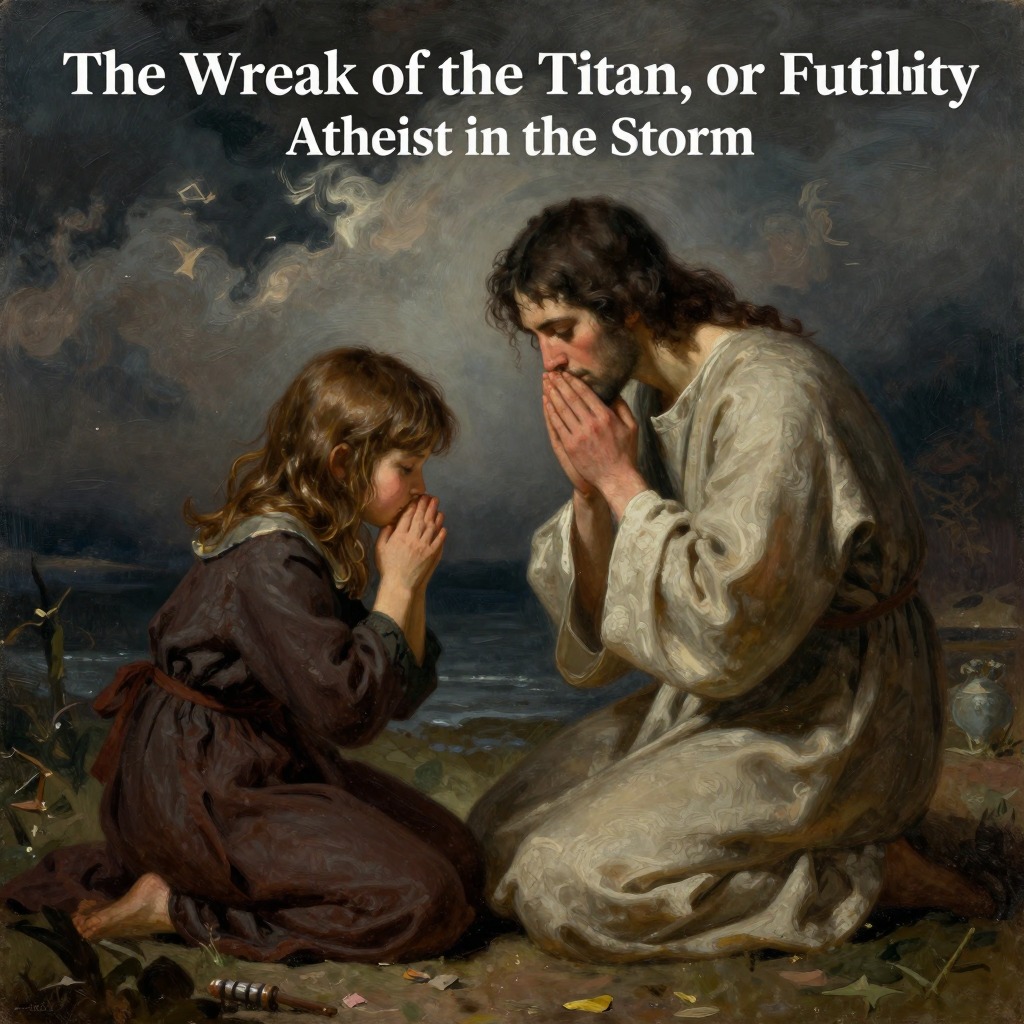
Rowland himself seems aware of this irony. In his delirium on the ice, he muses on the cruelty of the universe, rejecting the idea of a merciful God: "No good, merciful God created this world or its conditions. Whatever may be the nature of the causes at work beyond our mental vision, one fact is indubitably proven---that the qualities of mercy, goodness, justice, play no part in the governing scheme." Yet immediately after this atheistic outburst, he prays—"For you, Myra"—begging for the child's life and the mother's safety, though he excludes himself from the prayer. This act of prayer, by the man who denied God, undermines his own philosophy. The survival of the fittest, which he had used to explain the universe, cannot account for his self-sacrifice or his sudden turn to faith. The novella thus uses the phrase to expose the limits of a purely mechanistic worldview, suggesting that human love and moral choice transcend mere biological fitness.
The Phrase as a Motif of Redemption
In the end, Rowland's survival is not a victory of the fittest but a redemption through love. He loses his arm, but he gains a future: he quits drinking, finds government employment, and is eventually summoned by Mrs. Selfridge, who writes that Myra "will not let me rest" and asks him to come see her. The phrase "survival of the fittest" never appears again after the wreck, but its shadow lingers. Rowland's journey from a drunken, suicidal sailor to a sober, self-respecting man is a refutation of the cold determinism he once embraced. The novella, while never explicitly rejecting the phrase, shows through Rowland's actions that the fittest to survive are not the strongest or the most ruthless, but those who can love and sacrifice. The phrase thus serves as a philosophical foil, a dark creed that the narrative ultimately transcends through the very human act of caring for a child.