Unsinkable
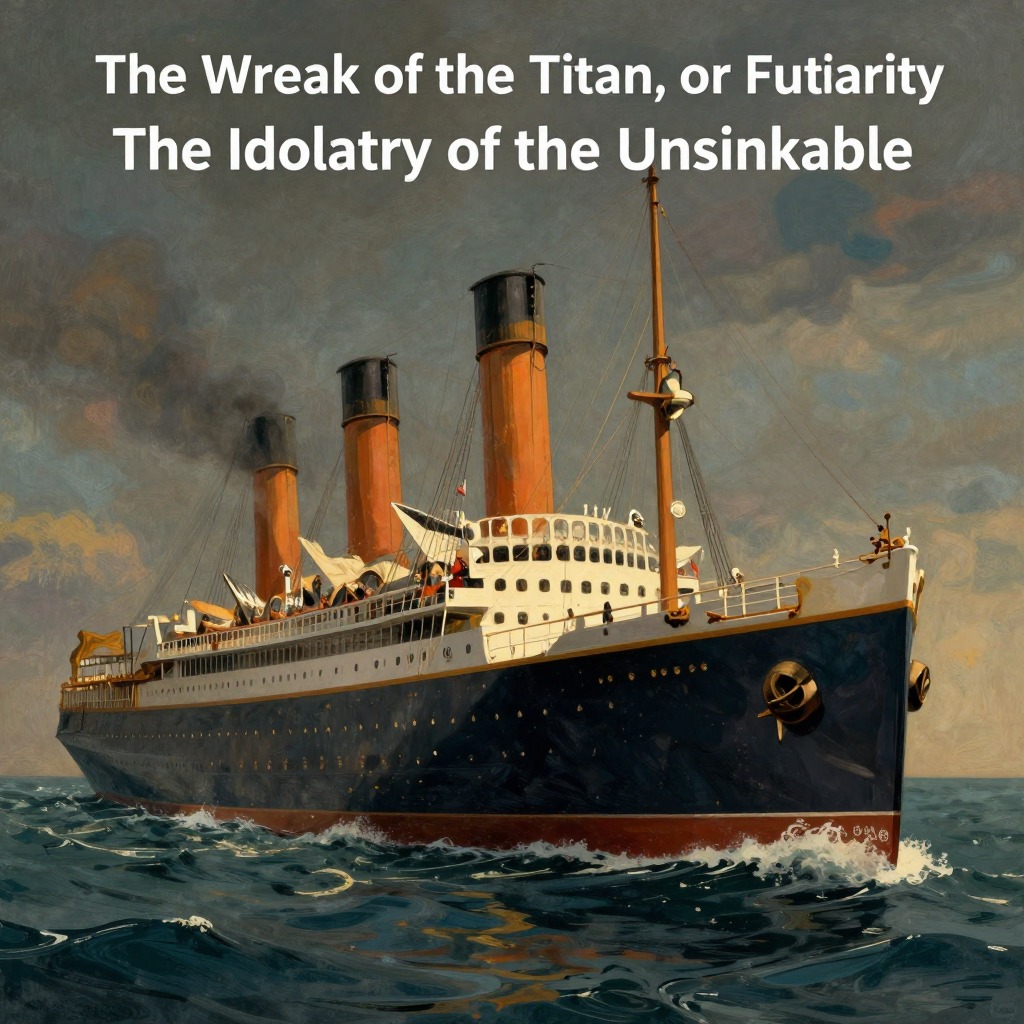
The Wreck of the Titan, or FutilityIn Morgan Robertson's 1898 novella The Wreck of the Titan, or Futility, the word "unsinkable" serves as the keystone of a technological faith that the narrative systematically dismantles. The term is first introduced in the ship's specification: the steamship Titan is described as "practically unsinkable," a claim reinforced by the assertion that she is "indestructible." This confidence rests on a series of engineering marvels detailed in the opening chapters, and the entire plot—culminating in the ship's catastrophic loss—functions as a dramatic refutation of that label. The word thus carries a double weight: it is both a sincere period belief in human mastery over nature and a bitter irony that the novel's readers, knowing the ship's fate, cannot miss. The novella, published fourteen years before the Titanic disaster, uses this irony to expose the dangers of corporate arrogance and the limits of technological solutions to the sea's unpredictability.
The Engineering Basis of the Claim
The Titan's unsinkability is grounded in specific design features that Robertson details with technical precision. She is "the largest craft afloat and the greatest of the works of men," eight hundred feet long, with a displacement of seventy thousand tons and seventy-five thousand horsepower. Her construction involves "every science, profession, and trade known to civilization," and her officers are not merely seamen but scientists, drawn from the pick of the Royal Navy and required to pass rigid examinations in winds, tides, currents, and geography. The ship's safety systems are equally impressive: ninety-two doors across nineteen water-tight compartments can be closed in half a minute by turning a lever, and these doors also close automatically in the presence of water. The critical claim is that "with nine compartments flooded the ship would still float," and since "no known accident of the sea could possibly fill this many," the Titan is deemed unsinkable. This engineering confidence extends to her hull design: built of steel throughout and carrying no combustible cargo, she is given the sharp dead-rise of a steam yacht, improving her behavior in a seaway. The ship is, in short, "a floating city," containing within her steel walls all that minimizes the dangers of the Atlantic voyage.
The Operational Rule That Undermines the Claim
The unsinkable label is immediately qualified by a company rule that reveals the commercial logic behind the technological boast. The steamship company announces that the Titan will "steam at full speed in fog, storm, and sunshine," on the Northern Lane Route, winter and summer. The stated reasons are fourfold: first, that if another craft strikes her, the force of impact will be distributed over a larger area, with the brunt borne by the other; second, that if the Titan is the aggressor, she will cut the other ship in two with no more damage than a paintbrush can remedy; third, that at full speed she can be more easily steered out of danger; and fourth, that in an end-on collision with an iceberg—"the only thing afloat that she could not conquer"—her bows would be crushed in but a few feet further at full than at half speed, flooding at most three compartments, "which would not matter with six more to spare." This rule, which prioritizes speed and profit over safety, is the first crack in the unsinkable facade. The company's confidence is so absolute that the ship carries only twenty-four lifeboats, securely covered and lashed down, which would hold five hundred people—far fewer than the three thousand berths on board. The law requires a cork jacket for each berth, but the ship carries no life-rafts, a detail that underscores the complacency born of the unsinkable belief.
The Collision and the Collapse of the Myth
The narrative's central event—the Titan's collision with an iceberg—directly contradicts the engineering assumptions. The ship, charging through fog at twenty-five knots, strikes a low beach of ice formed by the recent overturning of the berg. Instead of a perpendicular wall that would have crushed her bows and flooded at most three compartments, the Titan rides up onto the ice, her keel cutting like a steel runner, until her propellers are half exposed. She then heels, overbalances, and crashes down on her side. The holding-down bolts of twelve boilers and three triple-expansion engines, "unintended to hold such weights from a perpendicular flooring," snap, and the giant masses of steel and iron puncture the ship's sides, filling the engine and boiler rooms with scalding steam and killing the hundred men on duty. The ship sinks within minutes, taking nearly all of her three thousand passengers and crew. The narrator's description of the wreck as a "holocaust" and the ship as a "dying monster, groaning with her death-wound" completes the reversal: the unsinkable Titan is destroyed by the very element she was designed to conquer. The irony is sharpened by the earlier claim that the ship could not be sunk by any known accident; the iceberg, the one thing she "could not conquer," proves her undoing.
The Thematic Significance: Hubris and Its Consequences
The word "unsinkable" thus becomes a symbol of human overreach, and the novella uses it to critique the values of the age. The company's rule of full speed in fog is a direct consequence of the belief in the ship's invincibility, and it is this rule, not the ship's design, that leads to the disaster. The narrative repeatedly emphasizes that the wreck could have been avoided: the first officer, who had closed the water-tight compartments and pushed the button to call the captain, did not turn the engine-room telegraph lever, and the ship continued at full speed into the fog. The captain's later attempt to bribe the lookout John Rowland to remain silent about the earlier collision with the Royal Age reveals the corporate mentality that values reputation and profit over human life. Rowland's refusal to accept the bribe, and his declaration that he will speak of the "wholesale murder" to arouse anger in both countries and end the "wanton destruction of life and property for the sake of speed," articulates the novella's moral core. The unsinkable myth is not merely a technical error but a moral failure, a product of the same greed that drives the company to risk lives for a five-day crossing. The novel's ending, in which Rowland, having lost his arm and his love, finds a new purpose in saving the child Myra, suggests that redemption lies not in technological mastery but in human compassion and sacrifice. The word "unsinkable" thus haunts the narrative as a reminder of the cost of pride, and its refutation is the novel's central lesson.