Arrest of John Rowland
The Wreck of the Titan, or FutilityThe arrest of John Rowland on a Broadway street corner is the cruelest irony of his redemption arc: the man who had just risked his life to save a child from a polar bear is seized as a child-stealer, clubbed, and hauled to a police station like a common criminal. It is the moment when the civilized world, with its reflexive suspicion and class prejudice, turns on the very person who embodies selfless courage. The arrest caps a journey that began with the wreck of the Titan and Rowland's desperate struggle to reunite the orphaned Myra with her mother, and it tests whether his hard-won sobriety and newfound purpose can survive the stultifying effects of an urban environment that sees only rags and a missing child.
The Road to Broadway
Rowland's arrival in New York was the culmination of a transatlantic ordeal. After being rescued from the iceberg by the bark Peerless, he had been nursed back from the brink of death by Captain Barry, who had secured him two first-class tickets to New York as a means of getting the child home. The story of his heroism, embellished by Mr. Meyer and the press, had been cabled to New York but arrived too late for publication the morning he landed. Stepping down the gangplank at a North River dock with Myra on his shoulder, he was immediately surrounded by enthusiastic reporters who had read the account and demanded details. Rowland refused to talk, escaped them, and made his way through the side streets into crowded Broadway, where he entered the office of the steamship company that had employed him and secured from the Titan's passenger-list the address of Mrs. Selfridge, the only woman saved. He then took a car up Broadway and alighted abreast of a large department store, determined to present the child to her mother in proper attire.
The Department Store and the Policeman
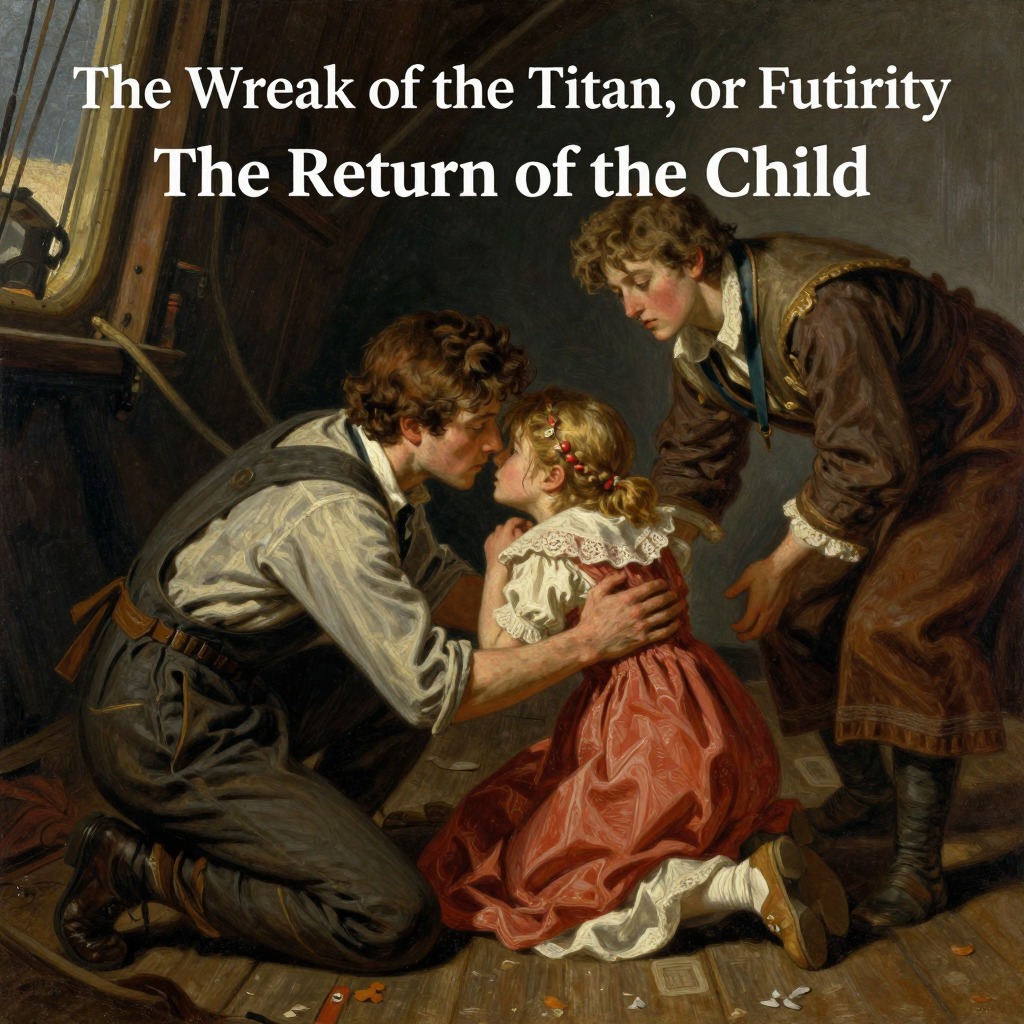
Rowland's poverty was absolute. He had spent his last money on the child, telling a young woman in the children's department, "This child has been shipwrecked. I have sixteen dollars and a half to spend on it. Give it a bath, dress its hair, and use up the money on a dress, shoes, and stockings, underclothing, and a hat." The young woman, moved by sympathy, kissed the little girl but protested that not much could be done. An hour later, penniless again, Rowland emerged with Myra bravely dressed in her new finery, a juxtaposition of rags and ribbons that immediately drew the attention of a policeman at the corner. The officer, marveling at the sight, demanded, "Whose kid ye got?" When Rowland answered haughtily that he believed it was the daughter of Mrs. Colonel Selfridge, the policeman was unconvinced and ordered him back into the store to verify the claim, placing his hand on Rowland's collar.
The Snatching and the Accusation
As they turned back, they were met at the door by a party of three or four people coming out. One of them, a young woman in black, uttered a piercing shriek and sprang toward them, screaming "Myra! Give me my baby --- give her to me." She snatched the child from Rowland's shoulder, hugged it, kissed it, cried, and screamed over it, then fainted in the arms of an indignant old gentleman. That gentleman, flourishing his cane over Rowland's head, exclaimed, "You scoundrel! We've caught you. Officer, take that man to the station-house. I will follow and make a charge in the name of my daughter." The policeman, now certain of the theft, rapped his prisoner on the head with his club and jerked him off his feet, while an approving crowd applauded. The man who had fought and conquered a hungry polar bear was dragged through the streets like a sick animal by a New York policeman, a humiliation the narrator attributes to "the stultifying effect of a civilized environment."
The Trial and the Revelation
The next morning, Rowland stood in the anteroom of a police court, ragged, disfigured by his clubbing, and disheveled by his night in a cell. The prosecuting witness, Mr. Gaunt, testified that Rowland had once been a gentleman and a frequent guest at his house, had asked for his daughter's hand, and, when refused, had threatened revenge. He claimed that Rowland had followed his daughter to sea in the guise of a sailor and attempted to murder the child, but the magistrate cut him off, confining testimony to the present offense. Mrs. Selfridge, pale and hollow-eyed but happy-faced, took the stand with her child in her arms and repeated her father's accusations, adding that Rowland had mutilated and tortured her baby, pointing to deep wounds in the child's back that a doctor had said were made by a sharp instrument, and that he had taught her to swear horribly. The magistrate, puzzled, asked what shipwreck this was, and half a dozen newspaper men called out "The Titan." Realizing the offense had been committed on the high seas under the English flag, he changed the charge to vagrancy. Then the clerk, instigated by the newspaper men, laid a morning paper before him, and the court read the news of Rowland's heroism. The magistrate, looking up, asked, "You are the man who was rescued from an iceberg, are you not?" and when Rowland bowed his head, roared "Discharged!" He added, "Madam, this man has merely saved your child's life. If you will read of his defending it from a polar bear when you go home, I doubt that you will tell it any more bear stories."
Aftermath and the Cost of Civilization
Mrs. Selfridge left the court with a mystified and rather aggrieved expression, while Myra shouted profanely for Rowland, who fell into the hands of the reporters. He refused to be entertained or to talk, escaped, and was swallowed up in the world without. The arrest, though brief, had stripped him of his dignity and exposed the chasm between his heroic deeds and the society's perception of him. Yet it also set the stage for his quiet rehabilitation: he became a one-armed dock lounger, fished with an old hook and string, traded and sold his catch, and gradually worked his way up through tallying cargo and addressing envelopes to a Civil Service position. The arrest, in its injustice, underscored the novel's critique of a world that judges by appearances, and it prepared the ground for the final reconciliation when Mrs. Selfridge, unable to bear Myra's cries, would write to him, and he would go to see Myra once more.