Collision with the Royal Age
The Wreck of the Titan, or FutilityThe Collision with the Royal Age is the pivotal event in Morgan Robertson's novella The Wreck of the Titan, in which the supposedly unsinkable steamship Titan, steaming at full speed through a dense fog on the Northern Lane Route, cuts a smaller ship in half on the first night out from New York. The collision, witnessed from the crow's-nest by John Rowland, sets in motion the central conflict of the story: Rowland's refusal to accept the captain's bribe to remain silent, his subsequent drugging and discrediting, and the eventual legal confrontation at Lloyds that exposes the company's negligence and leads to the ruin of Captain Bryce and Mr. Austen. The event also foreshadows the Titan's own destruction by an iceberg, as both disasters stem from the same reckless policy of full speed in fog.
Background: The Titan's Design and the Rule of Full Speed
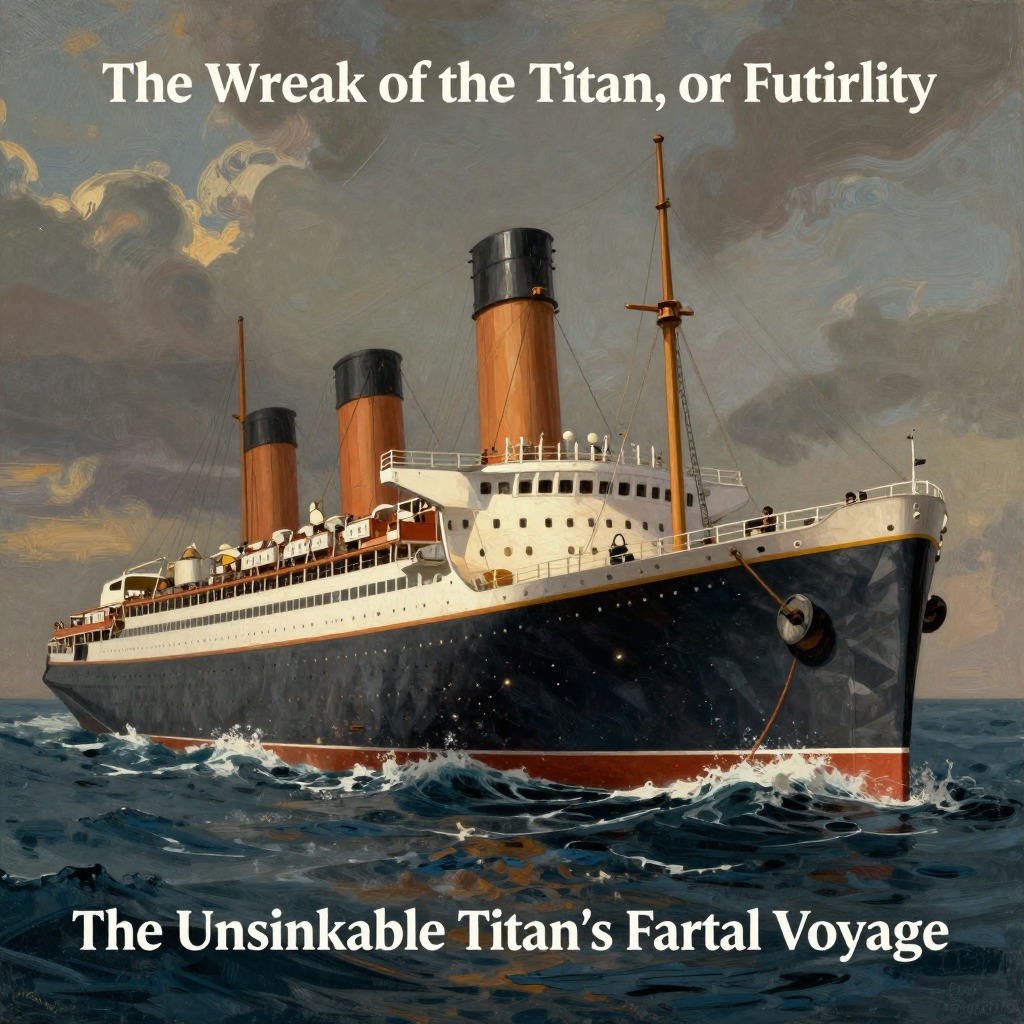
The Titan was the largest craft afloat, a floating city of steel, eight hundred feet long, with a displacement of seventy thousand tons and seventy-five thousand horsepower. She had steamed at twenty-five knots an hour on her trial trip, and her designers had given her the sharp dead-rise of a steam yacht, discarding the flat, kettle-bottom of cargo boats. She was built for passenger traffic only, carrying no combustible cargo, and was considered practically unsinkable: with nine of her nineteen water-tight compartments flooded, she would still float. The company had announced a rule of navigation that applied to the Titan: she would steam at full speed in fog, storm, and sunshine, on the Northern Lane Route, winter and summer. The reasons given were that if another craft struck her, the force of the impact would be distributed over a larger area, and the brunt of the damage would be borne by the other; that if the Titan was the aggressor, she would certainly destroy the other craft, even at half-speed, and perhaps damage her own bows, while at full speed she would cut the other in two with no more damage to herself than a paintbrush could remedy; that at full speed she could be more easily steered out of danger; and that in case of an end-on collision with an iceberg, her bows would be crushed in but a few feet further at full than at half speed, and at the most three compartments would be flooded, which would not matter with six more to spare. This policy, which the captain later admitted was the cause of the wreck, was the direct cause of the collision with the Royal Age.
The Collision: What Happens
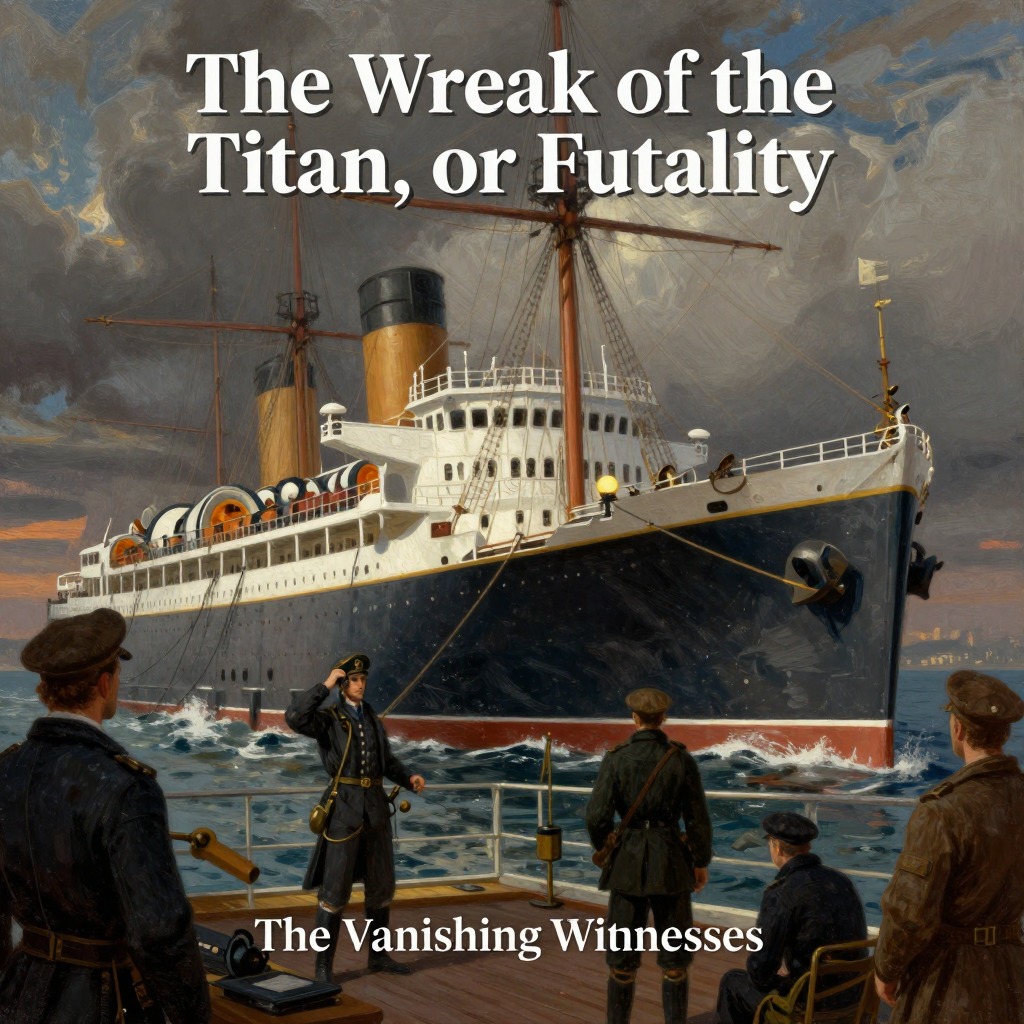
At a quarter past twelve on the first night out from New York, the Titan was charging through a fog-bank with undiminished speed, with two deck officers and three lookouts straining sight and hearing. The first officer had just taken the deck, and the watch had been relieved. John Rowland, who had been lifted aboard drunk the day before, was in the crow's-nest, sixty feet above the deck. When three bells had sounded, and the boatswain and his men were lighting up for a final smoke, there rang out overhead a startling cry from the crow's-nest: "Something ahead, sir --- can't make it out." The first officer sprang to the engine-room telegraph and grasped the lever, roaring, "Sing out what you see." The cry came back: "Hard aport, sir --- ship on the starboard tack --- dead ahead." The first officer repeated the order to the quartermaster at the helm, who answered and obeyed. But before three degrees on the compass card were traversed by the lubber's-point, a seeming thickening of the darkness and fog ahead resolved itself into the square sails of a deep-laden ship, crossing the Titan's bow, not half her length away. The first officer growled, "H--l and d---," then shouted, "Steady on your course, quartermaster. Stand from under on deck." He turned a lever which closed compartments, pushed a button marked "Captain's Room," and crouched down, awaiting the crash. There was hardly a crash. A slight jar shook the forward end of the Titan, and sliding down her foretopmast-stay and rattling on deck came a shower of small spars, sails, blocks, and wire rope. Then, in the darkness to starboard and port, two darker shapes shot by --- the two halves of the ship she had cut through. From one of these shapes, where still burned a binnacle light, was heard, high above the confused murmur of shouts and shrieks, a sailorly voice: "May the curse of God light on you and your cheese-knife, you brass-bound murderers." The shapes were swallowed in the blackness astern; the cries were hushed by the clamor of the gale, and the Titan swung back to her course. The first officer had not turned the lever of the engine-room telegraph; the ship did not stop. The boatswain bounded up the steps of the bridge for instructions, and the first officer, his voice hoarse and strained, ordered him to put men at the hatches and doors, send every one who came on deck to the chart-room, tell the watchman to notice what the passengers had learned, and clear away that wreck forward as soon as possible.
Aftermath: The Captain's Attempt to Buy Silence
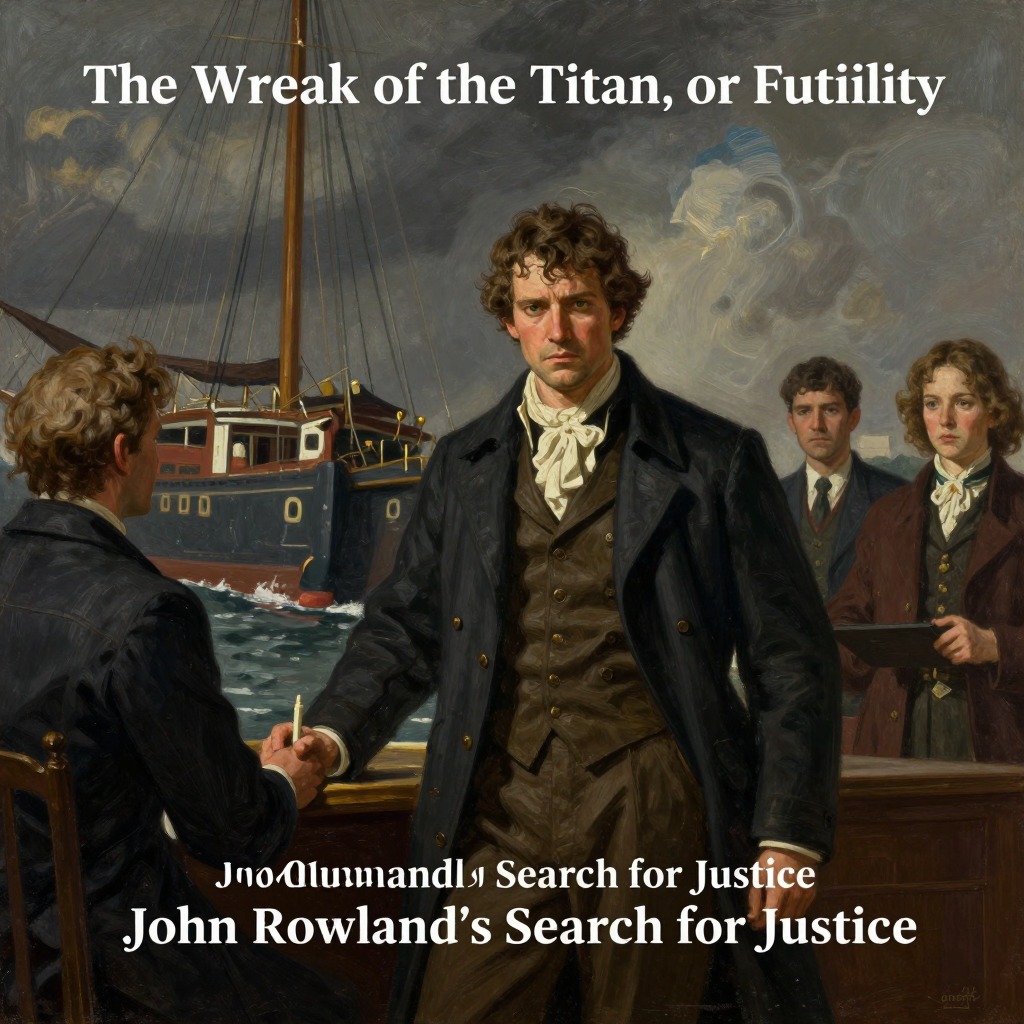
In the chart-room, the captain of the Titan, pale-faced and intense, interviewed the watch on deck, one by one, in his office. He asked each man to keep silent about the collision, and offered Rowland, who had been in the crow's-nest, a package containing one hundred pounds in banknotes, to be delivered at Liverpool, for his silence. Rowland refused, saying, "On the contrary, captain, I shall not receive it. On the contrary, sir, I shall speak of this wholesale murder at the first opportunity!" The captain, taken aback by the defiance of this debauched-looking sailor, tried to reason with him, warning that he would stand alone, be discredited, lose his berth, and make enemies. Rowland, revealing that he was a graduate of Annapolis and the captain's equal in professional technic, declared his object: "That I may do one good, strong act in my useless life --- that I may help to arouse such a sentiment of anger in the two countries as will forever end this wanton destruction of life and property for the sake of speed-that will save the hundreds of fishing-craft, and others, run down yearly, to their owners, and the crews to their families." The captain, unable to buy or intimidate him, told the first officer, "He is a broken-down wreck with a temporarily active conscience; but is not the man to buy or intimidate: he knows too much. However, we've found his weak point. If he gets snakes before we dock, his testimony is worthless. Fill him up and I'll see the surgeon, and study up on drugs." The next morning, Rowland found a pint flask in the pocket of his pea-jacket, which he suspected was drugged, but it was not; it was good whisky, a leader to warm his stomach while the captain was studying. Later, the captain and boatswain plotted to drop a drug into Rowland's drinking pot, and the first officer, on the night of the iceberg collision, engaged Rowland in conversation about navigation, while the drug took effect, causing him to see frightful shapes and to rave about his lost love, Myra. This drugging, which Rowland later identified as hasheesh, was intended to discredit his testimony about the collision with the Royal Age.
The Legal Confrontation at Lloyds
Two months after the loss of the Titan, Mr. Meyer, the heaviest insurer of the ship, confronted Captain Bryce and Mr. Austen in his office on Threadneedle Street, with the attorney Mr. Thompson present. Mr. Meyer accused them of concealing in their sworn statement all reference to the fact that they had collided with and sunk the ship Royal Age on the night before the wreck of their own ship. Captain Bryce blustered, and Mr. Austen claimed that Rowland was an irresponsible drunkard, in a condition of delirium tremens up to the shipwreck. But Rowland, who had been rescued from the iceberg and brought to the office by Captain Barry of the Peerless, told the terrible story of the cutting in half of the ship, finishing with the attempted bribery and his refusal. Captain Bryce called it a lie, and Captain Barry threatened him. The attorney argued that the concealment had no bearing on the validity of the policy, but Mr. Meyer insisted that the fact that the captain had a drunken man on lookout when the Titan struck the iceberg would void the policy. Mr. Austen, however, recanted, saying that Rowland was sober and competent when on lookout, and that he had discussed theories of navigation with him intelligently. Rowland then pointed out that Captain Bryce and Mr. Austen, as part owners of the Titan, had committed an act of barratry by drugging a sailor into a stupor and having him on lookout out of his turn, which nullified the insurance. Captain Bryce, enraged, lunged at Rowland but was knocked down by Captain Barry. Mr. Austen, in a slip, revealed that the drug was an infusion of Indian hemp, which is hasheesh, and thus self-convicted. Mr. Meyer, triumphant, told the two officers that they would be bulletined and listed at Lloyds, and that Scotland Yard would be looking for them, but that his door was not locked. They left, pale, shamefaced, and crushed.
Consequences: Ruin and Redemption
The collision with the Royal Age had far-reaching consequences. Mr. Selfridge, the grandfather of little Myra, who had invested his last farthing, one hundred thousand pounds, in Titan stock, learned that the insurance would not be paid and that he was ruined; he died of heart failure in Mr. Meyer's office. Mr. Meyer, who had hoped to avoid paying the insurance, was thwarted when Rowland, in a surprising turn, refused to testify, saying that the cause of the wreck was full speed in a fog, and that the underwriters knew the speed and took the risk. "Let them pay," he said. This act of selflessness, motivated by his desire not to break the child Myra, who would inherit nothing if the insurance was not paid, saved the company and the child's future. Rowland, who had lost his arm to the polar bear and his health to the ordeal, was given two first-class tickets to New York by the attorney, which he accepted as a bribe to get the child to her mother. He vowed never to drink again, saying, "I've a future now, as well as a past." The collision also led to Rowland's arrest in New York, when he was mistaken for a kidnapper, and his subsequent trial, where the magistrate, after reading the newspaper account of his heroism, discharged him. The event thus serves as the catalyst for Rowland's redemption, transforming him from a disgraced, drunken sailor into a man who, through his courage and integrity, wins the respect of others and a new life.
Thematic Significance
The collision with the Royal Age is a powerful indictment of the maritime industry's reckless pursuit of speed at the expense of human life. The Titan's full-speed rule, which the company justified with specious reasoning, is shown to be a death sentence for smaller vessels. The event also highlights the moral corruption of the ship's officers, who are willing to bribe, drug, and lie to protect their interests. Rowland's refusal to be silenced, despite the threats and temptations, underscores the theme of individual conscience against institutional greed. The collision also foreshadows the Titan's own destruction, as the same policy of full speed in fog leads to the iceberg collision that sinks the supposedly unsinkable ship. The event thus serves as a critique of technological hubris and a warning about the dangers of prioritizing profit over safety.