Fight with the polar bear
The Wreck of the Titan, or FutilityThe fight with the polar bear is the pivotal ordeal of John Rowland's survival on the iceberg after the wreck of the Titan, in which the crippled, one-armed sailor kills a starving polar bear with only a jackknife, saving the child Myra and marking his transformation from a degraded drunkard into a selfless protector. The encounter, which occurs on the morning after the shipwreck, is the first test of Rowland's newfound purpose and the act that will later be celebrated in the newspapers and cited in court as proof of his heroism. It is also the moment that permanently maims him, costing him his left arm and several ribs, and it sets the course for his subsequent rescue, his confrontation with the ship's officers, and his eventual redemption.
The Setting and the Threat
Rowland wakes at daylight on the iceberg, his limbs stiffened and numb from the cold, and drinks a small quantity of the whisky he had saved from the wreck before stepping out onto the ice. The fog has cleared, revealing a blue, sailless sea stretching to the horizon, with a mountain of ice behind him and, to his right, a pile of hummocks and taller peaks interspersed with canyons and caves, glistening with waterfalls. As he climbs the elevation and looks out from a precipice a hundred feet high, he sees no sail or steamer's smoke anywhere to cheer him. Retracing his steps, he spots a moving white object approaching from the direction of the peaks. His eyes, still affected by the drug he had been given, are uncertain at first, but he soon realizes the object is a polar bear, lean and famished, coming on at a lumbering run with great red jaws half open and yellow fangs exposed. The bear has scented food and is seeking it, and Rowland has no weapon but a strong jackknife, which he pulls from his pocket and opens as he runs. He does not hesitate at a conflict that promises almost certain death, because the presence of the bear involves the safety of a child whose life has become of more importance to him than his own.
The Attack and the Fight
As Rowland bounds down the slope, shouting for the child to go back, the bear reaches Myra first and, with seemingly no effort, dashes her a dozen feet away with a blow of its massive paw, leaving her lying quiet. Turning to follow, the brute is met by Rowland. The bear rises to its haunches, sinks down, and charges; Rowland feels the bones of his left arm crushing under the bite of the big, yellow-fanged jaws. But, falling, he buries the knife-blade in the shaggy hide, and the bear, with an angry snarl, spits out the mangled member and deals him a sweeping blow that sends him farther along the ice than the child had gone. He arises, with broken ribs, and, scarcely feeling the pain, awaits the second charge. Again the crushed and useless arm is gripped in the yellow vise, and again he is pressed backward; but this time he uses the knife with method. The great snout is pressing his breast; the hot, fetid breath is in his nostrils; and at his shoulder the hungry eyes are glaring into his own. He strikes for the left eye of the brute and strikes true. The five-inch blade goes in to the handle, piercing the brain, and the animal, with a convulsive spring which carries him half-way to his feet by the wounded arm, rears up, with paws outstretched, to full eight feet of length, then sags down, and with a few spasmodic kicks, lies still. Rowland has done what no Innuit hunter will attempt: he has fought and killed the Tiger-of-the-North with a knife.
Aftermath and the Child's Wounds
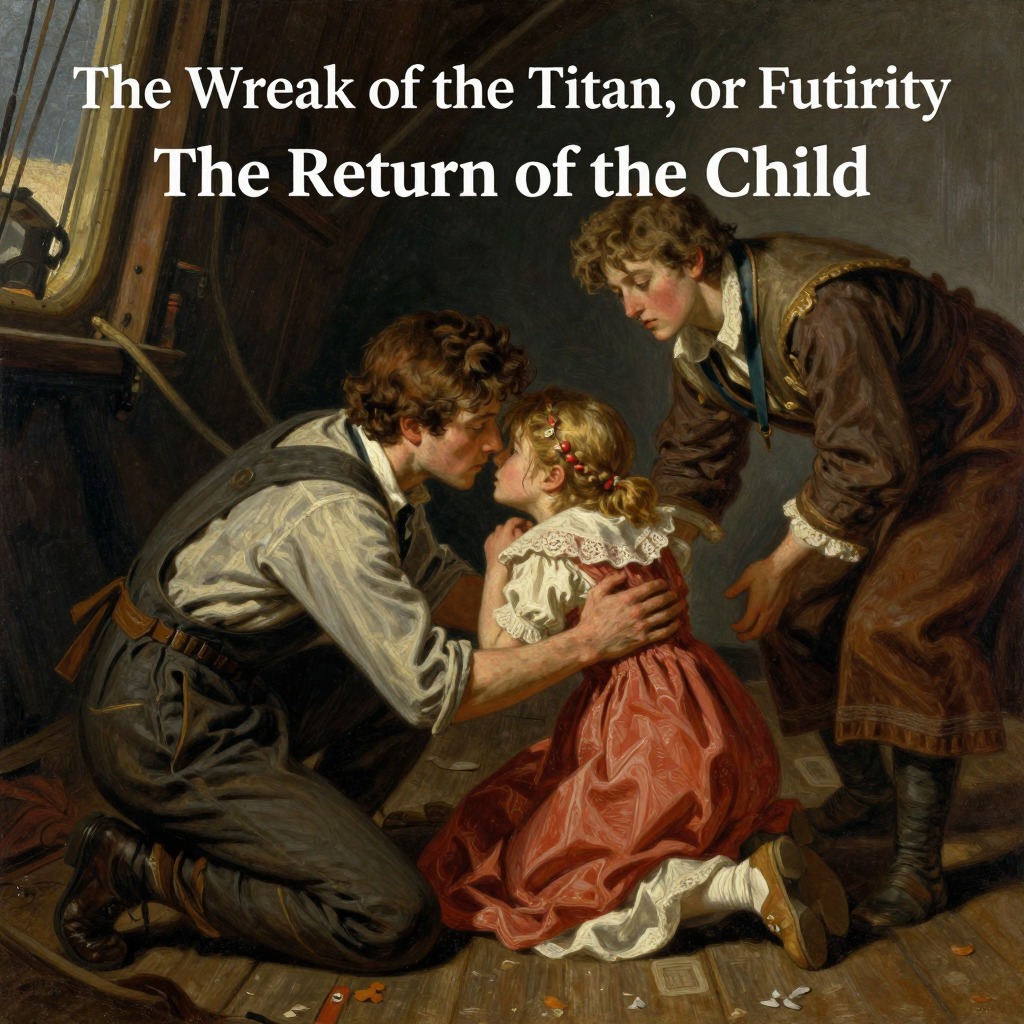
The fight lasts only a minute, but in that minute Rowland is crippled for life; in the quiet of a hospital, the best of surgical skill could hardly avail to reset the fractured particles of bone in the limp arm, and bring to place the crushed ribs. He is adrift on a floating island of ice, with the temperature near the freezing point, and without even the rude appliances of the savage. He painfully makes his way to the little pile of red and white, and lifts it with his uninjured arm, though the stooping causes him excruciating torture. The child is bleeding from four deep, cruel scratches, extending diagonally from the right shoulder down the back; but he finds upon examination that the soft, yielding bones are unbroken, and that her unconsciousness comes from the rough contact of the little forehead with the ice, for a large lump has raised. Of pure necessity, his first efforts must be made in his own behalf; so wrapping the baby in his coat he places it in his shelter, and cuts and makes from the canvas a sling for his dangling arm. Then, with knife, fingers, and teeth, he partly skins the bear, often compelled to pause to save himself from fainting with pain, and cuts from the warm but not very thick layer of fat a broad slab, which, after bathing the wounds at a near-by pool, he binds firmly to the little one's back, using the torn night-gown for a bandage. He cuts the flannel lining from his coat, and from that of the sleeves makes nether garments for the little limbs, doubling the surplus length over the ankles and tying in place with rope-yarns from a boatlacing. The body lining he wraps around her waist, enclosing the arms, and around the whole he passes turn upon turn of canvas in strips, marling the mummy-like bundle with yarns, much as a sailor secures chafing-gear to the doubled parts of a hawser, a process that would have aroused the indignation of any mother who saw it. But he is only a man, and suffering mental and physical anguish.
Survival and the Bear's Provision
By the time he has finished, the child has recovered consciousness and is protesting its misery in a feeble, wailing cry. But he dares not stop, lest he become stiffened with cold and pain. There is plenty of fresh water from melting ice, scattered in pools. The bear will furnish food; but they need fire, to cook this food, keep them warm, and prevent the dangerous inflammation from their hurts, and to raise a smoke to be seen by passing craft. He recklessly drinks from the bottle, needing the stimulant, and reasoning, perhaps rightly, that no ordinary drug could affect him in his present condition; then he examines the wreckage, most of it good kindling wood. Partly above, partly below the pile, is a steel lifeboat, decked over air-tight ends, now doubled to more than a right angle and resting on its side. With canvas hung over one half, and a small fire in the other, it promises, by its conducting property, a warmer and better shelter than the bridge. A sailor without matches is an anomaly. He whittles shavings, kindles the fire, hangs the canvas and brings the child, who begs piteously for a drink of water. He finds a tin can, possibly left in a leaky boat before its final hoist to the davits, and gives her a drink, to which he has added a few drops of the whisky. Then he thinks of breakfast. Cutting a steak from the hindquarters of the bear, he toasts it on the end of a splinter and finds it sweet and satisfying; but when he attempts to feed the child, he understands the necessity of freeing its arms, which he does, sacrificing his left shirtsleeve to cover them. The change and the food stop its crying for a while, and Rowland lies down with it in the warm boat. Before the day has passed the whisky is gone and he is delirious with fever, while the child is but little better.
The Fight's Legacy
Rowland's fight with the polar bear becomes a central piece of evidence in the later legal confrontation at Lloyds, where Captain Barry, the master of the bark Peerless that rescues Rowland, testifies to having seen the bear that Rowland killed in open fight, and to having nursed him away from death without hearing any whines or complaints. The story of the fight, embellished by Mr. Meyer and the reporters, is blazoned out in the great dailies of England and the Continent and cabled to New York, where it arrives too late for publication the morning Rowland steps down the gangplank with Myra on his shoulder. In the courtroom, the magistrate, having read the newspaper account, discharges Rowland and rebukes Mrs. Selfridge for telling Myra the story of Elisha and the bears, noting that the man saved the child's life by defending it from a polar bear. The fight thus serves as the dramatic proof of Rowland's worth, contrasting sharply with the accusations of attempted murder and the image of him as a degraded drunkard. It is also the physical cause of his amputation, which he later mentions when he says, "they cut my arm off at Christiansand, and I still live," and which ultimately ends his career at sea, as he tells Captain Barry, "my going to sea is ended. Even a mate needs two hands." The bear, killed by a man who had been drugged and was half-delirious, becomes the emblem of Rowland's transformation from a broken wreck into a man capable of selfless courage, and the story of the fight, repeated and exaggerated, ensures that his heroism is known to the world even as he himself refuses to speak of it.