Lloyds
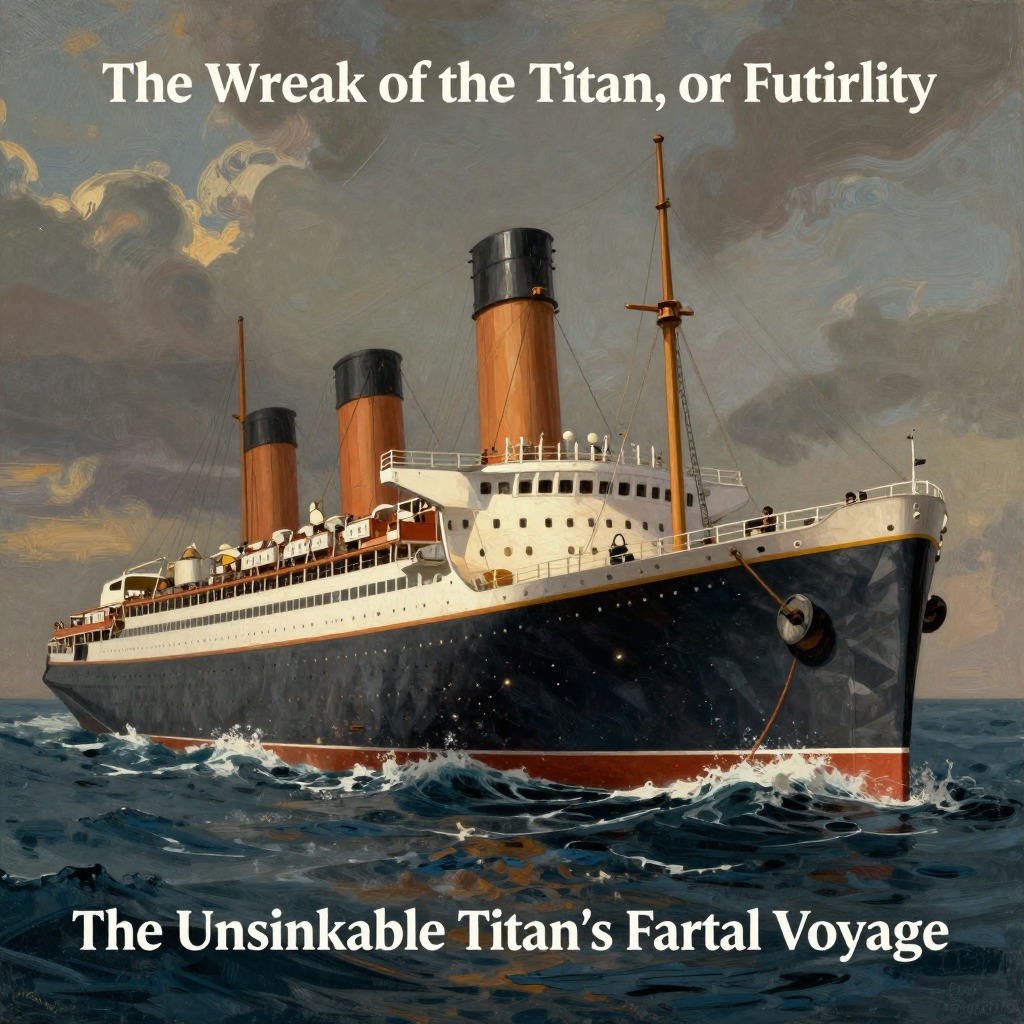
The Wreck of the Titan, or FutilityLloyds is the immense London-based association of underwriters, brokers, and shipping-men that serves as the headquarters of marine insurance and intelligence in Morgan Robertson's The Wreck of the Titan. Originating from Edward Lloyd's coffeehouse in the late seventeenth century, it has grown into a powerful corporation so well equipped and splendidly organized that kings and ministers of state appeal to it at times for foreign news. In the novel, Lloyds is not merely a setting but an active force: its bulletin boards, its "Room," its Caller, and its specialized offices shape the financial stakes, the legal disputes, and the moral reckonings that follow the sinking of the supposedly unsinkable Titan.
The Institution and Its Premises
Lloyds occupies a large apartment on the first floor of the London Royal Exchange, studded with desks around which surges a hurrying, shouting crowd of brokers, clerks, and messengers. This main hall, known in the technical language of the "City" as the "Room," is fringed with doors and hallways leading to adjacent rooms and offices, and scattered through it are bulletin-boards on which are daily written in duplicate the marine casualties of the world. At one end is a raised platform, sacred to the presence of an important functionary called the "Caller," whose business it is to call out in a mighty sing-song voice the names of members wanted at the door and the bare particulars of bulletin news prior to its being chalked out for reading.
Among the adjoining rooms is the Chartroom, where can be found in perfect order and sequence, each on its roller, the newest charts of all nations, with a library of nautical literature describing to the last detail the harbors, lights, rocks, shoals, and sailing directions of every coast-line shown on the charts, the tracks of latest storms, the changes of ocean currents, and the whereabouts of derelicts and icebergs. A member at Lloyds acquires in time a theoretical knowledge of the sea seldom exceeded by the men who navigate it. Another apartment, the Captain's room, is given over to joy and refreshment, and still another, the antithesis of the last, is the Intelligence office, where anxious ones inquire for and are told the latest news of this or that overdue ship.
The Institution's Role in Maritime Record-Keeping and Risk
Lloyds functions as the repository of professional reputations and the arbiter of maritime risk. Not a master or mate sails under the English flag but whose record, even to forecastle fights, is tabulated at Lloyds for the inspection of prospective employers. Not a ship is cast away on any inhabitable coast of the world, during underwriters' business hours, but what that mighty sing-song cry announces the event at Lloyds within thirty minutes. This institutional omniscience makes Lloyds the natural venue for the novel's climactic legal and financial confrontation over the loss of the Titan.
The underwriters' willingness to insure the Titan is itself a product of Lloyds' risk calculus. The steamship company had announced that the Titan would steam at full speed in fog, storm, and sunshine, on the Northern Lane Route, winter and summer, with reasons that included the claim that in an end-on collision with an iceberg, her bows would be crushed in but a few feet further at full than at half speed, and at the most three compartments would be flooded. Mr. Meyer, the heaviest insurer, took the risk knowing that she was to run the Northern Lane at full speed through fog and snow, as he later admits. This calculated gamble, rooted in the actuarial logic of Lloyds, sets the stage for the disaster and the subsequent battle over the insurance money.
The Panic and the Financial Stakes
When the news of the Titan's destruction breaks, the assembled throng of underwriters and brokers is thrown into an uproarious panic. The Crier's announcement that the great Titan was destroyed sends papers of Europe and America issuing extras giving the meager details of the arrival at New York of one boat-load of her people. In the Intelligence office, weeping women and worrying men crowd to ask for more news. Among them, a feeble old gentleman raises his voice in a quavering scream: "My daughter-in-law is safe; but where is my son, --- where is my son, and my grandchild?" This is Mr. Selfridge, the largest holder of Titan stock, who has invested his last farthing --- one hundred thousand pounds --- in the ship.
In the first tumultuous riot of inquiry, one underwriter, the noisiest of all, a corpulent, hook-nosed man with flashing black eyes, breaks away from the crowd and makes his way to the Captain's room, where, after a draught of brandy, he seats himself heavily with a groan that comes from his soul. "Father Abraham," he mutters, "this will ruin me." This is Mr. Meyer, who has covered the whole of the Royal Age and the biggest chunk of the Titan. When asked how much he stands to lose, he answers, "Ten thousand." A fellow underwriter unkindly tells him, "Serve you right; have more baskets for your eggs." Mr. Meyer, neglecting his business and drinking heavily in the Captain's room, bemoans his luck until a bulletin announces the arrival at Gibraltar of a second boat-load of people, and then, on the tenth day, he reads with watery eyes a notice that a life-buoy of the Royal Age has been picked up among wreckage. "Oh, mine good God," he howls, rushing toward the Captain's room. An observer remarks, "Poor devil --- poor damn fool of an Israelite. He covered the whole of the Royal Age, and the biggest chunk of the Titan. It'll take his wife's diamonds to settle."
The Confrontation and the Legal Battle
Lloyds becomes the stage for the novel's central legal drama. Mr. Meyer, roused from his lethargy by fellow underwriters who have a thousand on the Titan and want to know why, is taken to a Turkish bath and then home, and the next morning he is at his desk, clear-eyed and clear-headed. He summons Captain Bryce, the first officer Mr. Austen, the steamship company's attorney Mr. Thompson, and Mr. Selfridge to his private office in Threadneedle Street, where he confronts them with the accusation that the Titan collided with and sunk the Royal Age on the night before her own wreck. Captain Bryce and Mr. Austen deny it, but Rowland, brought from Christiansand by Captain Barry of the Peerless, tells the terrible story of the cutting in half of the ship, the attempted bribery, and the drugging. When Captain Bryce blurts out that the drug was "an infusion of Indian hemp," Rowland points out that hasheesh is made from Indian hemp, and Mr. Meyer exclaims, "Self-convicted." The underwriter then threatens the two officers: "England is a fine country, my friends --- a fine country to leave pebind sometimes. Dere is Canada, and der United States, and Australia, and South Africa --- all fine countries, too --- fine countries to go to with new names. My friends, you will be bulletened and listed at Lloyds in less than half an hour, and you will never again sail under der English flag as officers."
Yet the legal battle takes an unexpected turn. Mr. Meyer declares that the insurance will not be paid, and that Mr. Selfridge, as the largest stockholder, will be ruined. Mr. Selfridge, who has just learned that little Myra is his granddaughter, collapses and dies of heart failure in the office. Rowland, however, refuses to testify, saying, "I, the one man who can prevent it, refuse to testify." He explains to Captain Barry: "The cause of the wreck was full speed in a fog. All hands on lookout could not have seen that berg. The underwriters knew the speed and took the risk. Let them pay." Mr. Meyer, enraged, locks the door, but Captain Barry kicks it down, and the three leave. The underwriters, hoping to find other witnesses, decide to give Rowland's story to the press, which leads to his arrest in New York and his eventual vindication in court.
Significance
Lloyds in The Wreck of the Titan is more than a backdrop; it embodies the novel's critique of corporate greed and the moral blindness of risk management. The institution's meticulous record-keeping, its rapid dissemination of disaster news, and its actuarial logic all serve to quantify human life and suffering in financial terms. The underwriters, led by Mr. Meyer, are willing to insure a ship they know will steam at full speed through fog, and when the disaster occurs, they fight to avoid paying, using legal technicalities and even attempting to discredit a witness. Rowland's refusal to testify, his insistence that the underwriters "took the risk" and should pay, strikes a blow against this system, but the novel leaves the institution's power intact. Lloyds remains the arbiter of maritime fate, a place where the fates of ships and men are decided by the stroke of a pen and the call of a Crier.