Northern Lane Route
The Wreck of the Titan, or FutilityThe Northern Lane Route is the transatlantic shipping corridor on which the steamship Titan operates at full speed in all weather, a policy that directly leads to the iceberg collision that destroys the ship and drives the novel's central conflict over corporate negligence and maritime law. The route is introduced as the setting for the Titan's record-breaking voyages, a lane chosen for speed rather than safety, and it becomes the stage for the two collisions that define the narrative: the fatal encounter with the Royal Age and the final impact with the iceberg. The route's significance extends beyond geography, as it embodies the hubris of the steamship company and the legal battles that follow the wreck.
Definition and Setting
The Northern Lane Route is one of the established transatlantic shipping lanes, used by the Titan for its voyages between New York and Liverpool. The route is described in the context of the ship's operational rules: the steamship company announces that the Titan will steam at full speed in fog, storm, and sunshine, and on the Northern Lane Route, winter and summer. This policy is justified by the company with four reasons, including the belief that at full speed the Titan could cut another ship in two with minimal damage to herself, and that in a collision with an iceberg—the only thing afloat she could not conquer—her bows would be crushed in but a few feet further at full than at half speed, flooding at most three compartments, which would not matter with six more to spare. The route is thus chosen for its directness and speed, reflecting the company's prioritization of record times over safety.
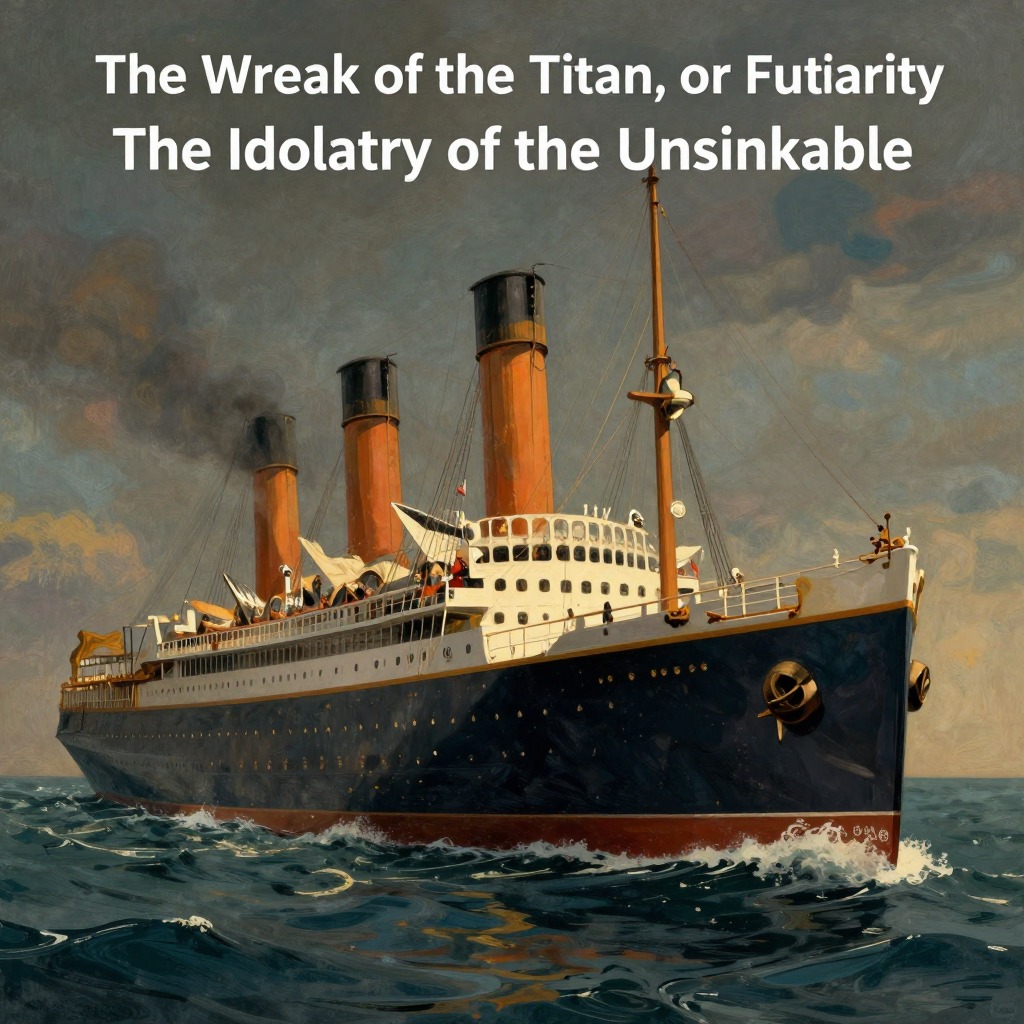
The Titan is described as the largest craft afloat, eight hundred feet long, with seventy thousand tons displacement and seventy-five thousand horsepower, capable of steaming at twenty-five knots an hour. She is built of steel throughout, with ninety-two doors of nineteen water-tight compartments that could be closed in half a minute, and with nine compartments flooded she would still float, making her practically unsinkable. The ship carries only twenty-four lifeboats, which would hold five hundred people, and three thousand cork jackets, a detail that underscores the route's inherent danger when combined with the full-speed policy.
The Route as a Site of Disaster
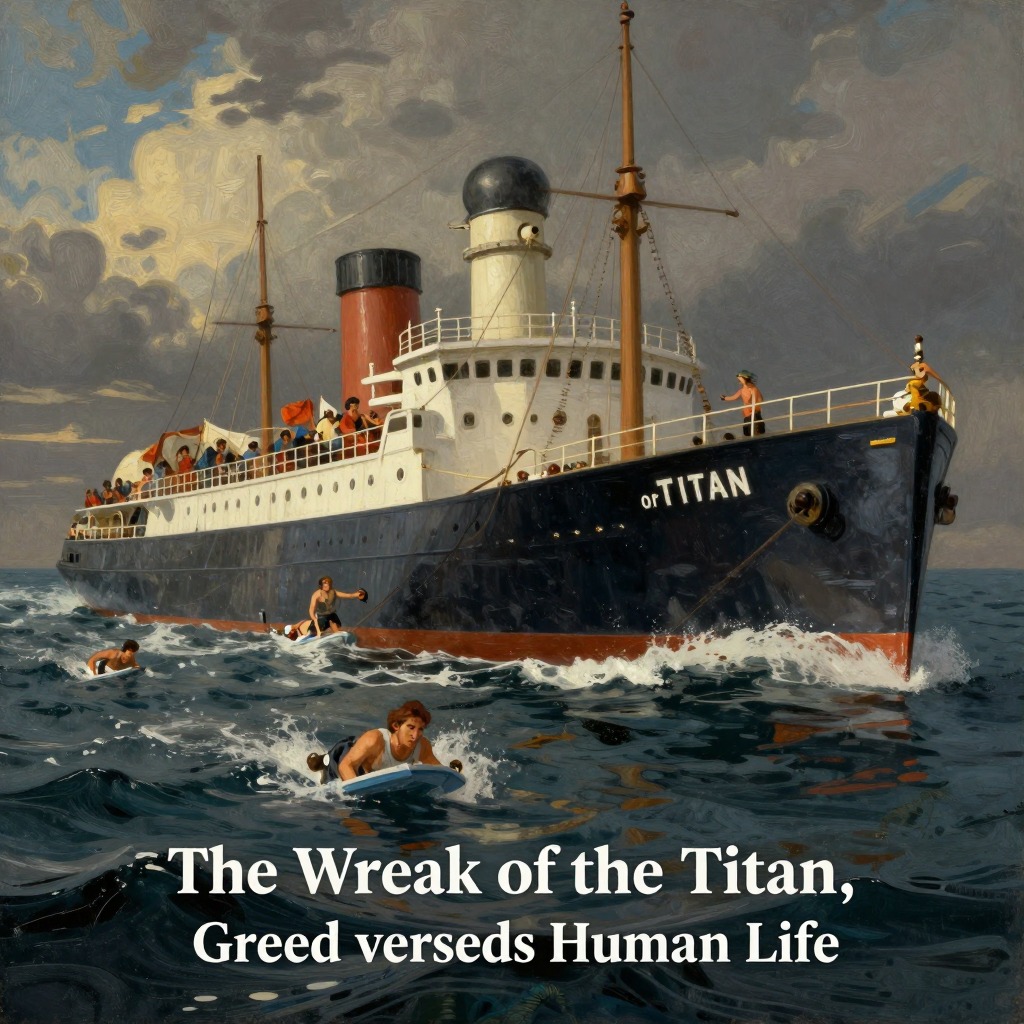
The Northern Lane Route is the setting for the Titan's fatal voyage. On the night of the first collision, the ship is plunging through a fog-bank at undiminished speed, with two deck officers and three lookouts straining to see. The first officer, on the bridge, spots a deep-laden ship crossing the Titan's bow, and despite a hard aport turn, the Titan cuts the ship in two. The collision is barely felt aboard the Titan, but the wreckage and the cries of the doomed crew are heard, and the first officer does not even turn the engine-room telegraph. This incident, later revealed to be the sinking of the Royal Age, is the first consequence of the full-speed rule on the Northern Lane Route.
The second and final disaster occurs on the same route, when the Titan, still at full speed, encounters an iceberg. The lookout's cry of "Ice ahead" comes too late, and the ship, with seventy-five thousand tons dead-weight rushing at fifty feet a second, strikes the ice. The impact is not against a perpendicular wall but a low beach, and the Titan rises out of the sea, then crashes down on her side. The holding-down bolts of twelve boilers and three triple-expansion engines snap, and the ship sinks, with nearly all of her people unable to climb vertical floors and ceilings. The Northern Lane Route is thus the graveyard of the Titan and the hundreds of lives lost.
Legal and Moral Implications
The Northern Lane Route becomes a focal point in the legal proceedings after the wreck. At Lloyds, the underwriter Mr. Meyer confronts Captain Bryce and Mr. Austen, the first officer, accusing them of concealing the collision with the Royal Age. Rowland, the lookout who witnessed both disasters, testifies that the cause of the wreck was full speed in a fog, and that all hands on lookout could not have seen the berg. He argues that the underwriters knew the speed and took the risk, and therefore should pay the insurance. This position is central to the novel's critique of corporate negligence: the route's full-speed policy is a deliberate choice that prioritizes profit over human life, and the legal battle over the insurance policy becomes a battle over who bears responsibility for the disaster.
The route also carries jurisdictional implications. When Rowland is arrested in New York for allegedly kidnapping Myra, the magistrate notes that the offense was committed on the high seas under the English flag, and questions why it is brought into the court. The Northern Lane Route, as an international shipping lane, thus becomes a space where national laws and corporate interests intersect, complicating the pursuit of justice.
Narrative Significance
The Northern Lane Route is more than a setting; it is a symbol of the novel's central themes. The route's full-speed rule embodies the arrogance of technology and the belief that the Titan is unsinkable, a belief that is shattered by the iceberg. The route also serves as a contrast to the Southern Lane, the highway of spring traffic, which is mentioned as the destination of the lifeboat carrying Mrs. Selfridge to safety. The Northern Lane Route, with its winter and summer operation, represents the relentless pursuit of speed, while the Southern Lane offers a safer, more seasonal alternative. The novel's critique of the Northern Lane Route is thus a critique of the industrial age's disregard for human life in the name of progress.
In the end, the Northern Lane Route is the catalyst for Rowland's transformation. It is on this route that he witnesses the collision with the Royal Age, is drugged and placed on lookout, and survives the iceberg wreck, only to be rescued and later confront the ship's officers. The route's dangers force him to confront his own past and his atheism, leading to his prayer for the child's safety and his eventual redemption. The Northern Lane Route, therefore, is not just a geographical location but a moral and narrative force that shapes the destinies of all the characters.